
Your DOOH Campaign Failed Before It Started
A trafficking coordinator I know — I'll keep the agency name out of it, she didn't sign up for this — spent a full day untangling a brief for a national retail client. Twelve-week flight. Six markets. Six figures. The IO was signed, the creative was cleared through legal, and the start date was confirmed.
The brief had two Chicago boards listed by address. Neither existed. One was a vacant lot where a billboard used to stand before the city made the operator remove it in 2023. The other was a panel ID that hadn't been active since the operator decommissioned it during a hardware refresh.
She found out by calling the operator directly, which is how these things come out. Not through the brief process — that process doesn't catch it. The brief listed what the buyer thought they were buying. The reality was something different.
The campaign launched four days late. The buyer was unhappy. Nobody at the agency could explain how a decommissioned board made it into a signed insertion order.
This story is not unusual. I have heard some version of it from operators in Phoenix, Atlanta, Dallas, and Houston over the past two years. The details change. The pattern doesn't.
The Brief Problem Runs Deeper Than Typos
Most operators, when I ask them about trafficking failures, start with creative. That's where the visible problems show up. But the trafficking problems actually begin upstream, with the brief itself.
Here is how a national campaign brief comes together. The agency media planner puts together an inventory list based on what the IO commits to. They send it to the operator for availability confirmation. The operator confirms. The IO gets signed. Then the agency's trafficking team starts the process of actually executing the campaign across however many operators are involved.
The gap between "IO signed" and "trafficking coordinated" is where most national DOOH campaigns develop problems that could have been caught in the first phone call.
When a campaign involves one operator, the brief problem is manageable. When it involves three or four operators across multiple markets, which is standard for anything north of $50,000 in OOH spend, the brief has to be accurate across every operator's system simultaneously. One wrong panel ID in the Chicago market, one decommissioned face in the Phoenix market, one date discrepancy between the IO and the trafficking manifest — any of these creates a cascading delay that hits every operator in the chain.
I talked to an operator in Phoenix last year who had received a brief for a QSR campaign that listed inventory across three different operators. The brief included boards from an operator that the QSR had no existing contract with. Nobody at the agency had checked whether the three operators even worked from compatible trafficking systems. They didn't. The campaign had to be restructured from the ground up, which cost three weeks and a very uncomfortable call between the agency and the client.
This is not a tech problem. This is a process problem. The tech standards exist — OpenRTB and related protocols — but they are not universally adopted, and they require operator infrastructure that a lot of smaller regional players have not built.
The brief, in most cases, is still a spreadsheet sent over email. This is the same inventory coordination problem we wrote about in the context of spreadsheet-based operations, and it shows up in trafficking because the brief data has nowhere reliable to live. That spreadsheet lives in someone's inbox until someone at the operator prints it out and manually checks availability against their system. That manual step is where errors hide.
Creative QC Is Where Days Disappear
Once the brief is sorted, and it is not always sorted, which I'll get to, the creative problem begins.
Every DOOH operator has file spec requirements. These vary. Lamar has its own spec sheet. Outfront has a different one. Clear Channel runs different requirements for their digital network than for their static bulletin inventory. The regional operator in your tertiary market is probably still running Windows 7 on the machine that plays their digital spots, which means they need files in a format that was standard in 2011.
When a national agency sends creative for a multi-operator campaign, they typically send one file version. That file clears the agency's internal QC process. Then it lands in four different operator systems and fails QC at three of them.
I am only half joking about that number. The Geopath-measured circulation data that operators use to set impression baselines also feeds into trafficking accuracy, because when the audience estimate is wrong, the contracted delivery numbers are wrong from the start. The OAAA published data in 2024 suggesting that roughly 18% of DOOH campaigns experienced delays related to creative file issues. I think that number is low, based on what operators have told me, but nobody tracks it systematically so we are working from the official figure.
Here is what a creative QC failure looks like in practice. The operator receives a file that was submitted as a high-resolution ProRes file. It looks beautiful in the preview. It cannot be ingested by the operator's playback system because they run hardware that only accepts H.264 files under a specific bitrate threshold. The operator's QC team rejects the file and sends a spec sheet back to the agency. The agency has to resubmit. That resubmission has to go back through QC. The whole cycle takes, on average, two to three days per rejection.
On a 30-day campaign, losing three days to one creative rejection means you are now running 27 days instead of 30. The buyer paid for 30 days. The operator delivered 27. That gap is either a negotiation, a credit, or a dispute, and none of those outcomes are good for the relationship.
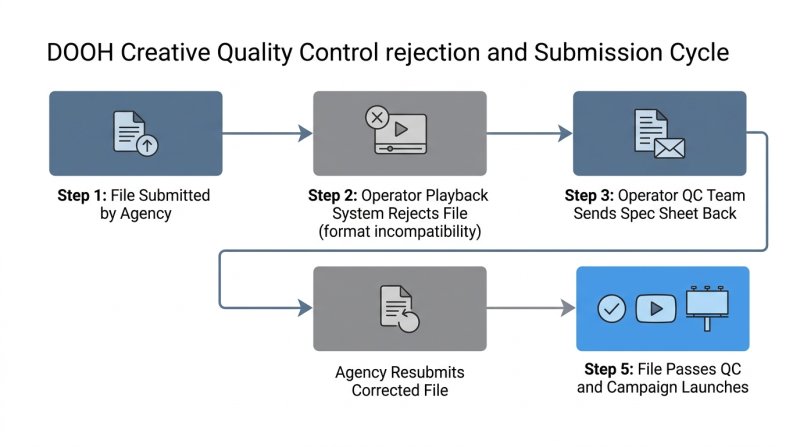
The agencies that run the cleanest DOOH campaigns have a pre-flight creative check that happens before the IO is even finalized. They send the actual files to each operator's trafficking system in advance of the campaign start date, get the rejections back early, and resolve them before the first frame is supposed to run. This takes three to five extra days in the sales cycle. Most agencies do not build that time in because their sales teams are not measured on trafficking efficiency — they are measured on close rate and revenue.
The operators who know this build a creative QC buffer into their proposal process. They tell the buyer upfront: files must be submitted five business days before the campaign start. They say it in the IO, they say it in the proposal, they say it in the confirmation email. Then they enforce it. When a file comes in two days before launch and fails QC, they have written documentation that the delay is on the agency, not on the operator.
Most operators do not do this. Most operators take the late file, do their best, and absorb the problem when the buyer complains about the late start.
The Daypart Configuration Gap
Here is one I see less coverage on, which means it is probably happening more than the industry admits.
A buyer wants a specific daypart. They are buying digital, which means they can target time-of-day. A financial services brand wants morning commute impressions, 7 to 9 AM, Monday through Friday. That is a premium window. The CPM for that daypart is meaningfully higher than ROS, run of schedule, meaning whatever happens to run whenever.
The agency trafficking coordinator puts the daypart requirement into the IO. The IO goes to the operator. The operator confirms. The campaign launches.
What nobody confirmed, what the trafficking process as commonly practiced does not include a step for, is whether the daypart the buyer wants actually matches what the operator's system will deliver.
I heard about this one from an operator in Chicago who had a digital face that was sold ROS to a different buyer during the morning commute window. The board was technically available for the 7 to 9 AM slot, but it was also committed to another buyer for the same window under a different contract. When the first campaign's proof of play came back, the morning impressions were almost entirely from the other buyer's creative running, not the financial services brand. The buyer got overnight impressions instead of the morning commute window they paid premium rates for.
This is the same class of problem as why campaigns get cancelled mid-flight, just caught at a different point in the process. The operator had to issue a credit. The agency was caught in the middle because their trafficking coordinator had confirmed daypart availability without checking whether the operator's system could actually execute it without conflicting with existing commitments.
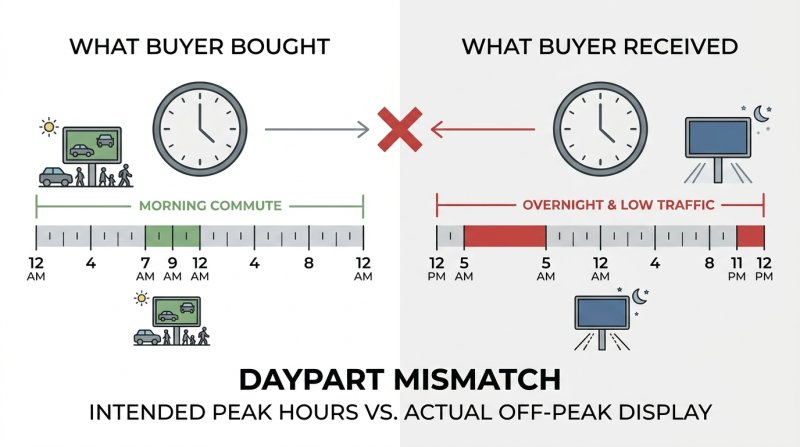
This is not a tech problem either. It is an operational process problem. The trafficking systems, the platforms operators use to schedule and manage their digital inventory, are not always integrated in real time with what is actually committed at any given hour. The availability shown in a proposal system might not reflect the actual booked status of a daypart in the trafficking system that the operations team uses.
When those two systems are out of sync, the buyer pays for something they do not receive. The operator finds out at the post-campaign review. The agency gets blamed. Nobody wins.
For operators, this is why your daypart availability needs to live in one place: the same place your sales team is quoting from. When your sales system and your trafficking system are different tools with different data, this is the gap where buyers get billed for the wrong impressions.
Proof of Play Has No Standard
After the campaign ends, you have to prove what ran.
Proof of play sounds simple. Show that the creative was displayed on the screens during the campaign window. In practice, it is a minefield of mismatched expectations and inconsistent formats.
Most operators, when a campaign ends, send screenshots. The QC team takes photos of the screens with a phone. Those photos go into a folder and get sent to the agency. The agency traffic team reviews them and forwards them to the client. The client, if they are sophisticated, wants timestamped photos with GPS data embedded. The operator, if they are sophisticated, has a system that automatically generates that from the playback logs. Most operators are not there yet.
I worked with a regional operator last year who was losing deals to a national competitor in the same market. Not on price — his rates were actually lower. On proof of play. The national competitor sent a polished PDF after every campaign, with geotagged photos, impression delivery data from the screen hardware, and a campaign summary that the client's analytics team could import directly into their reporting system. This operator sent a folder of JPEGs with filenames like IMG_4523.jpg and IMG_4524.jpg.
The buyers who cared about reporting, and the agencies working with national brands almost all care, picked the competitor. Not because the competitor's boards performed better. Because the competitor's reporting was easier to work with.
This is the part of the business that does not get talked about at conferences. The conference talks are about attribution models and impression delivery and CPM optimization. The quiet reason some operators keep clients and others lose them to a competitor with identical inventory is that one of them sends professional post-campaign reports and the other one does not.
The fix is not complicated. A standardized proof of play template, one that includes screen ID, location, campaign dates, total impression delivery, and at least two timestamped photos per screen, takes an operator maybe a day to build. What it does to the client relationship is disproportionate to the effort. It signals that you are running your business like a business.
Some operators have moved to automated proof of play generation from their playback hardware. The screen logs the creative that ran, the timestamps, and the duration. The operator's system generates the report automatically at campaign end. This is where the industry is heading. The operators who have already built this are the ones who are winning the clients who care about it.
Post-Campaign Reconciliation Is Where Relationships Break Down
The last stage of the campaign is where the operator's operations quality gets scored.
A campaign ends. The operator sends their proof of play. The agency reviews it and sends it to the client. The client compares what was delivered to what was invoiced. Discrepancies get flagged.
The most common discrepancy: impression delivery versus contracted impressions. The IO commits to a certain number of impressions based on the audience estimate. The screen actually delivers something different. The difference can be large or small depending on whether the audience data was accurate, whether the creative ran consistently, and whether the screen hardware logged correctly.
Buyers who have been burned before will sometimes dispute the entire invoice if the impression shortfall is large enough. I have seen operators absorb a full campaign credit because the proof of play documentation was not strong enough to defend the delivery numbers. The buyer said the impressions were short. The operator said they were not. The operator could not prove it because their reporting was a folder of screenshots and a spreadsheet.
The operators who handle this well have a post-campaign reconciliation process that starts before the campaign launches, not after it ends. They confirm the contracted impression baseline with the buyer upfront. They share screen-level delivery data at the midpoint of the campaign, not just at the end, so the buyer can see if the campaign is tracking as expected. When the campaign ends, they have a standardized report that the buyer cannot dispute on formatting grounds because it is presented professionally and includes all the data.
This is also where operators lose credibility on pricing. Attribution and measurement data, which we wrote about separately, only makes this harder when the operator cannot produce clean delivery data to support their numbers. When a buyer sees a rate on an IO and then sees a lower effective CPM once impression data is factored in, that is a conversation you want to have upfront. When the buyer discovers it on their own from the data, it is a conversation you are having defensively.
The operators who run clean post-campaign reconciliation processes are also the ones who get better renewal rates. The buyer knows what they paid for, knows what they received, and trusts the operator because the reporting was transparent. That trust is the difference between a campaign that renews and a campaign that goes to RFP the next cycle.
A Pre-Flight Checklist Worth Using
I have spent this whole post describing problems. Let me describe what actually works.
The operators I have worked with who have the fewest trafficking failures, the ones whose campaigns start on time, run cleanly, and close without disputes, all have a pre-flight process. It is not complicated. It is just consistently applied.
Here is what it includes.
One: a trafficking manifest review before the IO is signed. The manifest lists every screen in the campaign, every operator involved, and every trafficking requirement. The operator reviews it against their actual system availability before the IO is countersigned. This catches the wrong panel IDs, the decommissioned faces, and the date discrepancies before they become problems.
Two: a creative submission deadline that is enforced. Files must be received five business days before launch. Late files do not get priority QC treatment. This is in the IO. The operator enforces it.
Three: a daypart conflict check for every digital campaign. Before launch, the operator confirms in writing that the dayparts the buyer wants match what the trafficking system will actually deliver. If there is a conflict, it is surfaced before the campaign starts, not after.
Four: a proof of play format commitment from the buyer. Before launch, the operator asks what reporting format the buyer expects and confirms they can deliver it. This is not a negotiation. It is an alignment step. Getting it in writing prevents the post-campaign format dispute.
Five: a mid-campaign check-in for campaigns over four weeks. A brief note to the buyer at the midpoint: impressions are tracking at X percent of contracted delivery, here are the screen-level numbers. Buyers who get this information mid-campaign do not get surprised at the post-campaign review.
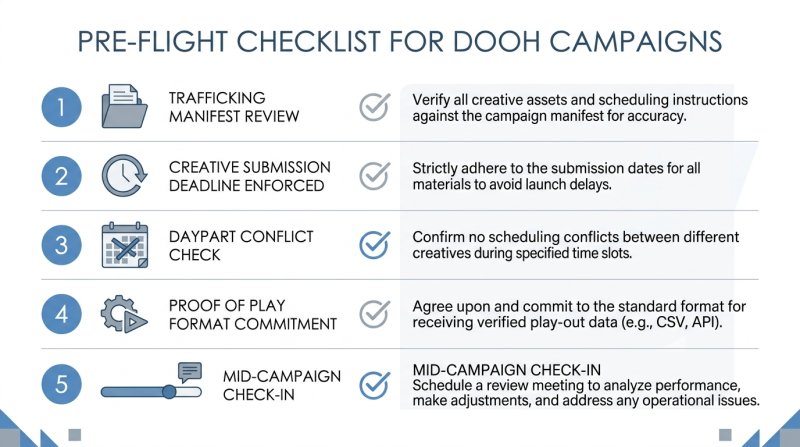
None of this is automated. All of it is process. The operators who do this consistently have fewer cancelations, fewer disputes, and better renewal rates. They also, I should note, have more time than operators who are constantly firefighting trafficking failures. The time savings from running a clean pre-flight process are hard to quantify but they are real.
FAQ
Why do national DOOH campaigns experience more trafficking problems than regional ones?National campaigns involve multiple operators across multiple markets. Each operator has different trafficking systems, different file specifications, different QC processes, and different reporting formats. The complexity scales with the number of operators involved. A campaign with one operator and three screens is straightforward. A campaign with four operators across six markets and twenty screens requires coordination that most agency trafficking teams do not have the process to manage.
What is the most common creative QC failure in DOOH?File format incompatibility is the most common. Agencies submit creative in formats optimized for TV or digital, ProRes, high-bitrate H.264, or files with aspect ratios that do not match the screen specifications. Every operator's playback hardware has specific requirements. When a file arrives in the wrong format, it fails QC and has to be resubmitted, which adds days to the campaign launch timeline.
How can operators prevent daypart conflicts in digital OOH campaigns?The daypart availability must be confirmed against the trafficking system. Not the sales system. Not the proposal tool. The actual system the operations team uses to schedule playback. If the buyer wants a specific time window, the operator should confirm in writing that the window is available and will not conflict with other committed buyers before the IO is signed.
What should a proof of play report include?A complete proof of play report should include screen ID and location for every board in the campaign, the campaign start and end dates, total impression delivery with the methodology used to calculate it, and at least two timestamped photos per screen. Sophisticated buyers increasingly expect GPS-tagged photos and automated data export from the playback hardware. Operators who cannot provide this format are at a competitive disadvantage against those who can.
How do trafficking failures affect operator-client relationships?Trafficking failures, including late starts, creative mismatches, daypart disputes, and incomplete proof of play, accumulate in the buyer's perception as operational incompetence. Even if the underlying problems are not the operator's fault, the buyer associates them with whoever sent the invoice. Operators who have repeated trafficking failures with a client typically see lower renewal rates and more competitive pressure on pricing in subsequent negotiations.
Last updated: April 2026 About Marcus Webb
Marcus Webb is the Operations Lead at AdGrid, where he has spent eight years working with billboard operators across the country on inventory management, campaign trafficking, and deal execution. He has managed more than 600 billboard faces across print and digital formats and has spent more time than he would like to admit cleaning up trafficking problems that could have been caught in the first phone call.
Marcus Webb is the Operations Lead at AdGrid, where he has spent eight years working with billboard operators across the country on inventory management, campaign trafficking, and deal execution. He has managed more than 600 billboard faces across print and digital formats and has spent more time than he would like to admit cleaning up trafficking problems that could have been caught in the first phone call.
Ready to Modernize Your OOH Operations?
Join the leading OOH media owners who use AdGrid to automate their quoting, manage inventory, and grow their revenue.