

I have been on both sides of this one. You spend three days pulling together what you think is a bulletproof proposal for a billboard package. Clean design. Demographic reach data. The whole rate card. You even called ahead to make sure the buyer was expecting it.
Twelve days later, you find out they went with someone else.
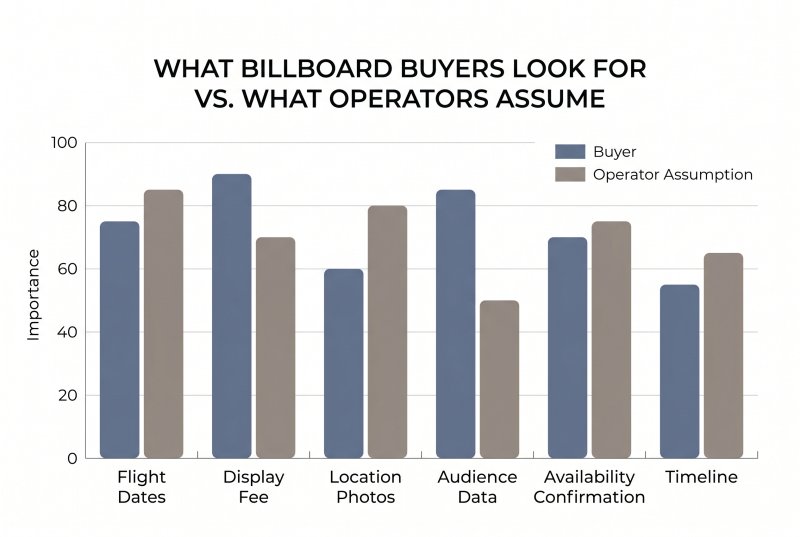
What happened? Here is what I have learned talking to operators who manage anywhere from 40 to 300 faces at a time: the problem is almost never the inventory. And it is rarely the CPM. It is almost always the proposal itself — and more specifically, what it assumes about the person reading it.
Most proposals are built to showcase the operator. They are not built for the media buyer who has to justify the spend to a CFO, defend the media buy to a client, and then explain to their boss why they picked that particular stretch of highway.
This post is about what I see killing deals in the proposal stage, and what to do instead.
The 40-Page Trap
There is an instinct in OOH sales to throw everything at the proposal. Your rate card. Your media kit. Your full inventory list. Screenshots of campaigns you ran two years ago. A company history section. Maybe even a headshot of the sales team.
The theory: the more thorough, the more professional, the more impressive.
The theory is wrong.
Here is what actually happens. A media buyer at an agency gets an RFP on a Tuesday. They have four operators to evaluate. They will spend about 90 seconds on each proposal before deciding which ones are worth escalating for a deeper look. Ninety seconds. A 40-page PDF does not get read. It gets forwarded to the junior buyer with a note that says something like "can you pull the Chicago numbers and see which one fits the brief."
The junior buyer job is to extract numbers, not to understand your market positioning.
If your key pricing and availability information is on page 14, it will not be found in time to matter.
The best proposals I have seen — the ones that move from RFP to signed IO quickly — are built around one idea: front-load the decision, not the documentation. The first page should answer three questions in order: what location, what display fee, and what start and end date. Everything else goes in the appendix, which the buyer will only open after they have decided your proposal is worth taking seriously.
The Rate Card Problem
Here is a specific mistake I see constantly. Operators show the published rate. Not the effective rate — the published rate. The one on the rate card that no one has paid in six years.
Billboard rate cards are like hotel rack rates. They are the number you put on the wall so that when you give a 35% discount, it feels like you are getting a deal. Nobody pays the published rate. Media buyers know this. Media directors know this. The CFO who eventually has to sign off knows this.
When you put an $18,000-per-month display fee in your proposal for a board that typically moves at $11,000 to $12,000 in that market, what you are signaling to every experienced buyer is that either you do not know your own market, or you are padding the number. Either way, it makes everything else in the proposal suspect.
Show the published rate as a reference point. Then show the rate you are actually quoting for the package. Then — and this is the part most operators skip — show the comparable rate. What does a similar board cost in the same market? Give the buyer a frame of reference so they are not guessing.
This takes five minutes in a spreadsheet. It changes the dynamic of every pricing conversation you have.
Here is a real example from an operator I worked with in Chicago. He was getting pushback on his digital board rates consistently, losing deals he thought he should have won. When we looked at his proposals, he was quoting $14,200 per month on a board that two other operators were regularly placing at $9,800. His proposal did not say anything about why his board was worth 45% more. He just put the number in and waited.
Once he started including the market context — traffic counts, audience delivery data, comparable placements — the conversation changed. Buyers were not comparing $14,200 to $9,800. They were comparing $14,200 with his audience data against $9,800 with no data. Different conversations.
The effective CPM is the number that should be on page one. Display fee divided by the actual audience you are delivering, not the theoretical one.
The Flight Date Blindspot
You would think this would be obvious. The start date, the end date, the number of weeks. A plain-English statement about whether those dates are confirmed or subject to availability. And in some markets — particularly the ones where inventory is tight — a line clarifying that the quoted rate is valid for the dates listed and subject to change if the campaign has to shift.
About a third of the proposals I review do not have flight dates anywhere on page one. Maybe they are on page three, buried under the executive summary and the market overview. Sometimes there is a start date with no end date. Sometimes the proposal lists the campaign duration but not the specific calendar dates.
This matters more than it sounds like it would. Here is why. Buyers submit insertion orders internally. Those insertion orders go to traffic and operations. If the dates in your proposal do not match what the buyer submits to their own team, you get a phone call three weeks before the campaign start asking if you can accommodate a schedule change. That phone call is expensive. It usually involves discounting to make up for the confusion, or losing the campaign entirely because the buyer does not have the bandwidth to fight with their own operations team.
Put flight dates in a clearly labeled box on page one. State whether the dates are guaranteed or subject to inventory confirmation. Always include a line that reads approximately: "Dates listed are subject to availability at time of campaign confirmation." This protects you when buyers need to shift quarters mid-campaign, which happens constantly, and it sets an expectation that keeps everyone aligned.
Why Your Proposal Has No Pictures
You are selling visual media. Your proposal has no photos of the boards.
This one drives me a little crazy. I have reviewed proposals for digital faces on the Eisenhower Expressway in Chicago that did not include a single image of the actual billboard. Just an address and a demographic table.
Think about what that looks like from the buyer side. They are trying to picture the inventory. They might not know the area. Google Maps is not going to give them the approach angle, the lighting, the context of surrounding signage. They have to do extra work to evaluate your proposal, and extra work is the thing that makes buyers move on to the next option.
I understand why operators skip this. Professional photography costs money. Scheduling it around weather and traffic is a hassle. But the buyer is not looking for a production. They are looking for two things.
First, an approach-view photo — the view a driver would have of the board. Second, a context shot that shows the surrounding area. Not scenic shots. Just enough to see what the signage environment looks like and whether your board pops or disappears into the noise.
There was a situation I heard about from an operator in Atlanta. He had included approach photos in his proposal for a national CPG campaign. The buyer team actually told him afterward that those photos were the reason the proposal got a second look. The buyer had been to that stretch of I-75 and could immediately visualize the board and the approach angle from the photo in a way they could not from an address and a map pin.
That board was not the cheapest in the market. It was not even the most well-located by some metrics. But the proposal made it easy for the buyer to do their job, and that was the deciding factor.
The fix is to maintain a shared folder with approach-view photos for every active location in your inventory. Update them seasonally. Yes, weather affects lighting. Yes, construction changes the context. Keep them current. This is not a large lift once you have the workflow in place, and it belongs in every standard proposal package you send.
What to Actually Include
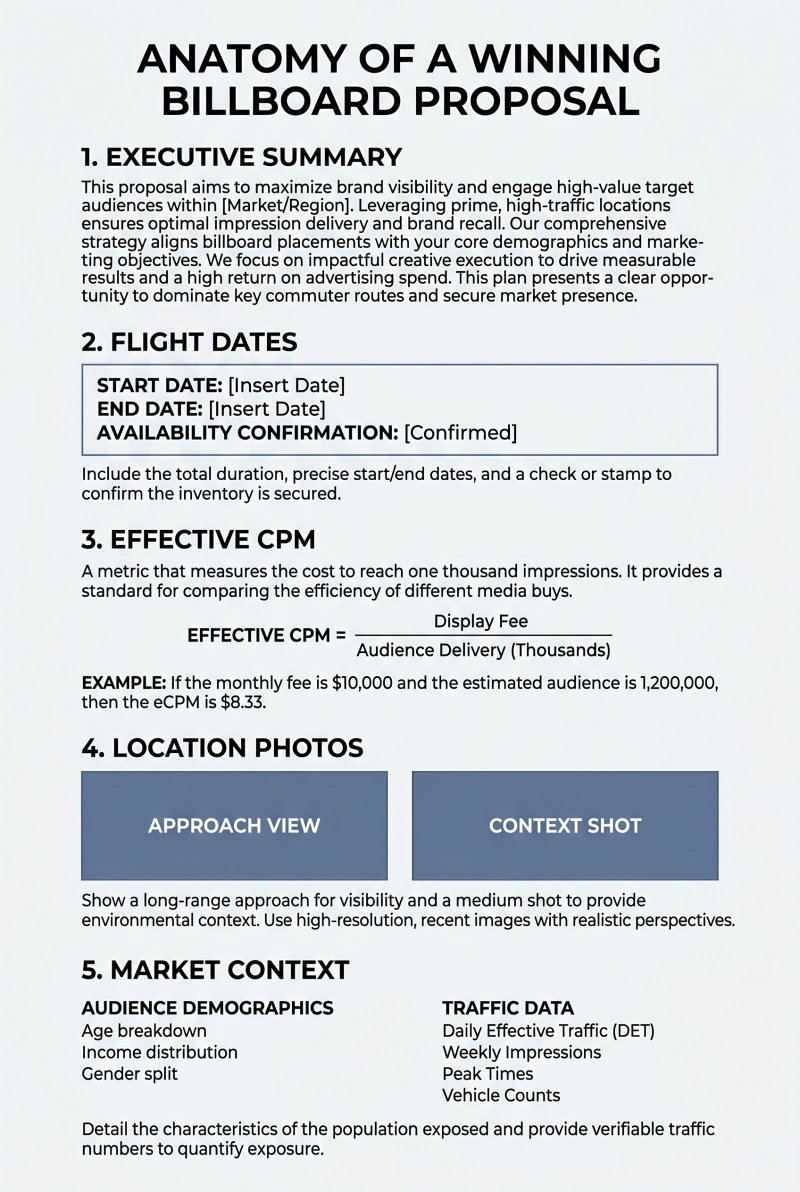
Now that we have covered what to cut, here is what should be in every proposal.
The Executive Summary (Yes, It Is Necessary)
Most operators skip the executive summary. They think it is corporate filler for presentations, not for OOH sales. The operators who include one usually write it wrong too — they turn it into a summary of their own company rather than a summary of what they are proposing.
Here is what the executive summary should contain. Four or five sentences. First, restate the buyer specific situation in their own terms. Second, state what you are proposing and why it fits. Third, hit the key number — the display fee and the duration. Fourth, name the one thing that makes your proposal different from the other three they have in front of them. Fifth, close with what you want them to do next.
That is it. Five sentences. Most operators could write this in under ten minutes once they have the structure. The buyer is evaluating four or five proposals simultaneously. The executive summary is the thing they read before they decide whether to keep reading. If you do not write it, they have to build it themselves in their head, which is work, and work makes it easier to drop your proposal down the priority list.
The Market Context Section
Not a market overview — that is too broad and reads like Wikipedia. A context section that ties the specific location to the specific campaign the buyer is trying to run.
A buyer running a political campaign in a midterm cycle cares about different things than a buyer running a QSR brand activation. Your proposal should acknowledge that. Not with a long narrative, but with a brief section that shows you understand the type of advertiser you are pitching.
The traffic count is on page one. The audience composition — what the demographics of that traffic actually look like — is what goes in this section. Who lives and drives through this market? What is the income distribution? Is this a commuter corridor, a weekend shopping corridor, a tourism route? This is where operators with strong close rates differentiate themselves, because it signals that you see the inventory not just as panels but as a strategic media placement.
The Proof Point Section
One section. No testimonial language, no case study format, no quotes about how satisfied the previous advertiser was. Just the facts.
We ran X weeks for Y brand in Z market. The advertiser campaign goal was to reach A demographic in B location. The result was C. One paragraph. Specific numbers, specific names where you have permission to use them.
Buyers trust specifics. They do not trust adjectives.
The Proposal Workflow Problem
Now let me address the part that most operators ignore entirely, which is the actual process of sending and managing proposals.
The average mid-size billboard operator I work with is sending proposals via email attachment. PDF, subject line, send. Maybe a brief note in the body. Then they wait.
The buyers they are sending to are getting those PDFs in inboxes that also have 300 other emails that day. The PDF might get opened. It might get forwarded to the media planner with a note. That note might get a response in 24 to 48 hours. Then there is a round of follow-up questions, usually about pricing or availability. Then there is a counteroffer on CPM. Then there is back and forth on the rate.
This process takes an average of six to eight days for a mid-market deal, according to the operators I have asked. The ones who use a digital proposal system — not a full CRM, just a better tool for building and sending quotes — cut that timeline in half. Not because the technology is the point, but because it removes the friction of the email back-and-forth. When a buyer can view a proposal, see the inventory details, click through to location specs, and submit a counteroffer on the same platform, the deal moves faster.
There are two platforms built for this that operators tell me actually work in practice. One is a proposal generation tool that lets you build and send a shareable link instead of an attachment. The other is a quote management system that ties inventory directly to what you have available in your current database. Both work. Neither is complicated to set up. The thing that stops most operators is not the cost or the complexity — it is the workflow change. You have to stop sending PDFs and start sending links.
Here is the part I have to be honest about though. The technology is not what determines your close rate. I know operators who use every tool available and still lose deals because they give in on pricing too quickly. And I know operators who track their proposals in a spreadsheet and close at a higher rate because they understand what their inventory is worth and they hold the line.
The operators who close at 52% versus 28% are not the ones with better boards. They are the ones who do not fold when a buyer comes in with a counteroffer below their asking rate. That is the part the software cannot fix.
The Timing and Follow-Up System
Most operators I know send proposals whenever they get to them. This is understandable. You have inventory calls, billing, a dozen other things pulling your attention. But proposals sent same-day as an inquiry convert at a measurably higher rate than proposals sent two or three days later.
If an RFP lands in your inbox on a Friday afternoon, send the proposal Friday afternoon. Not Monday morning. The buyer is processing a lot of these at once, and the ones they receive first tend to set the mental baseline. You want to be early, not late.
After you send, you need a follow-up system. Not a CRM — a spreadsheet. Track when you sent, when you last followed up, and when you are going to follow up again. That is it. Most operators who lose deals to competitors never knew they were in the running, because they never followed up after the initial send.
One more thing. Send the proposal yourself. Not through an assistant, not through a traffic manager. Your name in the inbox, a brief personal note, something that signals this is a real business relationship and not a form submission. Buyers talk about this constantly. The operators who stand out are the ones who make it feel like a conversation, not a transaction.
FAQ
What should be on the first page of a billboard proposal?
The first page should have three things: the location and the board being proposed, the display fee, and the flight start and end dates. Everything else goes in the appendix. If a buyer cannot find those three things in 90 seconds, your proposal has already lost them.
How do you handle pricing objections in a billboard proposal?
Include market context in the proposal itself. Show the published rate, the quoted rate, and the comparable rate for similar boards in the same market. This reframes the pricing conversation from "are you overpriced?" to "what are you getting for the rate you are being quoted?"
Should billboard proposals include professional photography?
Not necessarily professional, but they should include photos. An approach-view shot from the driver perspective and a context shot of the surrounding area are the minimum. These help buyers visualize the inventory without doing extra research on their end.
How long should a billboard proposal be?
Short. The proposal should front-load the key decision information on the first page — location, rate, and dates — with supporting detail in the appendix. Forty pages is too long. Five to eight pages is the right range, including the appendix.
What is the average close rate for billboard proposals?
Industry estimates put the average close rate for OOH proposals in the 30% to 40% range for operators not using a structured follow-up system. Operators with disciplined proposal workflows and pricing consistency report rates in the upper 40s to low 50s. The difference is usually pricing discipline, not inventory quality.
How do you follow up on a billboard proposal without being pushy?
Send a follow-up within 48 hours of the initial send. Reference something specific in the proposal — the flight dates or the audience delivery numbers. Ask if they have questions rather than asking if they are ready to move forward. The goal is to start a conversation, not to close the deal in the first follow-up.
Last updated: April 24, 2026
About Marcus Webb
Marcus Webb is the Operations Lead at AdGrid, where he works with billboard operators across the country on inventory management, proposal workflows, and deal closing. He has managed over 600 billboard faces across multiple markets and spent eight years in OOH operations before joining the AdGrid team.
Marcus Webb is the Operations Lead at AdGrid, where he works with billboard operators across the country on inventory management, proposal workflows, and deal closing. He has managed over 600 billboard faces across multiple markets and spent eight years in OOH operations before joining the AdGrid team.
Ready to Modernize Your OOH Operations?
Join the leading OOH media owners who use AdGrid to automate their quoting, manage inventory, and grow their revenue.