
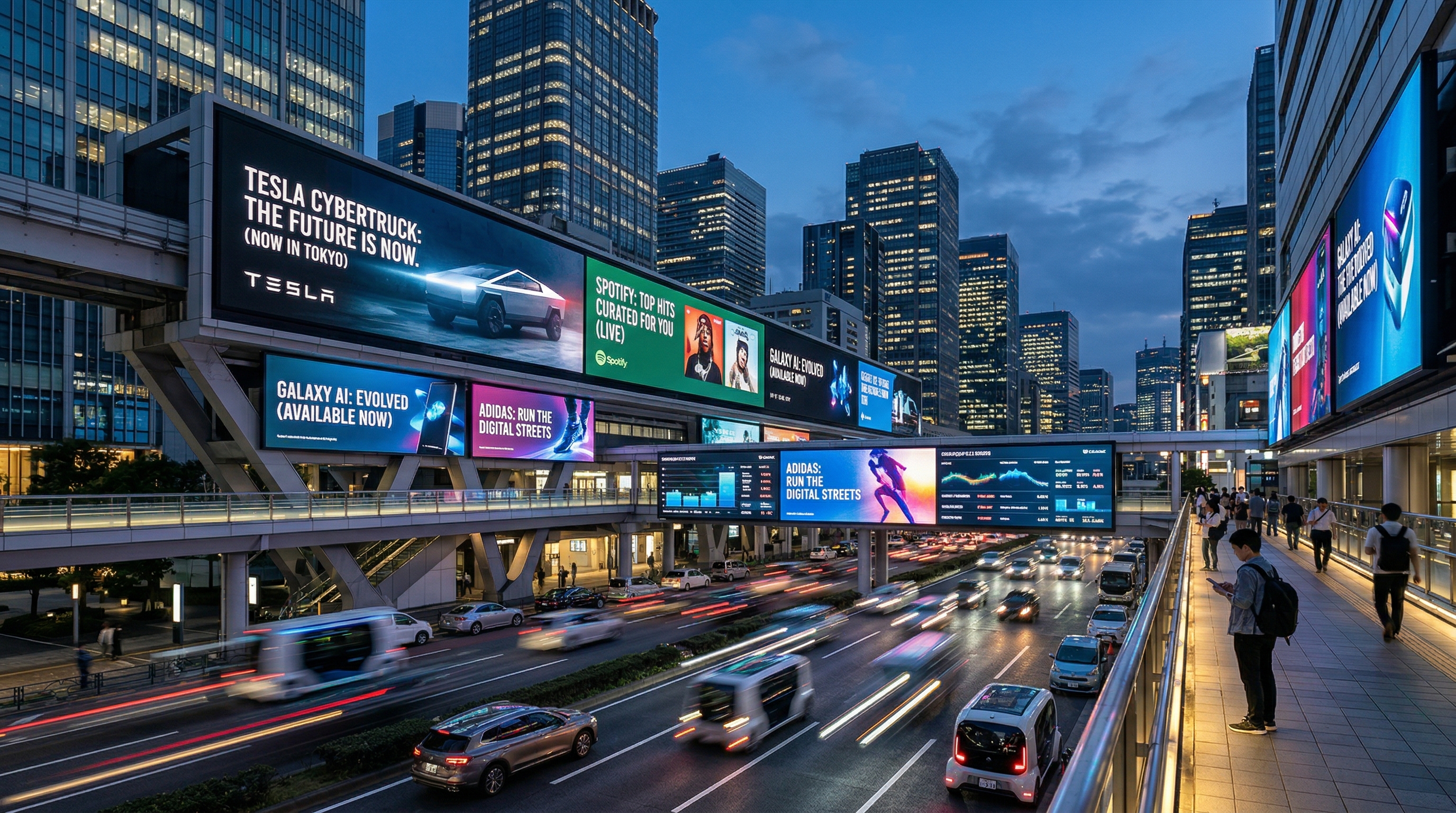
The Programmatic OOH Revolution: Why the Future is Automated, Not Manual
For decades, Out-of-Home (OOH) advertising was the domain of the patient and the manual. Buying a billboard meant spreadsheets, dozens of emails, and lead times that stretched into weeks. It was a world of static "buy-and-hold" inventory where performance was measured in estimates and anecdotal evidence.
But in 2026, the landscape has shifted fundamentally. We are no longer just putting "posters on walls." We are deploying dynamic digital assets into an ecosystem that values speed, precision, and data above all else. This is the Programmatic OOH (pOOH) revolution, and it isn't just a tech upgrade—it’s a survival requirement for modern media owners and agencies.
1. Beyond the Static: What pOOH Means in 2026
At its core, programmatic OOH is the automated buying and selling of digital billboard inventory. Instead of negotiating a fixed contract for a specific board, advertisers use software to buy impressions in real-time based on specific criteria.
In 2026, pOOH has evolved beyond simple automation. It is now a highly sophisticated layer that integrates with the broader digital marketing stack. Your billboard is no longer an island; it’s a synchronized touchpoint in a multi-channel campaign, behaving more like a Facebook ad or a Google search result than a traditional placard.
2. Efficiency vs. Control: Why Manual Agencies are Losing the Speed War
The primary friction point in traditional OOH is time. A manual agency might take three days to confirm availability and another two to finalize a contract. In the digital age, three days is an eternity.
Programmatic platforms eliminate this lag. Agencies using pOOH can launch, pause, or pivot campaigns in minutes. This speed doesn't mean a loss of control; rather, it provides granular control. You aren't just buying "Times Square"; you are buying "Times Square on Tuesday mornings when it’s raining and foot traffic from the 18-34 demographic is peaking."
Manual processes simply cannot compete with that level of tactical agility.
3. Data-Driven Decisions: Selling Inventory with Audience Metrics
The "spray and pray" model of billboard advertising is dead. Today’s advertisers demand accountability. They want to know who saw their ad and what they did next.
pOOH leverages mobile location data, camera sensors (where permitted), and third-party audience insights to provide real-time metrics. As a media owner, this transforms your inventory from a physical location into a "targeted audience delivery vehicle." You are no longer selling a piece of steel and LED; you are selling 50,000 impressions of high-intent commuters.
4. The Power of Triggers: Contextual Relevance at Scale
One of the most potent advantages of programmatic is the use of "triggers." Because the creative is delivered digitally and bought in real-time, campaigns can be programmed to respond to the environment:
- Weather Triggers: A coffee brand boosts its "Hot Latte" creative when the temperature drops below 40°F.
- Event Triggers: A sports apparel brand runs "Championship Gear" ads the second the local team clinches a win.
- Traffic Triggers: A rideshare app increases its presence on boards near major intersections when gridlock reaches a certain threshold.
This level of contextual relevance ensures that the ad is always useful, never just noise.
5. How AdGrid Prepares Regional Operators for a Programmatic World
For many regional operators, the leap to programmatic feels daunting. The technical requirements and the fear of "devaluing" premium spots often lead to hesitation.
This is where AdGrid bridges the gap. We don't just provide the software; we provide the infrastructure that makes your inventory "programmatic-ready." AdGrid simplifies the connection between your local boards and global Demand-Side Platforms (DSPs). We ensure that regional operators can maintain their direct-sales relationships while simultaneously opening up their "dark" (unsold) inventory to the massive programmatic marketplace.
With AdGrid, you don't have to choose between traditional and automated. You get the best of both worlds: the stability of direct contracts and the incremental revenue of the programmatic revolution.
6. Conclusion: Future-Proofing Your Agency Today
The revolution isn't coming; it’s here. Agencies and media owners who cling to manual workflows will find themselves increasingly sidelined by more agile, data-literate competitors.
The shift to programmatic is an opportunity to reclaim the OOH medium as a cutting-edge digital channel. By embracing automation, leveraging real-time data, and utilizing contextual triggers, you aren't just selling space—you are selling results.
The future of OOH is automated. Is your agency ready?
Ready to bridge the gap? Discover how AdGrid is empowering media owners to lead the pOOH charge at AdGrid.com.
Ready to Modernize Your OOH Operations?
Join the leading OOH media owners who use AdGrid to automate their quoting, manage inventory, and grow their revenue.