
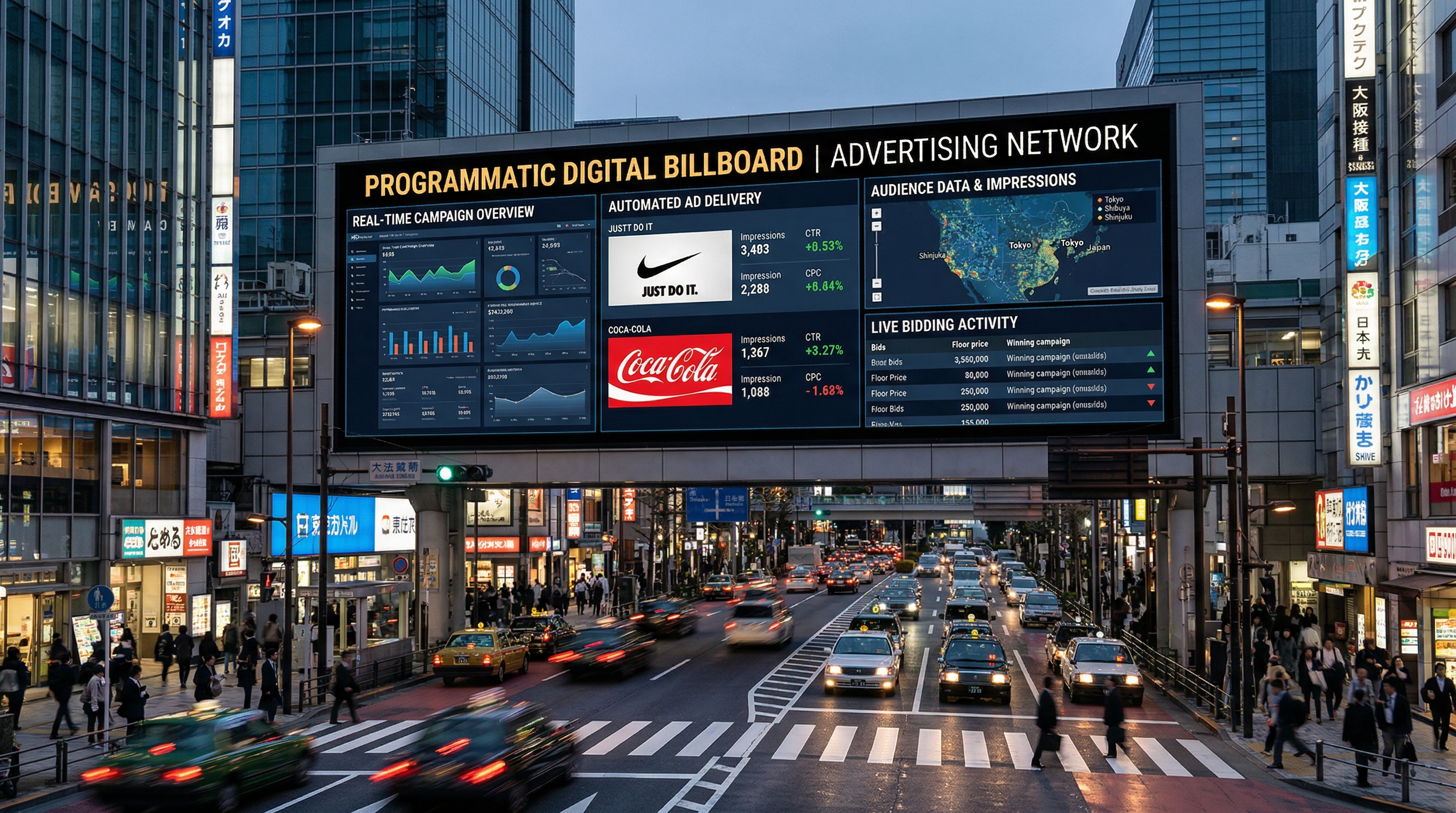
The billboard industry is undergoing its most significant transformation since the transition from hand-painted signs to vinyl. Programmatic Digital Out-of-Home (pDOOH) is no longer just a buzzword tossed around at industry conferences—it is becoming the primary revenue driver for forward-thinking media owners. Yet many traditional billboard agencies, comfortable with their tried-and-true direct sales models, are watching this shift from the sidelines, unsure of how to dive in or whether they even should.
This hesitation is understandable. The programmatic ecosystem comes with its own language—DSPs, SSPs, DMPs, CPMs, fill rates, and private marketplace deals—that can feel foreign to operators who have built their businesses on relationships, phone calls, and handshakes. But here is the reality: programmatic DOOH represents a massive opportunity to unlock new revenue streams, maximize yield on unsold inventory, and future-proof your business in an increasingly digital advertising landscape.
In this comprehensive guide, we will demystify programmatic DOOH, explain how it works in practical terms, explore why it matters for traditional operators, and provide actionable steps for getting started without disrupting your existing direct sales business.
What Is Programmatic DOOH, Really?
At its core, programmatic DOOH is simply the automated buying and selling of digital out-of-home advertising space through software platforms rather than through manual sales processes. Think of it like the difference between calling a travel agent to book a flight versus using an app like Expedia to search, compare, and purchase instantly.
In the traditional model, a media buyer interested in your digital billboards would need to call your sales team, request availability, negotiate rates, exchange insertion orders, and manually coordinate creative delivery. This process can take days or weeks. In a programmatic model, that same buyer can log into a Demand-Side Platform (DSP), see your available inventory in real-time, select the screens they want, set their targeting parameters, upload creative, and launch a campaign within minutes.
The "programmatic" part refers to the algorithms and automation that match buyers with sellers based on predefined criteria—budget, audience demographics, location, time of day, weather conditions, and countless other data signals. The transaction happens instantly, with the buyer only paying when their ad actually plays on your screen.
It is important to distinguish between two types of programmatic buying:
Real-Time Bidding (RTB): This is the auction-based model where multiple advertisers bid on your inventory in real-time. When a slot becomes available on your digital billboard, the SSP (Supply-Side Platform) sends a bid request to multiple DSPs. Advertisers have milliseconds to evaluate the opportunity and submit a bid. The highest bidder wins, and their ad plays. This model maximizes competition and can drive up CPMs, but prices fluctuate based on demand.
Programmatic Guaranteed: This is a more controlled model where you negotiate a fixed deal with a specific buyer through programmatic pipes. You agree on volume, rates, and terms upfront, but the execution happens automatically through the platform. This gives you the efficiency of programmatic with the revenue predictability of direct sales.
Why Traditional Billboard Agencies Should Care
The question many traditional operators ask is: "If my direct sales team is doing fine, why should I mess with programmatic?" The answer lies in three key benefits that programmatic delivers: incremental revenue, operational efficiency, and competitive positioning.
Unlocking Incremental Revenue
No billboard operator sells 100% of their inventory through direct sales. Industry averages suggest that even well-run agencies operate with 20-30% unsold inventory—or they deeply discount remnant space to move it. Programmatic provides a way to monetize that unsold inventory without cannibalizing your premium direct business.
Here is how: you can set floor prices in your SSP that ensure programmatic only fills slots that would otherwise go unsold. If your direct sales team sells a board for $10 CPM, you might set your programmatic floor at $4 CPM. When direct campaigns are running, they take priority. When there is unsold space, programmatic buyers can fill it at $4 or higher. You are essentially creating a secondary market for inventory that would have generated zero revenue.
For digital billboards specifically, this incremental revenue can be substantial. A single digital face might have 6-10 slots per minute, 18 hours a day, 30 days a month. That is thousands of potential impressions. Even filling 20% of unsold inventory at modest CPMs can generate significant monthly revenue with zero additional sales effort.
Operational Efficiency
Direct sales are labor-intensive. Each deal requires prospecting, pitching, negotiating, paperwork, trafficking, and reporting. For small to mid-sized agencies, this overhead limits how much inventory you can realistically sell.
Programmatic changes the economics. Once your inventory is connected to an SSP, the platform handles the transaction execution, creative trafficking, and basic reporting automatically. You are not eliminating your sales team—you are augmenting them. Your team can focus on high-value direct relationships and custom campaigns while programmatic handles the long tail of smaller, transactional buyers.
This efficiency extends to campaign management. When a programmatic campaign ends, the reporting is automatic. When a direct campaign needs optimization, it often requires back-and-forth emails and manual adjustments. Programmatic campaigns can be adjusted in real-time by the buyer, reducing your operational burden.
Competitive Positioning
The advertising industry is consolidating around programmatic buying. Media buyers at agencies and brands are increasingly trained to plan and execute campaigns through DSPs. If your inventory is not available programmatically, you are invisible to a growing segment of the market.
This is particularly true for national and regional buyers who want to execute multi-market campaigns efficiently. A brand wanting to run a campaign across 20 cities does not have time to call 20 different billboard companies. They want to log into their DSP, draw a geo-fence around their target markets, and buy inventory from every available screen in that area—including yours.
By making your inventory available programmatically, you are positioning your assets for inclusion in these large-scale campaigns. You are also future-proofing your business as more advertising dollars shift to automated buying.
How Programmatic DOOH Actually Works: The Technical Flow
Understanding the mechanics of programmatic transactions helps you make better decisions about implementation. Here is what happens when a programmatic ad serves on your digital billboard:
Step 1: Inventory Availability Your Content Management System (CMS) communicates with your SSP, indicating that a slot is available for programmatic sale. This happens in real-time, milliseconds before the slot is scheduled to play.
Step 2: Bid Request Your SSP sends a bid request to multiple DSPs. This request includes data about the opportunity: the screen location, the time of day, estimated audience demographics, environmental conditions (weather, traffic), and any other relevant signals.
Step 3: Bid Evaluation DSPs evaluate the opportunity against their advertisers' campaign criteria. If a brand wants to target males aged 25-34 in urban locations during evening commute hours, and your screen matches those criteria, the DSP might submit a bid.
Step 4: Auction Resolution Your SSP runs an auction, evaluating all bids against your floor price and any other rules you have set. The highest eligible bid wins.
Step 5: Ad Delivery The winning creative is delivered from the DSP through your SSP to your CMS. This happens in near real-time, ensuring the ad is ready to play when the slot begins.
Step 6: Playback and Reporting Your CMS plays the ad and sends confirmation back through the chain. The buyer is charged, you are paid, minus the SSP and any other platform fees, and reporting data flows to all parties.
The entire process—from availability signal to ad playback—happens in under 200 milliseconds. To the viewer, it is seamless. Your digital billboard simply shows the right ad at the right time.
Addressing Common Concerns
Traditional operators often have valid concerns about programmatic. Let us address the most common ones:
"Will Programmatic Cannibalize My Direct Sales?"
This is the number one fear, and it is largely unfounded if you implement programmatic strategically. The key is establishing clear rules of engagement:
- Set floor prices that protect your direct rates. If you sell direct at $8 CPM, set programmatic floors at $4-5 CPM. Direct deals should always win when they are available.
- Reserve premium inventory for direct sales. Your highest-traffic, most desirable locations can be excluded from open exchange programmatic or limited to private marketplace deals with approved buyers.
- Use programmatic for remnant only. Many operators start by making programmatic available only for slots within 48-72 hours of play, ensuring direct sales have first right of refusal.
Think of programmatic like a hotel's pricing strategy. Hotels sell rooms at premium rates to travelers who book in advance. As the date approaches, unsold rooms get released to discount sites at lower rates. The hotel would rather sell at 60% off than leave the room empty. Your unsold billboard slots work the same way.
"I Do Not Want Inappropriate Ads on My Screens"
Brand safety is a legitimate concern. No operator wants questionable content appearing on their billboards, especially in sensitive locations like near schools or houses of worship.
Modern SSPs provide robust brand safety controls:
- Category blocking: Prevent ads from categories like gambling, alcohol, pharmaceuticals, or adult content.
- Advertiser whitelisting: Only allow specific pre-approved advertisers to buy your inventory.
- Creative review: Require all creative to be pre-approved before it can serve on your screens.
- Geo-specific rules: Apply different brand safety settings to different locations based on local sensitivities.
You maintain control over what appears on your assets. Programmatic does not mean "anything goes."
"The Revenue Share Feels Like I Am Giving Away Money"
It is true that programmatic involves revenue sharing. A typical SSP might take 15-25% of gross revenue, and if you work through an aggregator, there may be additional fees. This can feel painful when you are used to keeping 100% of direct sales.
But this perspective misses the bigger picture. Fifteen percent of something is better than 100% of nothing. If programmatic fills inventory that would have gone unsold, you are generating revenue that would not have existed otherwise. Even with the SSP fee, the incremental revenue drops straight to your bottom line with no additional sales cost.
Additionally, programmatic CPMs have been rising as demand increases and premium inventory becomes available. Early programmatic was associated with low-quality remnant. Today, major brands are buying programmatically at premium rates because of the targeting capabilities and efficiency.
Getting Started: A Practical Roadmap
If you are convinced that programmatic deserves exploration, here is a practical roadmap for getting started without disrupting your core business:
Phase 1: Education and Planning (Month 1)
Start by educating yourself and your team. Speak with SSPs like Vistar Media, Place Exchange, or Hivestack. Understand their fee structures, their buyer networks, and their technical requirements. Ask for case studies from operators similar to your size and inventory mix.
Simultaneously, audit your current inventory utilization. What percentage of your digital slots go unsold? Which locations have the highest vacancy rates? This data will help you identify which screens to make available for programmatic and at what floor prices.
Phase 2: Technical Integration (Months 2-3)
Programmatic requires your CMS to communicate with an SSP. If you are using a modern CMS like Broadsign, Scala, or similar, there is likely already an SSP integration available. If you are using older technology, you may need to upgrade or add middleware to enable the connection.
During this phase, you will also establish your programmatic policies:
- Floor prices by location tier
- Brand safety rules and blocked categories
- Private marketplace vs. open exchange strategy
- Reporting and reconciliation processes
Phase 3: Soft Launch (Month 4)
Start with a limited subset of your inventory. Perhaps make 20-30% of your digital faces available for programmatic, focusing on locations with the highest direct sales vacancy rates. Set conservative floor prices and monitor closely.
Use this phase to understand the dynamics of your programmatic demand. Which locations attract the most bids? What CPMs are advertisers willing to pay? Are there times of day or days of week where demand is strongest?
Phase 4: Optimization and Expansion (Month 5+)
Based on your soft launch data, refine your strategy. Adjust floor prices up or down based on fill rates. Expand programmatic availability to additional locations if demand is strong. Consider experimenting with private marketplace deals for premium inventory.
Over time, you will develop a rhythm where programmatic and direct sales work in harmony. Direct sales focus on premium, long-term commitments. Programmatic fills the gaps with transactional demand.
The Future of Programmatic OOH
Looking ahead, programmatic DOOH will only become more central to the OOH industry. Several trends are accelerating adoption:
Retail Media Networks: Major retailers are building their own DOOH networks (think screens in grocery stores, gas stations, and retail locations). These networks are almost exclusively monetized programmatically, training a new generation of media buyers to think programmatic-first.
Data Integration: As Geopath and other measurement providers enhance their audience data, programmatic targeting becomes more sophisticated. Buyers can target not just by location, but by the specific audience composition passing your screens at any given moment.
Dynamic Creative: Programmatic enables creative that responds to real-time conditions—weather, traffic, sports scores, pollen counts, or any other data feed. This capability commands premium rates and drives better campaign performance.
Convergence with Digital: The lines between OOH and other digital channels are blurring. Brands want to plan holistic campaigns across mobile, desktop, CTV, and OOH through unified DSPs. If your inventory is not available programmatically, you are excluded from these integrated campaigns.
Conclusion
Programmatic DOOH is not a threat to traditional billboard agencies—it is an opportunity. It provides a mechanism to monetize unsold inventory, reach new categories of buyers, and operate more efficiently. The operators who thrive in the coming decade will be those who successfully blend the relationship-driven direct sales model with the efficiency and scale of programmatic.
The transition does not need to be disruptive. Start small, learn the dynamics, and expand thoughtfully. Your direct sales team remains essential for winning premium campaigns and building lasting client relationships. Programmatic simply ensures that when those efforts leave gaps, you are not leaving money on the table.
In a world where every other advertising channel has embraced automation, OOH cannot remain a manual island. The technology is mature, the demand is growing, and the revenue opportunity is real. The only question is whether you will capture it.
Ready to Modernize Your OOH Operations?
Join the leading OOH media owners who use AdGrid to automate their quoting, manage inventory, and grow their revenue.