
Introduction
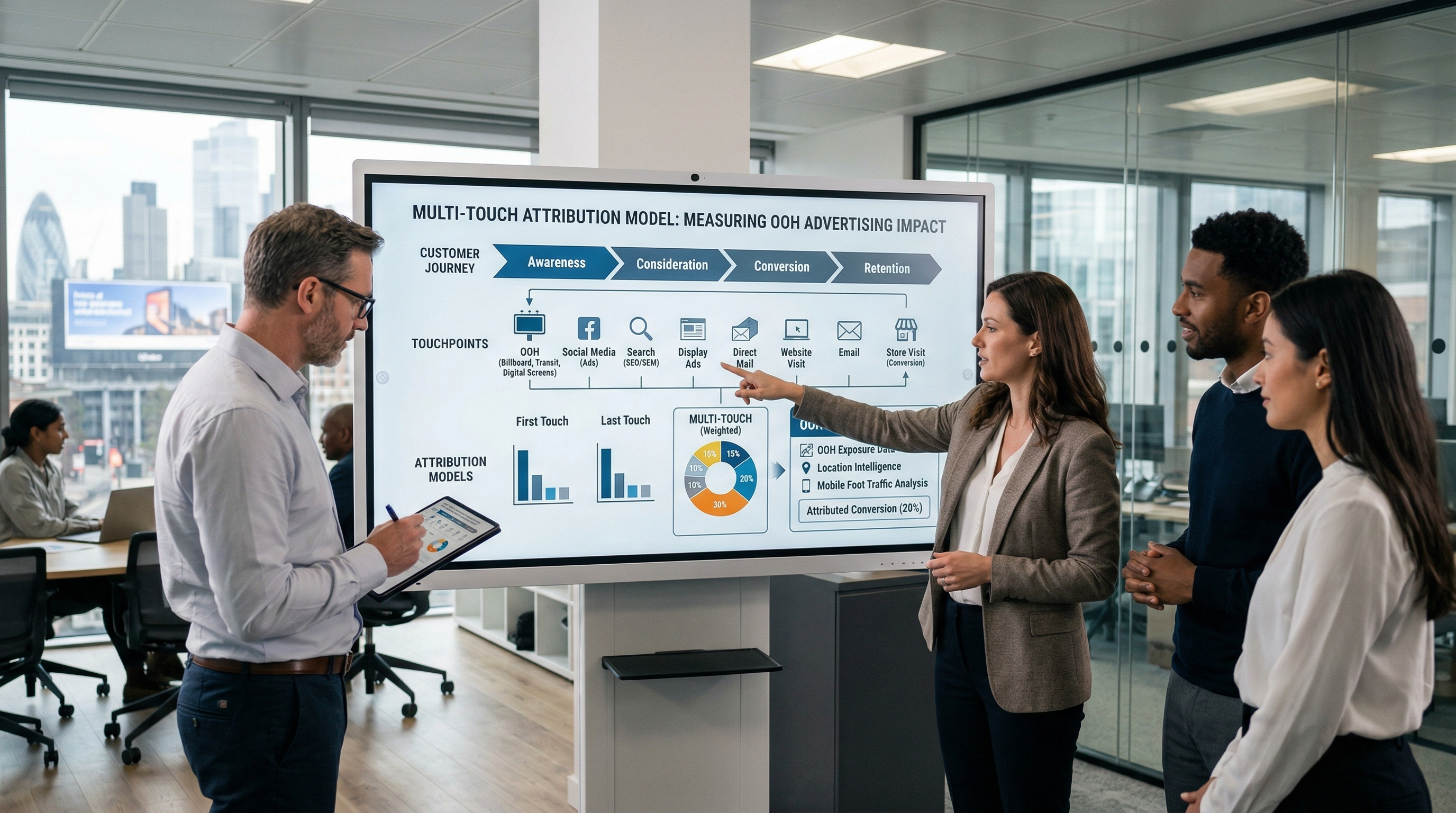
For decades, out-of-home advertising operated on faith. Media buyers trusted that billboards worked because, well, they could see them. But in an era where every digital channel offers granular attribution, the billboard industry faces an existential question: How do we prove our value?
The answer is transforming how OOH operates. Attribution and measurement—once considered impossible for physical advertising—are now not only achievable but increasingly expected by clients who demand the same accountability from their billboard spend that they get from Google and Meta.
This shift represents both a challenge and an opportunity for billboard agencies. Those who master OOH attribution will capture budget from competitors stuck in the "impressions and hope" era. Those who do not risk becoming irrelevant.
The Attribution Gap: Why OOH Lagged Behind
Digital advertising built its empire on measurability. Every click, view, and conversion is tracked, attributed, and optimized. OOH, by contrast, lived in a measurement black box. You knew how many people might have seen your billboard, but connecting that exposure to actual business outcomes was speculative at best.
This attribution gap created three critical problems for billboard agencies:
Budget vulnerability: When CFOs demand proof of performance, OOH budgets are often the first cut because they cannot be defended with hard data.
Lower rates: Media owners who cannot demonstrate value capture less revenue per impression than those who can prove ROI.
Missed optimization: Without performance data, campaigns run on intuition rather than insights, leaving money on the table.
The industry recognized this threat. Over the past five years, significant investments have flowed into solving the OOH attribution puzzle. The solutions that emerged are now mature enough to transform how agencies operate.
Modern OOH Attribution Methods
Today's billboard agencies have access to multiple attribution methodologies, each suited to different campaign types and client needs. Understanding these approaches is essential for any agency looking to compete in the modern landscape.
1. Mobile Location Data Attribution
The most widely adopted attribution method leverages the device everyone carries: smartphones. By analyzing anonymized mobile location data, agencies can determine if someone who was exposed to a billboard later visited the advertiser's location or took a desired action.
Here's how it works: When a consumer passes within viewing distance of a digital billboard, their mobile device ID is logged (anonymously and with privacy-compliant consent). This exposure is then matched against subsequent location data—did that same device visit the advertiser's store, dealership, or venue within a defined attribution window?
The technical infrastructure requires partnerships with location data providers like Foursquare, Placed (owned by Foursquare), or GroundTruth. These providers aggregate data from hundreds of mobile apps that users have opted into location tracking.
For a quick-service restaurant running billboard campaigns, this methodology can directly measure store visitation lift. A car dealership can track showroom visits. A concert promoter can measure ticket purchase behavior post-exposure.
The limitations are important to understand. Location data attribution works best for businesses with physical locations. E-commerce brands without brick-and-mortar presence need different approaches. Privacy regulations like GDPR and CCPA also require careful compliance, including proper consent management and data anonymization.
2. Conversion Zone Analysis
A more sophisticated extension of location data is conversion zone analysis. Rather than just measuring whether exposed users visited any location, agencies define specific "conversion zones"—geofenced areas around stores, dealerships, or venues—and measure visitation rates against control groups.
The methodology involves three steps:
First, define the target zone (the advertiser's location) and control zones (similar locations in markets where the campaign did not run).
Second, measure baseline visitation rates in all zones before the campaign launches to establish natural traffic patterns.
Third, measure visitation rates during and after the campaign, comparing lift in target zones versus control zones to isolate the campaign's impact.
This approach provides more rigorous attribution because it accounts for seasonal trends, local events, and other confounding variables that might inflate or deflate raw visitation numbers.
For example, a retail brand might see 15% more store visits in markets with billboard campaigns compared to control markets. This lift percentage, applied to the exposed audience, yields a concrete ROI calculation that satisfies even skeptical CFOs.
3. Website and App Lift Studies
Not every advertiser has physical locations. For e-commerce brands, SaaS companies, and service businesses, website and app lift studies provide viable attribution paths.
These studies measure whether billboard exposure correlates with increased website visits, app downloads, or specific online actions from users in exposed markets.
The methodology typically involves:
Exposed market analysis: Tracking web/app traffic from geographic areas where billboards ran versus control markets where they did not.
Time-series analysis: Measuring traffic before, during, and after campaigns to establish baseline patterns and isolate campaign impact.
Device graph matching: Advanced providers can match billboard exposure (captured via mobile data) to subsequent web visits from the same household IP or device graph.
Search lift measurement: Analyzing whether branded search queries increased in exposed markets, a strong proxy for awareness and intent.
A DTC e-commerce brand running billboards in Atlanta, for instance, might see 40% higher branded search volume and 25% more direct website traffic compared to similar markets without OOH presence. These metrics translate directly into attributable revenue.
4. Sales Lift and Offline Conversion Tracking
For ultimate attribution credibility, nothing beats connecting billboard exposure to actual sales data. While challenging due to data privacy and integration requirements, sales lift studies represent the gold standard.
Several approaches exist:
Credit card panel data: Partnerships with financial data providers can measure whether consumers exposed to billboards show increased spending with the advertised brand (at the category or merchant level).
Loyalty program integration: Retailers with robust loyalty programs can match member IDs exposed to billboards against purchase data, creating closed-loop attribution.
Point-of-sale matching: Some attribution providers can match mobile device IDs exposed to billboards against transactions at participating merchants (with proper consent).
Sales lift studies are most accessible for large advertisers with established measurement infrastructures. However, smaller agencies can partner with third-party measurement providers like Nielsen, Kantar, or specialized OOH attribution firms to access these capabilities.
5. Brand Lift and Awareness Studies
Not every billboard campaign aims for immediate conversions. Brand awareness, consideration, and favorability are valid objectives, especially for upper-funnel campaigns. Brand lift studies measure these intangible but valuable outcomes.
The standard methodology involves surveying two groups: those exposed to the billboard campaign and a demographically matched control group that was not exposed. The difference in brand metrics between groups represents the campaign's impact.
Key metrics typically include:
- Ad recall: Can exposed consumers remember seeing the billboard?
- Brand awareness: Do exposed consumers show higher unaided or aided awareness of the brand?
- Message association: Can they correctly identify the campaign message?
- Purchase intent: Are they more likely to consider purchasing from the brand?
- Brand favorability: Do they view the brand more positively?
Digital platforms have offered brand lift studies for years. OOH is now catching up, with providers like Kantar and Nielsen offering mobile-based survey methodologies that can measure billboard impact with statistical significance.
Building an OOH Attribution Strategy
Having access to attribution methods is one thing. Building a systematic strategy that satisfies clients and improves campaign performance is another. Here is how leading agencies approach attribution.
Step 1: Align Attribution to Campaign Objectives
Not every campaign needs the same measurement approach. The attribution strategy should flow from campaign objectives:
Awareness campaigns: Focus on reach, frequency, and brand lift studies. Website traffic lift and branded search volume provide secondary validation.
Consideration campaigns: Measure engagement metrics like QR code scans, augmented reality interactions, and website dwell time from exposed users.
Conversion campaigns: Prioritize foot traffic lift, sales lift, and direct response metrics. Location-based attribution is essential.
Retention campaigns: For existing customers, measure repeat visitation, loyalty program engagement, and customer lifetime value impact.
Before launching any campaign, agencies should document the primary objective, the key performance indicator that measures it, and the attribution methodology that will track it. This alignment prevents the common post-campaign scramble to find "something that worked."
Step 2: Establish Baselines and Control Groups
Attribution without context is meaningless. A 10% increase in store visits sounds good—but what if visits always rise 15% during that season? Or what if the control market saw 12% growth without any advertising?
Rigorous attribution requires:
Pre-campaign baselines: Measure all key metrics for at least four weeks before campaign launch to establish normal patterns.
Control markets: Run campaigns in test markets while holding out similar control markets. The difference between test and control represents true campaign impact.
Seasonal adjustments: Account for holidays, local events, weather patterns, and other variables that affect baseline behavior.
Statistical significance: Ensure sample sizes are large enough to draw confident conclusions. A 50% lift with 20 users is not meaningful; a 10% lift with 50,000 users is.
Step 3: Integrate Data Sources
Modern attribution rarely relies on a single methodology. The most sophisticated agencies combine multiple data sources to build comprehensive measurement frameworks.
A typical integration might include:
- Mobile location data for foot traffic measurement
- Google Analytics for website traffic analysis
- Search data from Google Trends or SEMrush for intent measurement
- Brand lift surveys for awareness impact
- Sales data (when available) for ultimate ROI validation
The key is building a measurement stack that can tell a coherent story: Billboards drove awareness, which increased search behavior, which generated website visits, which converted into store traffic and sales.
Data integration platforms and customer data platforms (CDPs) are making this easier. Agencies can now pipe attribution data from multiple sources into unified dashboards that show campaign performance across the entire funnel.
Step 4: Report Actionable Insights
Data without insights is just noise. The final step in attribution excellence is translating measurement into actionable recommendations.
This means going beyond vanity metrics to deliver:
Creative insights: Which billboard creative drove the highest engagement? Did dynamic creative optimization (changing messages based on time, weather, or audience) improve results?
Location insights: Which markets, neighborhoods, or specific billboard locations delivered the best ROI? Should future campaigns reallocate budget to higher-performing inventory?
Audience insights: Which demographic segments responded best to the campaign? Did the exposed audience match the intended target?
Timing insights: Did certain days of week, times of day, or seasonal periods drive better results? Should flighting strategies adjust?
Cross-channel insights: How did OOH complement other channels? Did billboard exposure improve digital ad performance through increased brand awareness?
The Technology Stack for OOH Attribution
Implementing attribution requires investments in technology and partnerships. Here are the key components of a modern OOH attribution stack.
Data Management Platforms (DMPs)
DMPs aggregate and normalize data from multiple sources, creating unified audience profiles that enable attribution matching. For OOH, this means connecting exposure data (who saw the billboard) with outcome data (who took action).
Leading DMPs with OOH capabilities include:
- Lotame: Strong audience segmentation and cross-device matching
- Oracle BlueKai: Extensive third-party data integrations
- Adobe Audience Manager: Enterprise-grade with strong analytics
- Salesforce CDP: Good for advertisers already in Salesforce ecosystem
Location Data Providers
Location intelligence is the foundation of modern OOH attribution. Key providers include:
- Foursquare/Placed: The industry leader, with extensive app partnerships and robust methodology
- GroundTruth: Strong in retail and QSR attribution
- Cuebiq: Good for foot traffic and competitive intelligence
- Verizon Media/Verizon Ads: Carrier-level data with high accuracy
Attribution and Analytics Platforms
Specialized platforms offer end-to-end OOH attribution:
- Cuebiq: Location intelligence and attribution platform
- NinthDecimal: Cross-channel attribution with strong OOH capabilities
- PlaceIQ: Location-based audience and attribution insights
- Kantar: Brand lift and effectiveness studies
- Nielsen: Cross-media measurement and sales lift studies
Programmatic Platforms with Built-in Attribution
Programmatic DOOH platforms increasingly offer native attribution:
- Vistar Media: Location-based attribution integrated with media buying
- Broadsign: Foot traffic and brand lift measurement
- AdGrid: Inventory management with integrated performance tracking
- Place Exchange: Programmatic platform with attribution capabilities
Privacy and Compliance Considerations
OOH attribution operates in an increasingly regulated environment. Agencies must navigate:
GDPR (Europe) and CCPA (California): Require explicit consent for location tracking and data collection. Attribution providers must offer opt-out mechanisms and data deletion capabilities.
IDFA and MAID restrictions: Apple's App Tracking Transparency and similar initiatives have reduced mobile ID availability. Attribution providers are adapting by using probabilistic matching and contextual signals rather than deterministic device matching.
Data anonymization: Most attribution uses aggregated, anonymized data rather than individual tracking. Understanding exactly how data is anonymized—and being able to explain this to clients—is essential.
Industry self-regulation: The Digital Advertising Alliance (DAA) and Network Advertising Initiative (NAI) provide frameworks for responsible data use. Partnering with compliant providers reduces regulatory risk.
The privacy landscape continues evolving. Forward-thinking agencies build attribution strategies that are effective and privacy-respecting, anticipating regulation rather than reacting to it.
The Future of OOH Attribution
The attribution capabilities available today would have seemed like science fiction a decade ago. The trajectory suggests even more transformation ahead.
Camera-based measurement: Computer vision technology can count actual viewers (not just traffic) and even estimate attention and engagement. Privacy concerns have slowed adoption, but anonymized, on-device processing may enable broader deployment.
Connected car data: As vehicles become data platforms, they offer new attribution pathways. Did a driver who passed a car dealership billboard visit that dealership within 30 days? Connected car data can answer that question.
Augmented reality integration: AR-enabled billboards can create immersive experiences while simultaneously measuring engagement depth. How long did users interact? What features did they explore? This behavioral data enriches attribution models.
AI-powered predictive attribution: Machine learning models can predict campaign outcomes based on historical patterns, allowing optimization before campaigns even launch. Post-campaign, AI can isolate the incremental impact of OOH from other variables with increasing precision.
Unified cross-channel attribution: The holy grail is a single attribution model that accurately assigns credit across all channels—OOH, digital, TV, radio, and print. Advances in identity resolution and data integration are bringing this closer to reality.
Conclusion
OOH attribution has evolved from impossible to essential. Billboard agencies that master measurement will capture budget, command premium rates, and deliver superior client results. Those that do not will find themselves competing on price in a race to the bottom.
The good news is that attribution infrastructure is more accessible than ever. You do not need a data science team or seven-figure technology investments to get started. Begin with simple location-based attribution for a single client. Prove the concept. Build the case study. Expand from there.
The billboard industry spent decades asking clients to trust that OOH works. Today, we can prove it. The agencies that embrace this shift will define the next era of out-of-home advertising.
Key Takeaways
Attribution is now table stakes: Clients expect OOH to demonstrate ROI with the same rigor as digital channels.
Multiple methodologies exist: Location data, website lift, sales data, and brand studies each suit different campaign objectives.
Control groups are essential: True attribution requires comparison against markets or time periods without advertising.
Technology enables scale: DMPs, location providers, and programmatic platforms make sophisticated attribution accessible to mid-size agencies.
Privacy compliance is mandatory: Build attribution strategies that respect consumer privacy and anticipate regulation.
The future is AI-powered: Predictive attribution, camera-based measurement, and cross-channel integration are transforming what is possible.
Ready to add attribution to your OOH offerings? Start with one methodology, one client, and one campaign. The data you generate will transform how you sell, plan, and optimize billboard advertising.
Ready to Modernize Your OOH Operations?
Join the leading OOH media owners who use AdGrid to automate their quoting, manage inventory, and grow their revenue.