
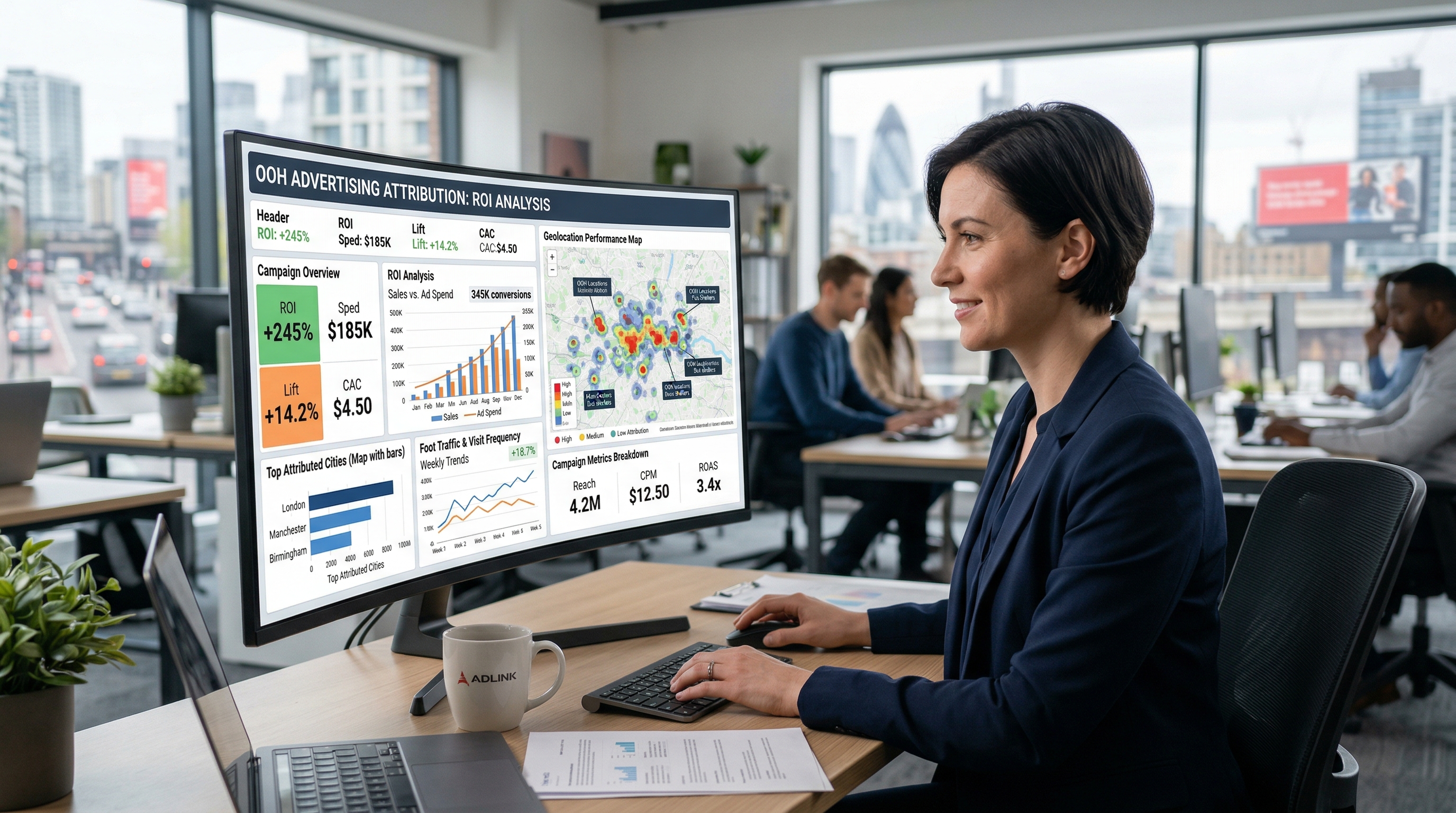
For decades, the out-of-home industry operated on faith. Media owners sold impressions based on traffic counts and hoped-for outcomes. Agencies presented bold creative concepts and prayed their clients would see results. And advertisers—who demanded precise return-on-ad-spend calculations from digital channels—somehow accepted that billboards were different, that their impact was ineffable, impossible to measure with the same rigor as a Facebook campaign.
That era is ending.
Today, OOH attribution has evolved from a pipe dream into a sophisticated discipline. Using mobile location data, foot traffic analysis, brand lift studies, and multi-touch attribution models, agencies can now prove—with hard numbers—the impact of their billboard campaigns. The question is no longer whether OOH works, but how agencies can leverage measurement to win more business, justify premium pricing, and build lasting client relationships.
This guide will walk you through the modern OOH measurement landscape, from basic metrics to advanced attribution techniques, giving you the tools to answer that dreaded client question: "How do we know this is working?"
The Measurement Revolution: Why Now?
OOH has always been measurable in theory. Traffic studies told us how many eyeballs passed a billboard. Sales data could be correlated with campaign timing. But these methods were imprecise, lagging, and difficult to connect directly to specific campaigns.
Three forces have changed the equation:
Ubiquitous Mobile Devices: With smartphones in nearly every pocket, we now have a proxy for human movement through the physical world. Mobile location data—aggregated and anonymized—allows us to understand not just how many people pass a billboard, but who they are, where else they go, and what actions they take after exposure.
Privacy-First Measurement: As cookies crumble and device-level tracking faces regulatory headwinds, OOH measurement offers a privacy-compliant alternative. It relies on aggregated patterns rather than individual surveillance, making it more resilient to the privacy changes disrupting digital advertising.
Client Expectations: Modern marketers are data-driven. They have grown accustomed to closed-loop measurement in digital channels, and they are bringing those expectations to OOH. Agencies that cannot speak the language of attribution risk being sidelined in media planning conversations.
The Foundation: Understanding Geopath and OOH Ratings
Before diving into campaign-specific attribution, you need to understand the baseline measurement infrastructure that underpins the entire industry. Geopath is the nonprofit organization that provides standardized audience measurement for OOH in the United States. Think of Geopath as the Nielsen of billboards—their data is the currency used to plan, buy, and sell OOH advertising.
Geopath's methodology combines several data sources:
Traffic Counts: For roadside inventory, Geopath uses GPS data, traffic sensors, and manual counts to understand how many vehicles pass each billboard location.
Audience Composition: Using mobile location data, Geopath can estimate the demographic makeup of audiences at specific locations—age, gender, income, and other characteristics.
Likelihood to See: Not everyone who passes a billboard actually looks at it. Geopath applies visibility adjustment factors based on road geometry, billboard position, and other variables to estimate actual impressions.
The result is a standardized rating system that allows buyers to compare inventory across markets and formats. When you tell a client that a billboard delivers "125,000 weekly impressions," that number comes from Geopath.
However, Geopath provides planning data, not campaign attribution. It tells you the potential audience for a location, but not whether your specific creative drove results. For that, you need additional measurement tools.
Foot Traffic Attribution: The New Gold Standard
The most significant advancement in OOH measurement is the ability to track whether exposed audiences actually visit a physical location—whether that is a retail store, a restaurant, a car dealership, or any other point of interest.
Here is how it works:
Control vs. Exposed Analysis: A measurement provider analyzes mobile location data to identify two groups: people who were exposed to your billboard (the exposed group) and demographically similar people who were not (the control group). Both groups are tracked to see if they visit the advertiser's location.
Lift Calculation: If 5% of the control group visits the store, but 8% of the exposed group visits, that is a 60% lift in foot traffic attributable to the OOH campaign.
Dwell Time and Behavior: Advanced analysis can show not just whether people visited, but how long they stayed, whether they made a purchase (if POS data is integrated), and whether they returned for repeat visits.
Major measurement providers like Placed (now part of Foursquare), NinthDecimal, and Cuebiq offer foot traffic attribution services. Some are integrated directly into DSPs for programmatic campaigns, while others require custom study setup for traditional buys.
For agencies, foot traffic studies are powerful sales tools. Being able to tell a client: "Your billboard campaign drove 47,000 incremental store visits at a cost per visit of $3.20" transforms the conversation from abstract brand awareness to concrete business outcomes.
Brand Lift Studies: Measuring the Upper Funnel
Not every OOH campaign is designed to drive immediate foot traffic. Many are focused on awareness, consideration, or brand perception—goals that require different measurement approaches.
Brand lift studies use survey methodology to measure changes in consumer attitudes and behaviors after OOH exposure.
How They Work:
Survey panels are recruited from mobile users who have either been exposed to your OOH campaign or are part of a matched control group. Both groups answer questions about brand awareness, purchase intent, message recall, and other metrics. The difference between exposed and control responses constitutes the "lift" attributable to your campaign.
Key Metrics:
- Ad Recall: Did exposed audiences remember seeing the ad?
- Awareness: Did the campaign increase unaided or aided awareness of the brand?
- Purchase Intent: Are exposed consumers more likely to consider purchasing?
- Favorability: Did perceptions of the brand improve?
Providers like Kantar, Nielsen, and Lucid offer brand lift measurement for OOH. While these studies require additional investment beyond the media buy itself, they provide invaluable data for proving campaign effectiveness and optimizing creative.
For agencies, brand lift studies solve a persistent challenge: demonstrating the value of OOH in multi-channel campaigns where the billboard may not be the final touchpoint before conversion. They show that even if OOH does not directly drive store visits, it is moving consumers down the funnel, making your other marketing more effective.
Multi-Touch Attribution: OOH in the Digital Mix
The most sophisticated marketers are moving beyond single-channel measurement to understand how OOH interacts with other media channels. Multi-touch attribution (MTA) models attempt to assign credit to each touchpoint in a consumer's journey.
The Challenge:
Traditional MTA relies on digital signals—clicks, impressions, conversions. OOH does not generate clicks. Someone sees a billboard and later visits a website, but there is no cookie trail connecting the two events.
The Solution:
Advanced MTA providers are now integrating OOH exposure data into their models using mobile location data. They can identify when a device was exposed to a specific billboard, then track subsequent digital behavior—website visits, app downloads, search queries, and conversions.
This allows you to answer complex questions:
- Does OOH exposure make consumers more likely to click on subsequent digital ads?
- How does the sequence of exposure affect outcomes? (OOH first vs. digital first)
- What is the optimal frequency of OOH exposure before it becomes subject to diminishing returns?
For agencies selling integrated campaigns, MTA capability is a differentiator. It positions OOH not as a siloed tactic, but as a critical component of holistic media strategies that work together to drive results.
Online Lift: The Digital Halo Effect
One of the most compelling findings in recent OOH research is the "digital halo"—the measurable increase in online activity that follows OOH exposure. Studies consistently show that OOH campaigns drive significant increases in:
Search Activity: Consumers exposed to billboards are more likely to search for the brand online. One study found that OOH campaigns drive an average 17% increase in incremental search activity.
Website Traffic: Direct website visits often spike during OOH campaigns, particularly for brands with strong call-to-action messaging.
Social Engagement: Mention monitoring can track increases in social media conversation about the brand during campaign periods.
Mobile App Downloads: App install campaigns see measurable lift when supported by OOH.
For agencies, the digital halo is a crucial narrative tool. It reframes OOH not as competing with digital budgets, but as amplifying them. Every dollar spent on billboards generates additional digital engagement that improves the efficiency of search, social, and display campaigns.
Sales Lift and Conversion Tracking
Ultimately, most advertisers care about one thing: did the campaign drive sales? While OOH measurement has traditionally stopped at awareness and consideration, new techniques allow for more direct sales attribution.
POS Integration: For retail advertisers with loyalty programs or email capture at point-of-sale, exposed audiences can be matched against transaction data to calculate sales lift.
Promotional Codes: Unique promo codes displayed on OOH creative allow direct tracking of conversions attributable to the campaign.
QR Codes and NFC: While still uncommon on billboards, QR codes and near-field communication technology can bridge the gap between physical exposure and digital action.
Econometric Modeling: For larger campaigns, statistical modeling can isolate the impact of OOH on overall sales, controlling for other marketing activities and external factors.
These approaches require more setup than simple foot traffic studies, but they provide the holy grail of marketing measurement: return on ad spend. Being able to tell a client that their $50,000 billboard campaign generated $300,000 in incremental revenue makes renewals much easier.
Implementing Measurement: A Practical Framework
Knowing what can be measured is different from actually measuring it. Here is a practical framework for integrating attribution into your OOH campaigns:
Before the Campaign: Set Up for Success
Define Clear Objectives: Is this campaign about awareness, foot traffic, or online engagement? The measurement approach should align with the campaign goal.
Establish Baselines: What are current awareness levels, foot traffic patterns, or web traffic volumes? You cannot measure lift without knowing where you started.
Choose Your Partners: Determine which measurement providers you will work with. Some are integrated into programmatic platforms; others require separate contracts.
Plan Creative for Measurement: Ensure creative includes clear calls-to-action that can be tracked—whether that is unique URLs, promo codes, or branded hashtags.
During the Campaign: Monitor and Optimize
Real-Time Tracking: For digital OOH, some metrics—like website traffic spikes—can be monitored in real-time, allowing for mid-flight optimization.
Weather and Contextual Adjustments: If you have access to dynamic creative, use measurement data to optimize. If foot traffic is higher on rainy days, adjust messaging accordingly.
After the Campaign: Report and Learn
Comprehensive Reporting: Present results in the context of client objectives. Awareness campaigns get brand lift reports; retail campaigns get foot traffic analysis.
Cross-Channel Analysis: If possible, show how OOH contributed to overall marketing effectiveness, not just its isolated impact.
Optimization Insights: Use measurement data to inform future campaigns. Which locations drove the highest conversion rates? Which creative performed best?
Addressing Common Objections
As you introduce measurement to clients, you will encounter skepticism. Here is how to address common concerns:
"Measurement Is Too Expensive"
Measurement does add cost—typically 5-15% of media spend for comprehensive studies. But consider the alternative: running campaigns blindly, unable to prove value, and watching budget shift to measurable digital channels.
Frame measurement as an investment in future business. The insights gained from measuring one campaign improve the effectiveness of every subsequent campaign. And the ability to show concrete ROI makes renewals far more likely.
"The Data Is Not Perfect"
It is not. Mobile location data has limitations—privacy settings, device sharing, and opt-out rates create gaps. Control groups are never perfectly matched. Correlation does not always equal causation.
Acknowledge these limitations upfront, but put them in context. Digital attribution has similar challenges—bots, viewability issues, cross-device tracking failures. Perfect measurement does not exist in any channel. What OOH attribution offers is directional confidence and comparative insight that was impossible just years ago.
"Our Clients Do Not Ask for This"
They will. As measurement becomes standard practice, clients will begin expecting it. Agencies that proactively bring measurement capabilities to the table will win against those who wait to be asked.
Position yourself as the forward-thinking partner who does not just place media, but proves its value. That is a powerful competitive differentiator.
The Future of OOH Measurement
The measurement capabilities available today are just the beginning. Several trends will shape the future:
Retail Media Integration: As retailers build their own OOH networks, they are bringing closed-loop measurement—directly connecting ad exposure to purchase data. This will raise expectations for all OOH measurement.
AI and Predictive Modeling: Machine learning models will get better at predicting OOH impact before campaigns run, allowing for better planning and optimization.
Standardization: Industry groups are working to standardize measurement methodologies, making it easier to compare results across providers and campaigns.
Convergence with Programmatic: As more OOH inventory becomes programmatically traded, measurement will become automated and integrated into buying platforms, reducing cost and friction.
Conclusion
OOH attribution has transitioned from a nice-to-have to a must-have. Agencies that master measurement will thrive in an increasingly data-driven marketing landscape. Those that do not will find themselves defending budget allocations against competitors who can prove their worth.
The good news is that you do not need to become a data science expert overnight. Start with simple foot traffic studies for retail clients. Add brand lift measurement for awareness campaigns. Gradually build your measurement capabilities as you learn what works for your clients and your business.
The billboard industry has spent decades asking clients to trust that OOH works. Now we can prove it. That is a powerful shift—and one that will reshape how OOH is planned, bought, and sold for years to come.
Ready to Modernize Your OOH Operations?
Join the leading OOH media owners who use AdGrid to automate their quoting, manage inventory, and grow their revenue.