
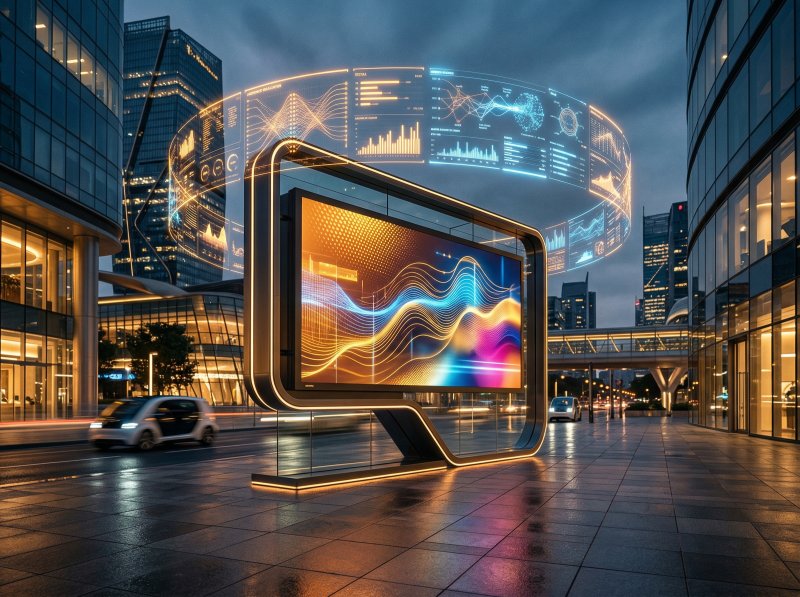
OOH in 2026: The Data Revolution Turning Outdoor Advertising Into a Performance Channel
For years, out-of-home advertising was the channel you bought when you wanted reach but could not prove much else. You booked a billboard, hoped the right people drove past, and crossed your fingers. That version of OOH is gone. In 2026, the industry has undergone a fundamental transformation, powered by programmatic buying, real-time audience intelligence, and attribution technology that finally closes the loop between a billboard and a purchase.
Total OOH revenue surpassed $9 billion last year, and digital formats now account for the majority of that growth. DOOH specifically is projected to represent 45.2% of total OOH ad spend by 2028, up from just 22.0% in 2016, according to eMarketer. Programmatic DOOH spend is expected to reach into the billions in 2026 alone. The channel has crossed a threshold. It is no longer a brand-awareness fallback. It is a performance channel with the reach of a broadcast medium and the precision of a digital buy.
Here is what that shift looks like in practice, and why it matters for marketers building omnichannel strategies today.
From Place-first to Audience-first: The Liquid Audience Shift
The most consequential change in OOH over the past two years is not technological. It is philosophical. The industry has stopped asking "Where is this screen?" and started asking "Who is passing this screen, and what are they inclined to do?"
In advanced markets, over 70% of DOOH campaigns now begin with audience segments rather than static location maps. Marketers define their target by commuting patterns, lifestyle tribes, tourism surges, income clusters, or purchase intent signals, and then let data identify which screens that audience frequents. The result is buying behavior that looks a lot more like programmatic display than traditional outdoor.
This is what industry observers call "liquid audiences," and it represents a genuine rethinking of what OOH is for. A brand no longer needs a flagship location on Times Square if its target customer is a suburban parent who commutes through a specific mall corridor on weekday mornings. Audience intelligence makes that kind of surgical precision possible for the first time.
The implications go further. As AI agents increasingly shape consumer decision-making, OOH planners are starting to model "intention-led movement patterns" rather than purely geographic ones. The question becomes not just "which screens" but "which moments of intent" can be intercepted in the physical world. That is a fundamentally different planning paradigm, and it is only possible because the data now exists to execute it.
Programmatic DOOH 2.0: From Novelty to Default
Programmatic buying in display advertising stopped being innovative years ago. It became the baseline. DOOH is following the same trajectory, and 2026 is the year the transition completes.
The first wave of programmatic DOOH was largely about automating the booking process, moving transactions that once required phone calls and PDF insertion orders into DSPs and SSPs. Useful, but not transformative. The second wave is different. It is about reactive, trigger-based execution at scale.
AI-driven buying platforms can now monitor real-world signals and adjust OOH creative in milliseconds. If a retail brand sees foot traffic drop at a specific mall location, the system can automatically bid on and activate ads on digital screens within a two-mile radius. If weather data shows rain approaching, a footwear brand can switch its creative from open-toe sandals to waterproof boots before the clouds arrive. If a local sports team wins a game that evening, victory merchandise can appear on screens in the surrounding neighborhood within an hour.
Programmatic DOOH is projected to exceed $33.3 billion globally by 2026, according to Research and Markets. That figure reflects not just more buying activity but a qualitative change in what the medium can do. The creative is dynamic. The targeting is behavioral. The optimization is continuous. For the first time, OOH behaves like the rest of the digital media stack.
This has a practical consequence for marketers who plan across channels. OOH can now be planned alongside CTV, mobile, and online video using familiar workflows, shared KPIs, and consistent reporting. The friction that once made cross-channel OOH integration painfully awkward is disappearing as buying platforms mature.
Dynamic Creative Optimization: Real-time Context at Scale
Dynamic creative optimization, or DCO, has been talked about in OOH for years. In 2026, it is finally operational at scale, and the results are making static creative look obsolete by comparison.
DCO in DOOH uses data signals like location, time of day, weather conditions, product availability, and even social media trending topics to adapt what appears on a screen in real time. A convenience store chain can show different creative based on whether it is Monday morning commute or Saturday afternoon. A QSR brand can promote breakfast items before 10 AM and lunch items after. A streaming service can display different content based on whether the screen is near a gym, a university, or a residential area.
The distinction matters because it changes how OOH earns attention. Static creative is designed for a generic audience. Dynamic creative is designed for a moment. And moments are where purchase decisions actually happen.
AI is playing an increasingly active role in the creative process itself, accelerating ideation and generating creative variations at a scale that would be impossible for a human design team alone. The practical result is that brands can run always-on, data-driven DOOH campaigns that continuously refine their creative based on performance signals. This is not theoretical. The infrastructure for this exists now, and the cost of entry has dropped significantly as DSPs, SSPs, and media owners have invested in making dynamic execution more accessible.
Retail Media and the Path to Purchase
One of the most underappreciated developments in OOH right now is how deeply it is becoming integrated with retail media networks. In-store digital screens are no longer an afterthought. They are a growing revenue channel for retailers and a high-value inventory source for brands trying to reach shoppers at the moment of decision.
Digital screens at store entrances, along aisles, and near checkout zones give brands access to consumers when purchase intent is highest. The targeting is not based on a behavioral model or a probabilistic audience segment. It is based on the simple fact that someone is standing in the beverage aisle right now. Retailer first-party data ties exposure to actual sales outcomes in a way that traditional OOH measurement never could, and that changes the unit economics of the channel significantly.
The DOOH category is expected to gain over 40% in revenue by 2027, with a meaningful portion of that growth coming from retail-integrated experiences, according to Caretta Research. Brands that understand this are no longer treating OOH as an off-site awareness play. They are treating it as part of a closed-loop retail media network that includes in-store screens, off-site digital, and mobile retargeting.
This convergence is also changing how media agencies structure their planning. OOH used to be booked by an out-of-home specialist in a separate system with separate metrics. In 2026, it is increasingly being planned by performance marketers who want it to deliver store visits and sales, not just impressions. That shift in who owns the channel is producing a corresponding shift in how campaigns are measured and optimized.
Accountability Finally Arrives
For decades, the knock on OOH was that it could not be measured. Brands paid for reach and accepted the uncertainty. The emergence of mobile location data, cross-platform attribution, and attention metrics has changed that conversation entirely.
Modern OOH campaigns can now demonstrate not just how many people saw an ad but what they did afterward. Did they visit the store? Did they search for the brand? Did they convert within a defined attribution window? These questions used to be unanswerable for outdoor. They are now table stakes for any campaign worth running.
The technology is not perfect. Attribution always involves some degree of inference, and the gold standard of a randomized control group remains difficult to implement in OOH. But the gap between what OOH can prove and what other digital channels can prove has narrowed dramatically. Marketers who once refused to allocate budget to OOH because they could not link it to business outcomes are now allocating significantly more, because they finally can.
This shift is most advanced in North America, where CMOs have driven an accountability-first culture across the media mix. In the US and Canada, OOH is now cross-channel by default, tied to business outcomes, and evaluated on dashboards rather than campaign recaps. The proof-first mindset is spreading globally, with EMEA brands focusing on compliance and sustainability alongside measurement, and APAC markets piloting increasingly sophisticated attribution frameworks.
The Sustainability Question Is No Longer Optional
Here is a fact that surprises many people: traditional OOH formats are up to 336% more carbon-efficient than programmatic video, according to research from Billups and Cedara, published via WorldOOH.org. The UK OOH industry accounts for just 3.3% of advertising's total power consumption and under 3.5% of its carbon footprint, according to Outsmart and KPMG.
That context matters because sustainability has become a real business consideration in OOH, not a PR exercise. Across Europe and Asia, media owners are scoring screens for energy use, providing real-time emissions dashboards to buyers, and defaulting to green infrastructure where possible. Smart cities are beginning to enforce energy caps on DOOH installations, and solar-powered builds are moving from pilot programs to standard deployments in some markets.
For brands, this creates a competitive dynamic that did not exist three years ago. Carbon visibility is becoming a factor in media planning, and OOH is emerging as one of the more defensible channels from a sustainability standpoint, particularly when compared to high-energy digital video formats. Brands that want to demonstrate environmental responsibility in their media mix have a credible argument for OOH that did not exist before the data existed to support it.
What This Means for Your Media Strategy
The changes reshaping OOH in 2026 are not incremental. They represent a fundamental reconception of what the medium is and what it can do. The brands that are winning with OOH right now are the ones treating it as part of the performance stack, not as a separate brand-awareness budget line.
That means planning with audience data from the start. It means buying programmatically so you can optimize in real time. It means thinking about creative as something dynamic that responds to context, not something that is set and forgotten for the duration of a campaign. It means measuring foot traffic, search uplift, and sales attribution alongside impression counts. And it means understanding that OOH now integrates with retail media, CTV, and mobile in ways that make cross-channel planning not just possible but essential.
The analog giant has woken up. The question is whether your media strategy has caught up.
Ready to Modernize Your OOH Operations?
Join the leading OOH media owners who use AdGrid to automate their quoting, manage inventory, and grow their revenue.