
The Rise of Liquid Audiences: How DOOH Is Becoming the Smartest Channel in Your Media Mix
For decades, out-of-home (OOH) advertising was the medium marketers loved to underestimate. The billboard on the highway, the transit poster at the station — impressions in the real world, but outcomes in the dark. You bought placement, crossed your fingers, and hoped brand lift surveys would justify the spend.
That era is officially over.
In 2026, OOH — and its digital sibling DOOH (digital out-of-home) — has undergone a transformation so profound that the question is no longer whether it belongs in your media mix, but whether your media mix can afford to function without it. The channel has quietly become one of the most sophisticated, data-rich, and measurable platforms available to marketers. And most brands are only just catching on.
From Places to People: The Liquid Audience Revolution
The most fundamental shift in DOOH today is not technological — it is philosophical. For most of its history, OOH planning began with inventory: a billboard here, a transit shelter there. You would build a media plan around where screens existed, then try to convince yourself it was an audience strategy.
That logic is now inverted.
In 2026, the most advanced DOOH campaigns begin with a completely different question: Who are we trying to reach, where are they in motion, and what do we want them to do next? The screen is the last thing selected, not the first.
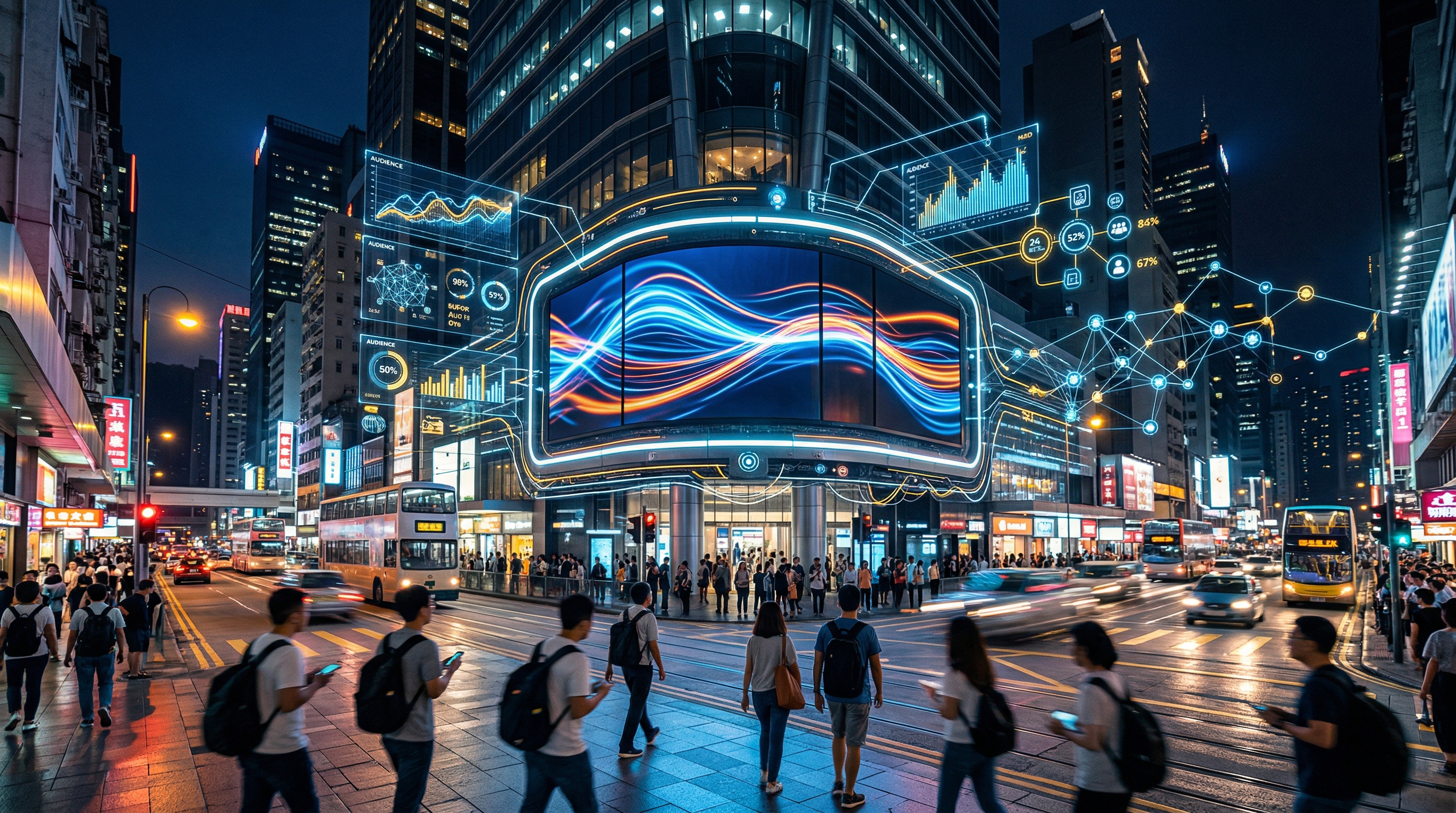
This is what industry leaders are calling the liquid audience model — the idea that people do not move in predictable, static patterns anymore. They flow between commute routes, retail environments, entertainment districts, and digital touchpoints throughout the day, influenced by real-time conditions, AI-powered recommendations, and cultural moments. Traditional place-based OOH planning could never account for this fluidity. Audience-first DOOH can.
In advanced markets, over 70% of DOOH campaigns now start with audience segments rather than static locations. Rather than buying the billboard at the junction, brands buy access to people — defined by behavioral clusters, movement patterns, purchase intent signals, and lifestyle tribes — as they move through the physical world.
Programmatic DOOH: From Experiment to Expectation
Programmatic display advertising has dominated the digital world for over a decade. The idea was simple: automate the buying process, apply audience data, and deliver the right message to the right person at the right time. OOH, with its static contracts and manual insertion orders, seemed a world away from that reality.
The gap has now closed.
Programmatic DOOH (pDOOH) has moved from a bleeding-edge experiment to a mainstream capability. In 2026, it is projected to exceed $33.3 billion globally, and the channel is no longer treated as a separate discipline requiring its own workflow, team, and vocabulary. Instead, it is being absorbed into unified programmatic platforms alongside CTV, mobile, and online video — using shared KPIs, consistent audience definitions, and familiar reporting structures.
Three programmatic buying models have emerged as the standard toolkit for DOOH planners:
Real-Time Bidding (RTB): The open-market model where DOOH inventory is bought and sold in real time through automated exchanges. Best for flexible, data-driven campaigns where audience targeting and timing matter more than guaranteed placement.
Private Marketplace Deals (PMPs): Curated pools of premium inventory offered to select buyers at negotiated rates. Balances the precision of programmatic with the quality assurance of direct deals.
Programmatic Guaranteed (PG): The closest analog to traditional direct-sold OOH, where inventory is reserved in advance at fixed rates through automated booking. Provides certainty and priority access while retaining the efficiencies of programmatic workflow.
Automated In-Advance Booking: Perhaps the most significant evolution of 2026, this model combines the certainty of direct deals with the efficiency of programmatic infrastructure. Rather than fighting over real-time scraps of high-demand inventory during tentpole moments, advertisers can lock in premium placements well in advance — then let dynamic creative optimization do the rest.
Dynamic Creative Optimization: AI Meets the Physical World
One of the most exciting frontiers in DOOH is dynamic creative optimization (DCO) — the ability to adapt the actual advertisement in real time, based on context signals like location, time of day, weather, product availability, and audience composition.
Imagine a beverage brand whose digital billboard changes its creative based on the temperature outside — promoting iced drinks when it is 85°F, hot beverages when it is 45°F. Or a retail brand whose in-store DOOH screens display different hero products based on the time of day. Or an automotive advertiser whose DOOH creative shifts based on proximity to a dealership.
AI is accelerating DCO is capabilities in two distinct ways. First, it is making the creative production process faster and more scalable. Rather than manually producing dozens of creative variations for different contexts, AI generation tools can produce, test, and iterate on dynamic DOOH creative at a pace that was previously impossible. Second, AI-driven contextual intelligence is moving beyond simple rules-based triggers toward genuinely predictive models that anticipate audience intent based on behavioral sequences.
The Measurement Revolution: Accountability Arrives in the Physical World
For years, OOH is Achilles heel was attribution. You could count impressions, estimate reach, and point to brand lift surveys. But you could not tell a client that a specific billboard drove 127 store visits on a Tuesday afternoon. Not credibly.
2026 is the year that changes.
The convergence of mobile location data, advanced attribution modeling, and cross-platform measurement has given DOOH a direct line to business outcomes. When a consumer sees a DOOH impression and later visits a store, searches for a brand online, or makes a purchase, modern attribution platforms can connect those dots — not perfectly, but well enough to make DOOH a defensible, optimizable channel rather than a brand-awareness gamble.
The metrics that matter are evolving accordingly. Beyond traditional reach and frequency, DOOH planners in 2026 are increasingly being asked to demonstrate:
- Visitation lift: Did people exposed to the DOOH campaign visit the brand is location more often than a control group?
- Dwell time and interaction: How long are people engaging with the screen?
- Cross-channel attribution: Did the DOOH impression act as a catalyst for subsequent digital engagement?
- Sales impact: When DOOH exposure data is matched with point-of-sale data, what is the measurable effect on purchasing behavior?
The proof-first era has arrived in North America especially, where CMOs are demanding live dashboards rather than post-campaign decks.
Retail Media: OOH Moves to the Moment of Decision
One of the most underappreciated growth vectors for DOOH in 2026 is its convergence with retail media networks. Retail environments are where purchase decisions are made. A consumer standing in an aisle, considering Product A versus Product B, is at peak purchase intent. DOOH screens positioned at entrances, in aisles, near high-intent zones like pharmacies and checkout areas, can reach consumers at precisely the right moment — with messaging that can adapt based on store context, time of day, or inventory levels.
The real power comes from data integration. Retailers possess rich first-party purchase data — what customers buy, when they buy it, how often, and at what price point. When this purchase data is connected to DOOH exposure data, brands gain an unprecedented level of insight into the actual return on their outdoor investment. This is closed-loop attribution that digital marketers have had for years — finally arriving in the physical world.
Sustainability: The Competitive Advantage No One Expected
In an era where every brand is racing to demonstrate environmental responsibility, DOOH has emerged with an unexpected advantage: it may be the most carbon-efficient advertising medium available.
Recent research from Billups and Cedara reveals that traditional OOH formats are up to 336% more carbon-efficient than programmatic video. The OOH industry in the UK accounts for just 3.3% of advertising is total power consumption and under 3.5% of its carbon footprint. Solar-powered screens, energy-capped digital displays, and carbon dashboards are becoming standard parts of the pitch — especially in markets like the UK, Netherlands, Australia, and Singapore.
For brands with genuine Net Zero commitments, this sustainability story is significant — and one that is rarely being told with the conviction it deserves.
Global Events as Catalysts: The 2026 Tentpole Moment
The 2026 FIFA World Cup and the 2026 Olympic Games are creating rare concentrations of collective attention across multiple time zones. But the most sophisticated DOOH strategies are not treating these events as single-day activations. They are building extended campaign arcs — pre-event anticipation campaigns, peak-moment intensity plays, and post-event follow-through — across multiple channels, with OOH serving as the physical-world anchor for digital narratives.
High-impact OOH inventory near transit hubs, fan zones, retail corridors, and entertainment districts is being secured months in advance. A World Cup match result becomes a creative trigger. A medal tally becomes a localized messaging opportunity. The physical world becomes a live canvas.
The Brands Winning in 2026
The brands getting the most from DOOH in 2026 share several characteristics. They organize regionally and act globally. They invest early in audience intelligence, treating synthetic audience modeling and AI-powered movement data as foundational infrastructure. They demand dynamic creative as a baseline expectation from every DOOH activation. They connect DOOH to their broader media stack, using cross-channel attribution to prove the channel is incremental value.
They are also not waiting for perfect measurement to start spending. The brands that treat DOOH as too difficult to measure and therefore too risky to invest in are ceding ground to competitors who have accepted good enough measurement and moved on to optimization.
The Question for Your Brand
OOH in 2026 is no longer the medium of last resort. It has become one of the most capable, accountable, and innovative channels in the media mix.
The future is not about whether outdoor advertising works. It is about whether your brand is working it hard enough.
The brands winning in 2026 are the ones that stopped asking Is OOH effective? and started asking How smart can our OOH strategy be?
That is the only question that matters now.
Ready to Modernize Your OOH Operations?
Join the leading OOH media owners who use AdGrid to automate their quoting, manage inventory, and grow their revenue.