
Introduction
Something significant has shifted in the retail world, and most OOH agencies have not caught up yet.
Retail used to be simple. A brand bought shelf space, ran a promotion, and measured success by whether the product moved. Digital advertising changed all that. Suddenly every click, impression, and conversion was trackable, and brands poured budgets into channels that could prove their worth.
But here is what the data keeps telling us: 80% of shopping in North America still happens in physical stores. That is not a rounding error. That is the majority of retail spending, and it has been largely invisible to the digital-first measurement frameworks that brands use to allocate budgets.
Retail media networks are changing that. Retailers like Walmart, Target, Kroger, and Walgreens have built sophisticated digital advertising ecosystems inside their stores, and they are generating billions in new revenue. The missing piece for many of them is out-of-home inventory. Digital screens in stores, at gas pumps, near checkout lanes. These placements are becoming part of retail media packages that brands are buying alongside sponsored products and display ads.
For OOH agencies, this is not a niche opportunity. It is potentially the largest new inventory category since digital billboards arrived. The agencies that figure out how to position their clients within retail media networks today will have a significant advantage as this market matures.
This article covers what retail media networks are, why in-store OOH matters now more than ever, what the data shows about effectiveness, and practical steps for agencies that want to get ahead of this trend.
What Are Retail Media Networks?
Retail media networks are advertising platforms built and operated by retailers. They use first-party data from customer purchases, loyalty programs, and in-store behavior to target ads to shoppers. The inventory includes digital screens inside stores, sponsored product listings on retailer websites, targeted emails, and increasingly, out-of-home placements within and around retail environments.
The business model works because retailers have something digital advertising platforms are losing: direct, consented access to real purchase data. When someone buys groceries every week using a loyalty card, the retailer knows what brands they prefer, when they shop, and how price-sensitive they are. That data, used responsibly, enables targeting precision that third-party digital advertising can no longer match now that cookies are going away.
Retailers have been slow to fully monetize this asset. For years, most retail advertising consisted of trade promotions and slotting fees paid by brands to secure shelf space. The shift to digital retail media started around 2018 and has accelerated dramatically. By 2025, retail media was one of the fastest-growing advertising categories, with major networks reporting billions in annual ad revenue.
The key insight for OOH agencies is this: retailers need high-quality media inventory to sell to brands. Their owned digital screens are valuable, but the footprint is finite. Partnering with OOH agencies gives retailers access to broader outdoor inventory that extends campaigns beyond the four walls of the store. This is where agencies can insert themselves into a rapidly growing revenue stream.
Why In-Store OOH Is Having Its Moment
The convergence of several trends has made in-store OOH suddenly relevant in a way it was not five years ago.
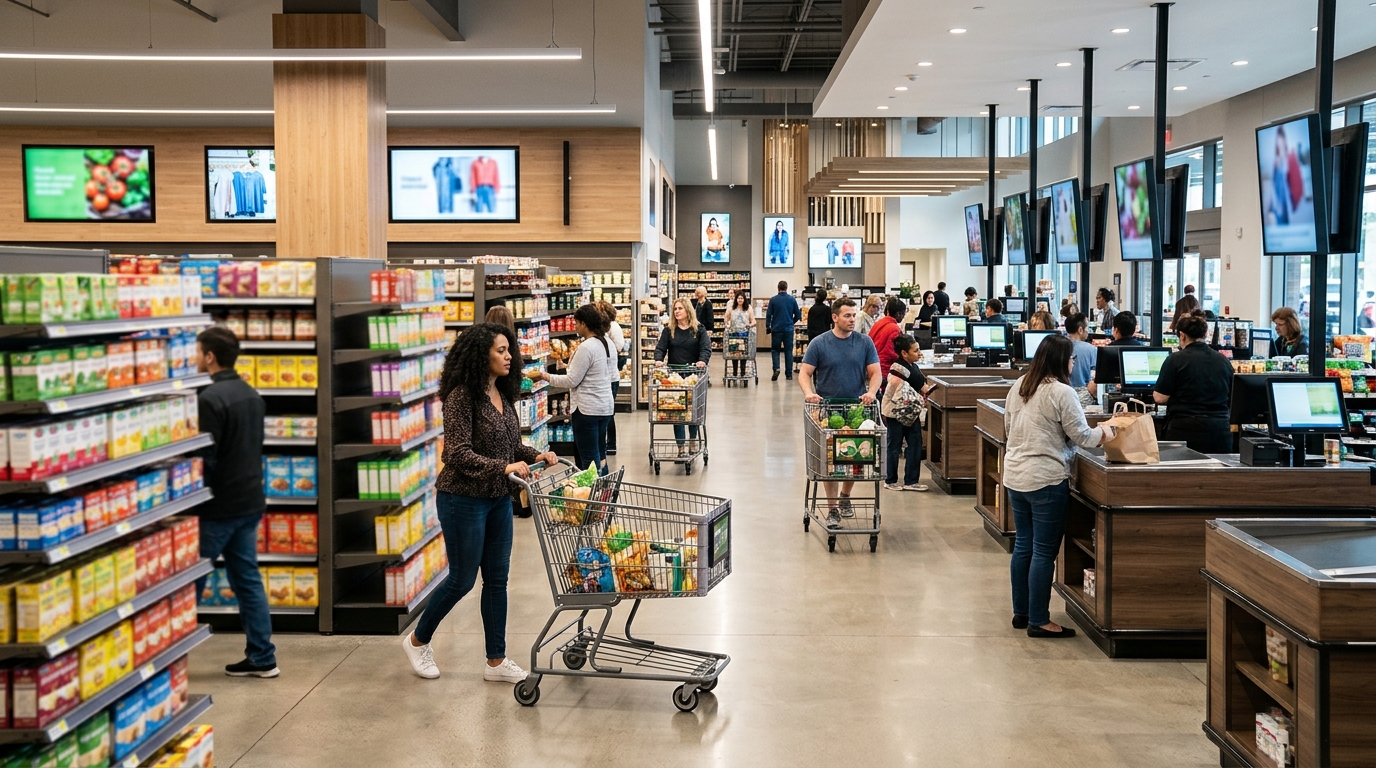
First, retail is rediscovering physical space. After years of store closures and ecommerce growth accelerated by the pandemic, retailers are investing in the in-store experience. Digital screens are now standard in most major retail environments. These networks are built, they are operational, and they are generating data that retailers want to monetize further.
Second, brands are demanding omnichannel measurement. The single-channel attribution model has broken down. Brands want to see how their advertising works across digital, social, television, and physical channels. In-store OOH gives brands a way to extend their retail media campaigns into the real world and measure how physical placements influence purchase behavior.
Third, the technology has caught up. Dynamic content systems can now update digital screen networks in real time. Programmatic buying platforms have integrated in-store inventory alongside traditional OOH and digital channels. Agencies no longer need separate workflows for in-store versus outdoor placements. The operational barriers that kept these inventory types separate are disappearing.
Fourth, and most importantly, the data connects. A brand can now target a specific audience segment using retailer loyalty data, activate that segment across digital ads, sponsored products, and in-store digital screens, then measure the combined effect on store visits and purchases. This closed-loop reporting was impossible in the OOH industry just a few years ago. It is becoming standard practice now.
What the Data Shows About In-Store Effectiveness
Numbers help make the case to skeptical clients or internal teams, and the data on in-store retail media is compelling.
Deloitte research puts 80% of shopping still happening in physical stores across North America. That baseline alone should make any brand reconsider how much weight they give to digital-only campaigns.
Retailers themselves are voting with their investment priorities. According to Deloitte surveys, 46% of retailers are focused on enhancing omnichannel experiences, and 36% are investing in loyalty programs to deliver more personalized value. Both of those investments support better in-store media activation. The retailers that are furthest ahead in retail media are the ones that have tied their loyalty data to their digital advertising platforms.
In-store digital formats also offer advantages that traditional OOH cannot match. Screens can display dynamic content that responds to time of day, weather, product availability, or audience segment. A digital display near the pharmacy section can show different messaging at 8am versus 6pm. A screen at a gas station can adjust content based on whether the weather is cold or hot. This contextual relevance increases the likelihood that messaging connects with the shopper.
When in-store media is fully integrated into a retail media network, the measurement story becomes much stronger. Brands can connect ad exposure to store visits using mobile location data, link those visits to purchase records from loyalty programs, and report on the full customer journey from impression to transaction. This is a fundamentally different conversation than the brand lift studies that OOH has traditionally relied on.
The Revenue Opportunity for OOH Agencies
Here is the practical question: how does an OOH agency actually participate in retail media networks?
There are several models, and the right approach depends on the agency existing relationships and inventory.
The most direct model is partnering with a retailer or retail media network operator to provide OOH inventory that extends the network beyond the retailer owned screens. An agency with billboards near Walmart stores, for example, can offer those placements as part of a broader retail media package. The retailer bundles the outdoor inventory with in-store screens and digital ads, creating a more compelling offering for brands.
A second model is becoming a verified media partner for a retail media network. Some of the larger retail media operators, including those run by Kroger, Walmart, and Walgreens, have formalized partner programs that allow agencies to access their platforms directly, purchase inventory, and integrate reporting with their campaign tools. These partnerships require some technical integration but give agencies access to a growing pool of demand from brands that want to reach retail audiences.
A third model is building proprietary retail media inventory. Some agencies are working with their media owner partners to deploy digital screen networks inside retail environments under revenue-sharing agreements. This requires more capital investment and relationship-building, but it creates a direct revenue stream from a rapidly growing category.
The agencies that are winning in this space share a common trait: they are treating retail media as a strategic priority, not a tactical add-on. They have dedicated teams working on retailer partnerships, they have invested in the technical infrastructure to integrate with retail media platforms, and they have repositioned their OOH inventory as part of omnichannel campaigns rather than standalone placements.
Practical Steps for Agencies Getting Started
If you are an OOH agency that wants to participate in retail media networks, here is a realistic roadmap.
Start by mapping your inventory to retail environments. Which of your media owner partners have locations near major retail stores, shopping centers, or gas stations? Do you have digital inventory that can be activated programmatically? This inventory audit will tell you what you have to offer before you approach any retailer.
Next, build relationships with retail media network operators in your markets. Many of these organizations are actively looking for additional media inventory to include in their packages. The relationship starts with a conversation about what you have, what their brand advertisers are asking for, and whether there is a natural fit.
Invest in programmatic capability. Retail media networks operate on programmatic infrastructure. If your agency still relies primarily on direct sales and manual workflows, you will struggle to integrate with these platforms. This does not mean you need to abandon direct sales, but you need the technical ability to buy and sell programmatically when the opportunity arises.
Develop retail-specific audience segments. Brands buying retail media want to reach specific customer profiles. Work with data providers or retailer partners to build segments based on purchase behavior, loyalty status, or category affinity. These segments should be documented in a way that makes it easy to explain their value to brand advertisers.
Finally, think about measurement from the start. Every campaign you run in a retail media context should include a measurement plan that ties exposure to business outcomes. Work with your retailer partners or third-party measurement providers to establish baselines and track results. The agencies that can demonstrate ROI in retail media will earn more budget allocation from brands over time.
Why This Trend Will Accelerate
The structural drivers behind retail media growth are not going away.
Privacy regulations will continue to limit what third-party digital advertising can do. First-party data, which retailers have in abundance, will become more valuable as those restrictions tighten.
Retailers are still early in building out their media networks. Most are generating significant revenue but have not yet reached the sophistication of digital advertising platforms. As these networks mature, they will need more inventory, better integration with external media channels, and more sophisticated measurement.
Artificial intelligence will play a larger role in optimizing in-store retail media. Real-time content optimization based on audience signals, predictive modeling for campaign performance, and automated audience segmentation are all areas where AI is already being applied in retail contexts. The agencies that understand these tools will be better positioned to advise brands on retail media strategy.
Consolidation will also shape the market. The retail media landscape is fragmented, with many independent networks operating regionally or within specific retail categories. As the market matures, consolidation will create larger networks with broader reach and more standardized platforms. The agencies that have established relationships early will be better positioned when that consolidation happens.
Conclusion
Retail media networks are not a niche category anymore. They represent one of the most significant revenue opportunities in the broader advertising ecosystem, and in-store OOH is increasingly central to how these networks operate.
The agencies that understand this shift will find themselves with a strategic advantage. They will have inventory that retailers need, relationships with the operators who are building these networks, and the technical capability to participate in programmatic retail media transactions.
The agencies that do not adapt will find themselves selling standalone outdoor placements while the rest of the industry moves toward integrated omnichannel campaigns.
The window to get ahead of this trend is now. Start by mapping your inventory to retail environments, building relationships with retail media operators, and investing in the programmatic infrastructure that makes integration possible. The agencies that take these steps will be well-positioned for whatever comes next in the evolution of retail media.
Ready to Modernize Your OOH Operations?
Join the leading OOH media owners who use AdGrid to automate their quoting, manage inventory, and grow their revenue.