
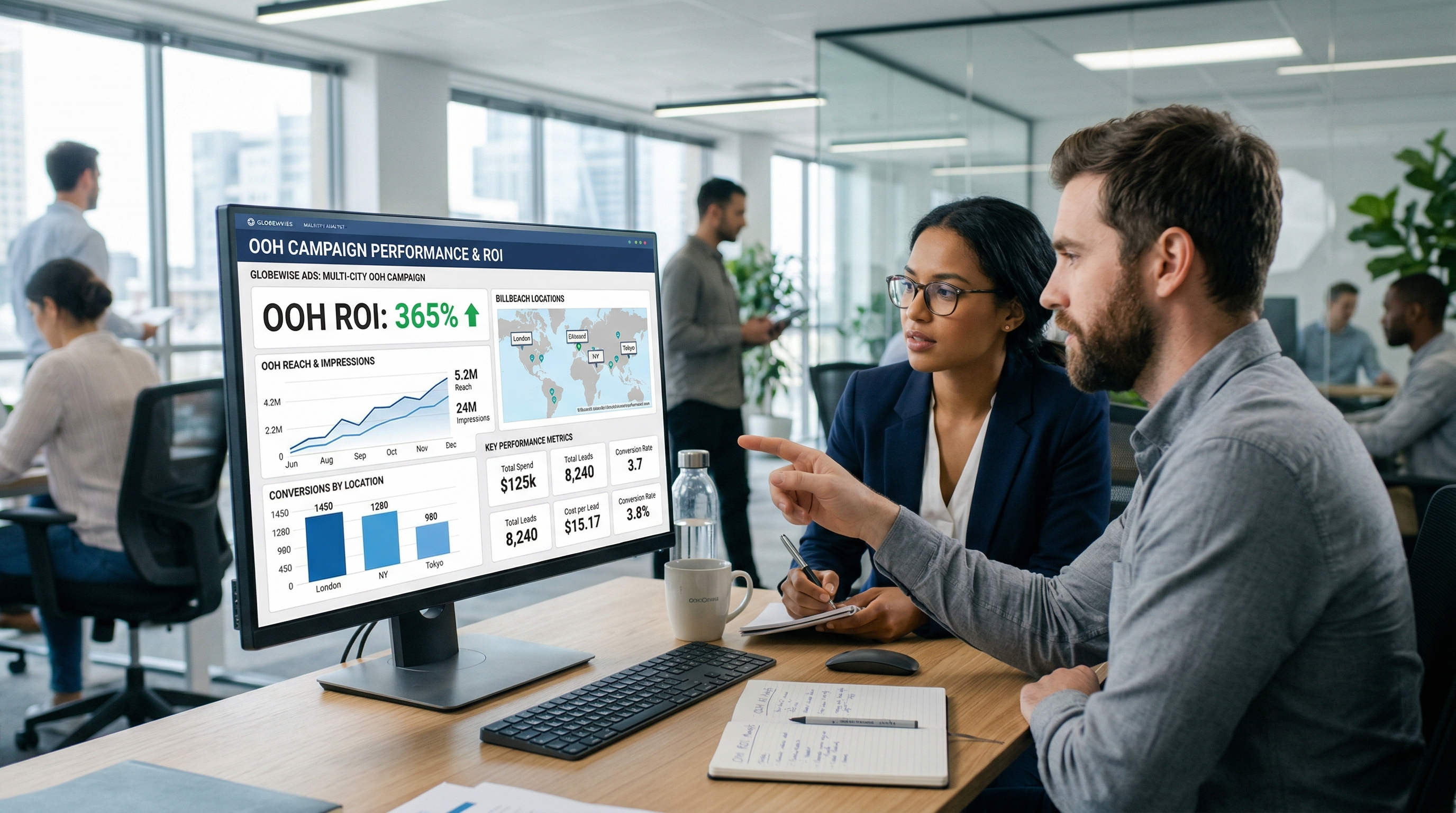
The billboard industry has a perception problem. Walk into any marketing strategy meeting and suggest allocating budget to out-of-home advertising, and you'll likely face the same question: "That's great, but how do we measure it?"
Unlike digital advertising with its endless dashboards and click-through rates, OOH has historically struggled with attribution. When a consumer sees a billboard and later makes a purchase, connecting those dots feels more like detective work than data science.
But here's the thing: OOH attribution has evolved dramatically. The methods available today would have seemed like science fiction a decade ago. Billboard agencies that master these techniques don't just survive client questions — they turn measurement into a competitive advantage.
Why Attribution Matters More Than Ever
Before diving into the how, let's address the why. Attribution isn't just about defending your media spend. It's about optimization, learning, and proving value in a world where every marketing dollar faces scrutiny.
The trust deficit: CMOs are under pressure to justify every expenditure. When digital campaigns can show granular conversion data, OOH needs comparable rigor. Agencies that can't provide this risk being cut from media plans.
The optimization opportunity: Attribution isn't just backwards-looking. Understanding which locations, creatives, and timing drive results allows you to refine future campaigns. Without measurement, you're flying blind.
The competitive landscape: Digital-native agencies entering the OOH space often bring sophisticated measurement expectations. Traditional billboard agencies need to meet or exceed these standards.
The reality: Most OOH campaigns do drive results. The problem isn't effectiveness — it's proving it. When you can connect a billboard exposure to a store visit, website traffic spike, or purchase, you transform perception and justify premium pricing.
The Attribution Challenge: Why OOH Is Different
Digital advertising benefits from a relatively straightforward attribution model. User clicks ad → cookie tracks → conversion recorded. The entire journey happens in a closed system that platforms control.
OOH operates in the real world, where measurement is inherently messier:
No direct interaction: Billboards don't have buttons to click. Viewers see the message and may act hours, days, or weeks later through completely different channels.
Multiple touchpoints: A consumer might see your billboard, later encounter a social media ad, and finally convert through organic search. Which touchpoint gets credit?
Privacy restrictions: As cookies crumble and mobile tracking faces regulatory scrutiny, even digital attribution is becoming harder. OOH never relied on these methods, but it also hasn't had easy alternatives.
Scale and geography: A national OOH campaign spans hundreds or thousands of locations. Understanding which specific boards drove results requires sophisticated geospatial analysis.
These challenges are real, but they're not insurmountable. The attribution landscape has evolved significantly, and today's methods can provide robust, defensible measurement for OOH campaigns.
Modern OOH Attribution Methods: A Complete Toolkit
1. Foot Traffic Studies
The most direct way to measure OOH impact is tracking whether exposure leads to physical store visits. This is particularly powerful for retail, restaurants, automotive dealerships, and any business with physical locations.
How it works: Mobile location data providers work with apps that users have opted into for location services. When a device is detected near a billboard location, it's flagged as "exposed." Later, if that same device visits the advertiser's store, the connection is made.
Control groups are established using devices that were in the same geographic area but not exposed to the billboard. The difference in store visitation rates between exposed and control groups represents the campaign's incremental impact.
Key providers:
- Placed (Foursquare): Industry leader in location intelligence, providing detailed foot traffic lift studies
- Cuebiq: Specializes in location-based attribution with privacy-compliant methodologies
- AdSquare: Offers cross-channel attribution including OOH foot traffic measurement
- NinthDecimal (InMobi): Provides location data and attribution for OOH campaigns
What you get: Foot traffic studies typically report:
- Visit lift percentage (exposed vs. control)
- Cost per incremental visit
- Visit patterns by time of day, day of week
- Dwell time and store engagement metrics
Real-world application: A quick-service restaurant chain running billboards in 15 markets might see a 23% lift in store visits among exposed devices compared to control. With average transaction data, this translates to estimated revenue impact, making ROI calculation straightforward.
2. Brand Lift Studies
Not every OOH campaign aims for immediate action. Brand awareness, consideration, and favorability are legitimate objectives, and brand lift studies measure these upper-funnel impacts.
How it works: Survey-based methodologies expose test groups to OOH creative (either in-person at locations or digitally simulated) and compare their brand perceptions to a control group that didn't see the ads.
For real-world OOH campaigns, mobile surveys can target users known to have been exposed to specific billboard locations, measuring differences in brand metrics compared to demographically similar non-exposed users.
Key providers:
- Milward Brown (Kantar): Gold standard for brand lift measurement
- Dynata: Provides survey-based brand lift with mobile location integration
- OnePulse: Quick-turn brand lift studies with mobile survey methodology
- LoopMe: Focuses on brand outcomes measurement across channels including OOH
What you get: Brand lift studies typically measure:
- Ad recall (aided and unaided)
- Brand awareness
- Purchase intent
- Brand favorability
- Message association
Real-world application: A luxury automotive brand launching a new model uses billboards in premium locations. A brand lift study might reveal that exposed consumers show 34% higher unaided awareness and 28% greater purchase consideration compared to control — metrics that support premium pricing for the media placement.
3. Conversion Tracking via Mobile IDs
For campaigns driving online actions, mobile ID-based attribution connects billboard exposure to digital conversions.
How it works: When a device is detected near a billboard, its mobile advertising ID (MAID) is logged (anonymously and with consent). If that same device later visits the advertiser's website, downloads their app, or completes another tracked action, the attribution is recorded.
This method bridges the physical-digital divide, showing how OOH exposure drives online behavior.
Key providers:
- Revere (Nielsen): Connects OOH exposure to digital actions
- Verizon Media: Leverages carrier data for cross-channel attribution
- PlaceIQ: Offers location-based audience insights and conversion tracking
- Factual: Provides location data for attribution and audience targeting
What you get:
- Website visit lift among exposed users
- App download attribution
- Online purchase tracking
- Cross-device journey mapping
Real-world application: A direct-to-consumer brand running billboards tracks a 17% lift in website visits among exposed devices within 48 hours of exposure. Further analysis shows these visits convert at 3.2% compared to 2.1% for other traffic sources, indicating higher-intent visitors.
4. Sales Lift Measurement
The ultimate metric for many advertisers is sales impact. While more complex to measure, sales lift studies connect OOH exposure to actual purchase behavior.
How it works: Partnerships with credit card companies, retailers, and data providers allow matching of billboard exposure data to transaction records. Privacy-preserving techniques ensure individual identities aren't revealed while aggregate patterns emerge.
Alternatively, geographic testing compares sales in markets with OOH campaigns to similar markets without, controlling for other variables.
Key providers:
- NCSolutions (NCS): Links advertising exposure to consumer purchases through loyalty card data
- IRI: Provides sales lift measurement with granular geographic analysis
- Circana (formerly IRI/NPD): Offers purchase-based attribution
- SafeGraph: Provides foot traffic and sales data for location analysis
What you get:
- Sales lift percentage attributed to campaign
- Return on ad spend (ROAS) calculations
- Category and product-level insights
- Customer acquisition cost comparisons
Real-world application: A consumer packaged goods brand runs billboards promoting a new product launch. Sales lift analysis shows a 12% increase in purchases among exposed households compared to control, translating to $2.4 million in incremental revenue against a $400,000 media spend — a 6:1 ROAS.
5. Search Lift Analysis
OOH campaigns often drive immediate search behavior as consumers look up brands, products, or offers after seeing a billboard. Search lift analysis captures this intent signal.
How it works: Comparing search volume for brand and campaign-specific keywords in markets with OOH campaigns versus control markets reveals the search impact. More sophisticated approaches use mobile location data to correlate individual exposure with subsequent searches from the same device.
Key providers:
- Google: Offers geographic search trend analysis
- Captify: Specializes in search intelligence across channels
- Kantar: Provides search lift as part of broader measurement suites
What you get:
- Search volume lift by market
- Keyword-level insights
- Search-to-conversion tracking
- Competitive search share analysis
Real-world application: A telecom provider running billboards with a specific promotional code sees a 45% increase in searches for their brand plus "promo code" in exposed markets. This search intent correlates with higher call center volume and online plan comparisons.
6. Social Listening and Engagement
OOH campaigns, particularly those with creative or provocative elements, often generate social media discussion. Social listening measures this organic amplification.
How it works: Monitoring social platforms for mentions of the brand, campaign hashtags, or image recognition of billboards captures earned media value. Geofencing around billboard locations can isolate locally-driven social activity.
Key providers:
- Sprinklr: Enterprise social listening with location-based filtering
- Brandwatch: Comprehensive social intelligence platform
- Meltwater: Social listening and earned media measurement
- Dash Hudson: Visual recognition for billboard social shares
What you get:
- Earned media value estimates
- Sentiment analysis
- Share of voice metrics
- User-generated content tracking
Real-world application: A tourism board's creative billboards become Instagram backdrops. Social listening reveals 8,500 organic posts featuring the billboards, generating an estimated $240,000 in earned media value — exceeding the paid media spend.
Building Your Attribution Stack
No single method tells the complete story. Sophisticated OOH agencies build attribution stacks that combine multiple approaches:
The Layered Approach
Base layer: Always-on foot traffic measurement for location-based advertisers Secondary layer: Brand lift studies for awareness campaigns Tertiary layer: Sales or conversion tracking for performance-driven clients Enhancement layer: Social listening and search lift for cultural impact
Choosing the Right Methods
Consider the campaign objective:
- Driving store visits → Foot traffic studies
- Launching new brand → Brand lift studies
- E-commerce promotion → Conversion tracking
- Product launch → Sales lift measurement
Consider the client sophistication:
- Data-driven clients expect multiple metrics and rigorous methodology
- Traditional clients may need education on what's possible
- Budget-constrained campaigns might start with a single method
Consider the timeline:
- Real-time optimization needs continuous measurement
- Campaign reporting can use post-campaign studies
- Annual planning benefits from longitudinal studies
Integrating Attribution Into Proposals
The most successful agencies don't treat attribution as an afterthought — they build it into the initial proposal:
Set expectations early: "This campaign includes foot traffic measurement to quantify store visit lift, with results available weekly for optimization."
Build measurement into pricing: Either include attribution costs in your media fee or offer it as a value-added service that differentiates you from competitors.
Establish benchmarks: Reference past campaign results: "Similar campaigns for retail clients have achieved 15-25% foot traffic lift."
Report consistently: Don't wait for the end-of-campaign recap. Weekly or bi-weekly reporting keeps clients engaged and allows for optimization.
Addressing Common Attribution Concerns
"OOH attribution isn't as precise as digital" True, but precision isn't the only metric that matters. The question is whether attribution is directionally accurate and statistically significant. Modern OOH attribution meets both criteria. Additionally, digital attribution faces its own challenges with cookie deprecation, privacy changes, and cross-device fragmentation.
"Attribution is too expensive for my campaigns" Costs have decreased significantly. Many providers offer scalable solutions suitable for smaller campaigns. Consider attribution an investment in client retention and upselling — not an expense.
"My clients don't ask for measurement" They will. Digital-native marketers joining brands expect data. Getting ahead of this curve positions you as a forward-thinking partner.
"Attribution takes too long" Traditional brand lift studies took weeks. Modern foot traffic and conversion data can be available in days, even real-time for some metrics.
"The data isn't actionable" This depends on methodology. Weekly foot traffic reports allow creative and placement optimization. Post-campaign sales lift informs future planning. Design your measurement to enable action, not just reporting.
The Future of OOH Attribution
The attribution landscape continues evolving rapidly. Several trends will shape the next few years:
Privacy-preserving measurement: As regulatory scrutiny increases and device-level tracking faces restrictions, attribution providers are developing aggregated, privacy-safe methodologies that maintain accuracy without individual tracking.
Retail media network integration: Retailers are building their own media networks with first-party data. OOH campaigns integrated with retail media will benefit from closed-loop attribution connecting exposure to purchase.
AI-powered modeling: Machine learning is improving the accuracy of attribution models, better accounting for variables like weather, events, and competitive activity that affect campaign performance.
Cross-channel unified measurement: The dream of a single dashboard showing all marketing touchpoints and their contribution to outcomes is becoming reality. OOH data feeds into these unified models alongside digital channels.
Standardization: Industry bodies like the OAAA and MRC are developing standards for OOH measurement, bringing consistency and credibility to attribution claims.
Getting Started: Your 90-Day Attribution Roadmap
If you're not currently offering robust attribution, here's how to build capability:
Week 1-2: Audit your current measurement. What are you already doing? What's missing?
Week 3-4: Select 2-3 attribution providers aligned with your typical client base. Request demos and case studies.
Week 5-6: Run a pilot attribution study on an upcoming campaign. Learn the process without client pressure.
Week 7-8: Develop attribution packages — basic, standard, and premium tiers — to offer clients.
Week 9-10: Update proposal templates to include attribution as a standard offering.
Week 11-12: Train your team on interpreting and presenting attribution results.
Ongoing: Build a library of case studies showing attribution-proven results. These become powerful sales tools.
Conclusion: Attribution as Competitive Advantage
The billboard agencies thriving in 2025 and beyond won't be those with the most locations or the lowest prices. They'll be the ones that can definitively answer the question: "Did it work?"
Attribution isn't just about defense — it's about offense. When you can prove that a billboard campaign drove 20% more store visits, increased brand consideration by 30%, or delivered a 5:1 return on ad spend, you command premium pricing. You win pitches against agencies that can only offer impressions and frequency estimates.
The tools exist. The methodologies are proven. The only question is whether you'll be the agency that masters them or the one left explaining why you can't measure results.
Your clients are asking. Now you can answer.
Ready to Modernize Your OOH Operations?
Join the leading OOH media owners who use AdGrid to automate their quoting, manage inventory, and grow their revenue.