
Outdoor advertising is having a genuine moment. OOH revenue crossed $9 billion last year, and digital formats are driving nearly all of that growth. DOOH specifically is on track to represent 45.2% of total OOH ad spend by 2028, up from just 22% in 2016. Programmatic DOOH investment is climbing 44% globally. Yet amid all this momentum, a strange paradox is quietly hiding in plain sight.
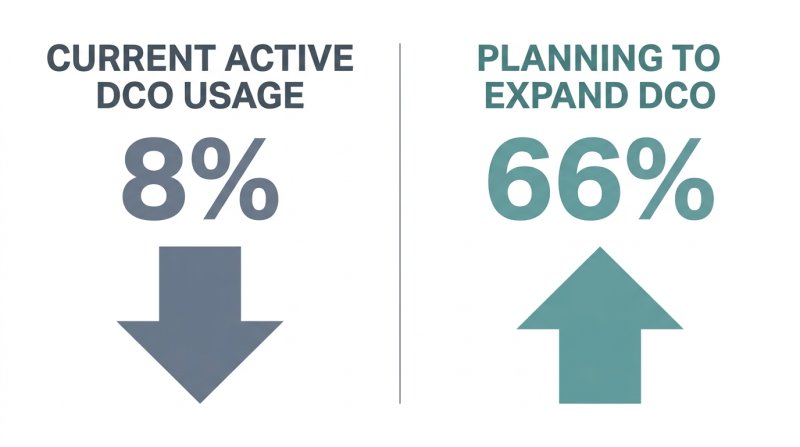
Sixty-six percent of advertisers plan to expand their use of dynamic creative optimization in DOOH campaigns. Only 8% are currently using it. That gap is not a market failure. It is an opportunity sitting uncollected, and it tells a story worth paying attention to.
This piece examines the DCO paradox in DOOH: where it comes from, why it matters, and how brands can move from wanting dynamic creative to actually running it at scale.
DOOH Is No Longer the Channel People Tolerate
There was a time when outdoor advertising was the fallback. The channel you added to a digital plan because you needed reach and could not quite fill it anywhere else. That characterization is becoming harder to defend.
The numbers are difficult to ignore. The US DOOH audience reached 247 million adults monthly in 2023, with 81% of adults aged 18 to 49 exposed to DOOH ads on a weekly basis. Gen Z consumers in Europe showed a 68% purchase influence rate from DOOH ads in the same year. These are not fringe audiences. These are the people brands spend the most effort trying to reach through every other channel.
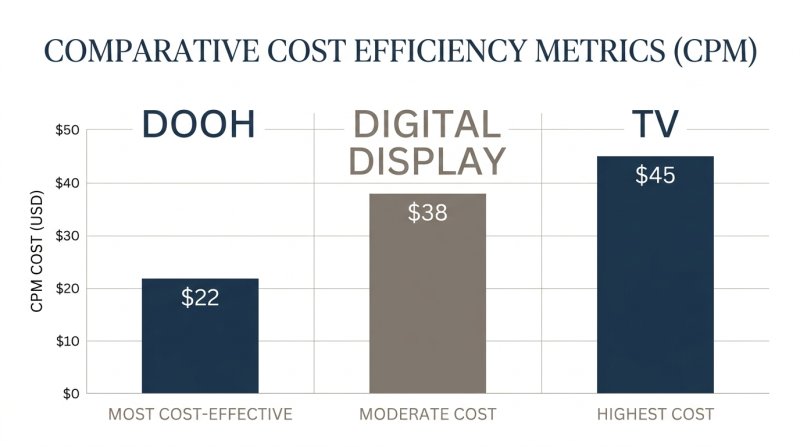
The channel also delivers on cost in a way that surprises people who still think of OOH as expensive. DOOH CPM runs at approximately $22, compared to $38 for digital display and $45 for television. For audiences that feel increasingly out of reach through social and search, DOOH offers genuine efficiency. The post-purchase recall rate for DOOH sits at 41%, higher than both print and social media. The ROI multiple comes in at 2.9 to 1 with a measurable 15% sales lift on average. Automotive campaigns, a category where creative and placement matter enormously, report a 4.2 to 1 ROI, the highest of any sector.
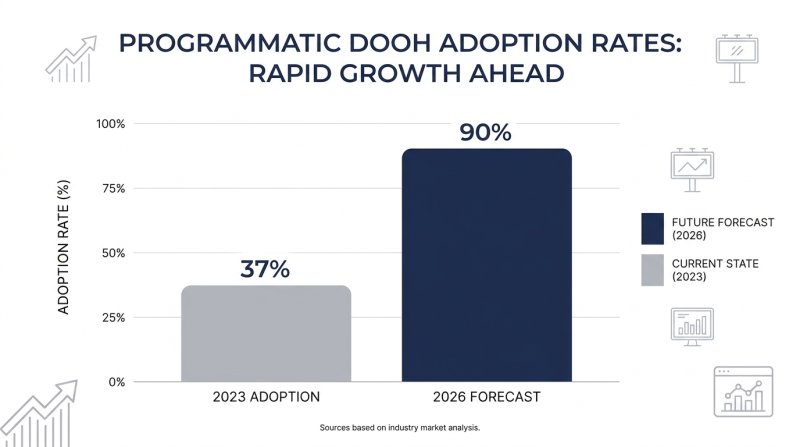
In key markets, 90% of buyers now include programmatic DOOH in their overall digital strategy, up from 37% in 2023. That is a fundamental shift in how the channel is perceived and purchased, not just within outdoor media teams but across media agencies and brand planning desks.
What DCO Actually Means in DOOH
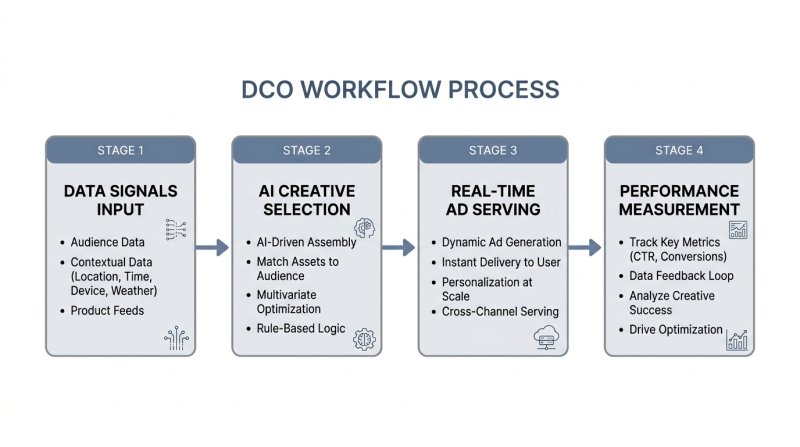
Dynamic creative optimization in outdoor advertising is not a single technology. It is a system that connects data signals to creative variations in real time, without requiring a human to manually change what is playing on a screen.
The data signals can come from a range of sources. Weather is the most commonly discussed. A coffee brand might show iced latte creative when the temperature forecast for a location exceeds 75 degrees, and switch to a hot coffee message when it drops below 45. Time of day matters for obvious reasons. A quick service restaurant might promote breakfast items in the morning and switch to lunch or dinner offerings by mid-afternoon. Location context is increasingly sophisticated, with inventory systems able to serve different creative based on proximity to retail locations, transit hubs, or sports venues. Local events, traffic patterns, product availability in nearby stores, and even social media trending topics are all being incorporated into dynamic strategies by the most advanced buyers.
The creative variations can be as simple as swapping out a headline or as complex as entirely different visual layouts triggered by different audience segments in the same location. The common thread is that the decision about which variation to serve happens automatically, based on rules or machine learning models, rather than through a media buyer manually uploading separate schedules.
AI is playing an expanding role in this process. Ninety percent of programmatic DOOH practitioners now use AI in at least one stage of campaign management, most commonly for creative generation, trend forecasting, and automated inventory selection. The workflow is moving from purely rules-based triggers toward models that can predict which creative variation is most likely to perform given a specific context and audience profile.
The Paradox Explained
The Viooh State of the Nation 2026 report surfaced a striking data point. The use of dynamically adapted creative content in DOOH actually dropped from 13% to 8% over the survey period, even as 66% of respondents said they planned to expand their DCO activity. That is a 58 percentage point gap between intention and execution.
The reasons are not mysterious. Brands and their agencies consistently cite three barriers. Lack of training ranks at the top. Media buyers and planners who learned their craft on insertion orders and Avails spreadsheets find DCO workflows unfamiliar. Creative teams accustomed to producing a final asset for a static placement struggle when the same placement can theoretically show hundreds of variations. The skill sets do not always live in the same person or the same team, and bridging that gap takes deliberate investment.
Budget limitations are the second factor. DCO requires more creative production upfront, more sophisticated technology infrastructure to manage variations, and more rigorous QA processes to ensure dynamically served content meets brand standards across all possible combinations. Some buyers treat this as a reason to defer. Others recognize it as a legitimate cost that should be weighed against the performance uplift dynamic creative typically delivers.
Creative resources are the third constraint. Generating multiple creative variations that are all strong enough to represent the brand is not simply a matter of duplicating a static ad and changing the headline. Dynamic creative that looks cobbled together or inconsistently styled undermines the brand signal that makes DOOH powerful in the first place. High-quality dynamic creative requires creative teams to think in components and variants from the start, which is a different way of working than most agencies have historically approached outdoor production.
There is also a process gap. Executing DCO in DOOH requires coordination across the buyer, the media owner, and the technology platform. All three need to agree on what triggers will be used, how the data will be fed into the system, how creative files should be formatted and named, and what the fallback logic looks like if a data signal is unavailable. That coordination does not happen automatically just because the intent exists.
Why Closing the Gap Is Worth the Effort
The paradox would matter less if the returns on DCO were marginal. They are not.
DOOH with dynamic elements consistently outperforms static placements in attention and conversion metrics. QR codes on DOOH ads generate 25% higher interaction rates than static placements. Interactive retail DOOH ads report a 30% higher conversion rate compared to static formats. Local-targeted DOOH campaigns generate 25% higher ROI than national campaigns, a finding that reflects the obvious: contextually relevant messaging at the right location outperforms generic messaging everywhere.
The efficiency argument is also structural. DOOH CPM economics already favor the channel relative to television and digital display. Dynamic creative amplifies that efficiency by increasing the relevance of each impression. When a consumer sees a message that accounts for the weather, the time, or their location, the brand impression is worth more than the same impression delivered without that context. Brands that figure out how to operationalize DCO at scale are essentially compounding the base efficiency advantage that DOOH already holds.
The attribution question is also settling. Sixty percent of respondents in the Viooh survey expect programmatic DOOH to deliver measurable results, surpassing both traditional DOOH and broader out-of-home on this dimension. DOOH post-purchase recall at 41% combined with a 2.9 to 1 ROI and 15% average sales lift gives performance-focused marketers something concrete to point to in media reviews. These are not soft brand metrics. They connect to line items in a P and L.
Moving From Intention to Execution
The brands and agencies that are already running DCO in DOOH at scale tend to share a set of practical habits that separate them from those still stuck in the planning phase.
Treat dynamic creative as a production problem, not a media problem. Most DCO failures begin in creative development, where teams produce one strong static ad and then scramble to generate variations under pressure at the end of a campaign timeline. The better approach is to design creative components as a system from the start. Headline variants, visual layers, calls to action, and contextual overlays should be planned as a modular set before any production begins. This requires creative strategists and media planners to collaborate earlier in the process than traditional workflows typically allow, but the payoff is a set of assets that are actually ready for dynamic serving.
Choose one trigger to start with. Teams that try to incorporate weather, time, location, event data, and audience segments all at once end up with a system that is too complex to manage and too expensive to justify. The most practical DCO launches begin with a single, well-understood trigger. Weather is the obvious choice because the data is freely available, the logic is intuitive, and the creative variation is easy to explain to stakeholders who may be skeptical of dynamic serving. A coffee brand running a weather-triggered DCO campaign in five markets is a complete DCO campaign. It does not need to be everything at once.
Establish clear QA processes before launch. Dynamic creative introduces a class of errors that static placements do not have. A headline that makes sense at 40 degrees makes no sense at 85 degrees. A product callout that references a location within two miles of a screen is irrelevant or misleading at 20 miles. A trigger that references an event calendar needs a fallback when the event is cancelled or moved. Teams that build QA into the workflow, including reviewing all possible creative combinations before the campaign goes live, catch these issues before they become embarrassing brand moments.
Connect DCO performance to measurement frameworks that already exist. Sixty-nine percent of brands report seeing measurable brand awareness within seven days of a DOOH campaign going live. That kind of fast feedback loop is exactly what DCO needs to justify continued investment. Brands that measure only at the campaign level miss the opportunity to understand which creative variations drove which outcomes. Linking DCO triggers to impression-level data and then to foot traffic or conversion signals where possible creates a learning engine that improves performance campaign over campaign.
What 2026 Looks Like for DCO in DOOH
Dynamic creative optimization in DOOH is moving from experiment to infrastructure. The tooling is mature. The data availability is not the bottleneck. The channel economics make the investment easy to justify. The remaining constraint is organizational: skills, workflows, and cross-team coordination that most agencies and brand teams have not yet built around DCO specifically.
The 66% of brands that want to expand DCO but are not yet doing it are not lacking vision. They are lacking a clear operational path from the creative brief to the live screen. That path exists, it is well-trodden by the 8% already executing, and the results they are reporting are making it increasingly difficult for holdouts to explain why they are sitting on the sideline of one of the most measurable and efficient channels in outdoor advertising.
DOOH is no longer a reach supplement or a brand awareness luxury. When it is done dynamically, with creative that responds to the real world in real time, it becomes something closer to a digital channel that happens to exist in physical space. The brands that understand that distinction and build the teams and processes to act on it will have a structural advantage in outdoor advertising that will be difficult for late movers to close.
The opportunity in 2026 is not to speculate about what dynamic creative might do. It is to run it, measure it, and learn from it at a scale that makes the 8% figure look as outdated as the 37% adoption rate from 2023 looks today.
Frequently Asked Questions About DCO in DOOH
What is dynamic creative optimization in DOOH?
Dynamic creative optimization in DOOH is a technology-enabled workflow that automatically selects and serves different ad creative variations based on real-time data signals such as weather conditions, time of day, location context, or audience profile. Rather than a single static ad running on a screen throughout a campaign, DCO allows the same screen to display contextually relevant creative that changes automatically without manual intervention.
Why are so few brands actually using DCO when most plan to expand it?
The three most commonly cited barriers are lack of training, limited creative budgets, and insufficient creative resources to produce high-quality variations at scale. Additionally, executing DCO requires coordination between the brand, the agency, and the media owner, which introduces process complexity that teams have not yet built into their standard workflows. These barriers are operational, not technological, which means they can be addressed with deliberate investment.
What data signals work best for DCO in DOOH campaigns?
Weather is the most accessible and widely used trigger because temperature data is freely available and the creative logic is straightforward to explain to stakeholders. Time of day is another reliable trigger, particularly for quick service restaurants and retail brands whose messaging naturally varies by meal period or shopping window. Location-based triggers using proximity to stores, transit hubs, or events are becoming more sophisticated as programmatic DOOH platforms improve their data integration capabilities.
Does DCO in DOOH actually improve campaign performance?
Yes. DOOH ads with QR codes generate 25% higher interaction rates than static placements. Interactive retail DOOH ads report 30% higher conversion rates compared to static formats. Local-targeted DOOH campaigns produce 25% higher ROI than national campaigns. These performance differentials reflect the fundamental principle that relevant messaging outperforms generic messaging, regardless of the channel.
How does DOOH compare to other channels on cost and ROI?
DOOH CPM runs at approximately $22, compared to $38 for digital display and $45 for television. The average DOOH ROI is 2.9 to 1 with a 15% average sales lift. Automotive DOOH campaigns report the highest ROI of any sector at 4.2 to 1. The post-purchase recall rate for DOOH sits at 41%, higher than both print and social media. These figures make DOOH one of the more efficient channels available to brand marketers, and dynamic creative compounds that efficiency by increasing the relevance of each individual impression.
Ready to Modernize Your OOH Operations?
Join the leading OOH media owners who use AdGrid to automate their quoting, manage inventory, and grow their revenue.