
AI Vision Meets DOOH: How Computer Vision Is Replacing Legacy Audience Measurement
Published April 23, 2026 | DOOH, Audience Measurement, Programmatic OOH
The billboard says it reached 50,000 people today. But how many of them were actually paying attention? How many were under 35? Were they walking toward the screen or just walking past it while staring at their phones?
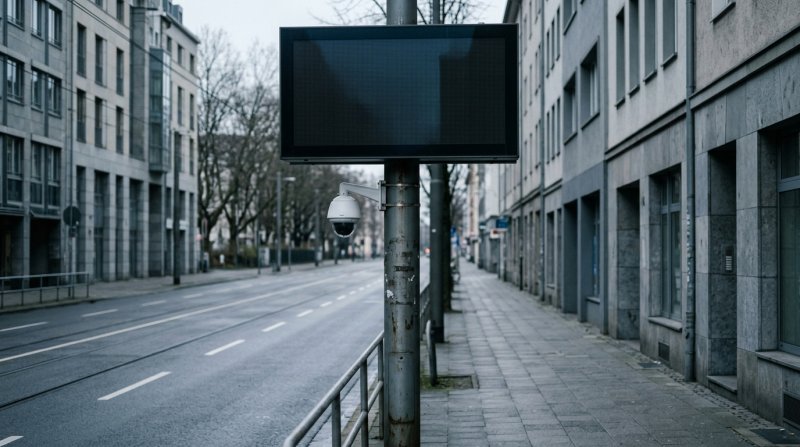
For decades, DOOH audience measurement has relied on estimates. Circulation figures. Drive-time traffic models. Broad demographic proxies that were accurate enough for media planning but too fuzzy for accountability. That era is ending quietly, and not because someone made a dramatic announcement. It is ending because computer vision got cheap enough to deploy at scale, and the cameras are already up there on the poles.
What Legacy Measurement Actually Measured
Before diving into what is changing, it is worth being specific about what legacy measurement was actually doing. The Postar rating system in the US, BARB in the UK, and their equivalents across European markets built their audience estimates from models. They combined vehicle count data from transportation authorities with observational studies of driver demographics. A 1990s methodology applied to a 2026 media environment.
The result was numbers that looked precise but were not. A location might report 100,000 daily impressions. That figure assumed all vehicles had one occupant, that all occupants looked at the billboard, that they looked for long enough to register the ad. None of those assumptions were checked against reality. They were industry conventions dressed up as data.
Agencies bought media this way for decades. Brands paid based on these estimates. The gap between reported reach and actual attention was treated as a cost of doing business in out-of-home. Everyone knew the numbers were soft, but no one had a better alternative that worked at commercial scale.
That gap is now being closed by computer vision.
The Computer Vision Stack Arriving in DOOH
Modern DOOH audience measurement runs on hardware that already exists in the field. High-resolution cameras mounted at or near digital screen locations, paired with on-device or cloud-based vision models that can detect and classify objects in real time. The systems count vehicles, estimate vehicle type, analyze pedestrian flow, and make demographic inferences from visual features.
The accuracy on vehicle classification is now solid. Distinguishing a sedan from a delivery van from a semi-truck is a solved problem for most vision models deployed in the 2025-2026 period. The harder task is the human side. Counting people is straightforward. Determining whether a person is looking at the screen, for how long, and inferring something useful about who they are, is where the technology is still actively improving.
The demographic estimation layer is the most contested. Some systems infer age range and gender from facial structure and posture. The results are good enough for broad audience segmentation but not defensible as precise demographic data in the way that online advertising knows your exact age and zip code. Privacy regulators in Europe have taken notice. GDPR considerations around biometric data processing are a genuine constraint on how aggressively computer vision can be applied in public spaces in EU markets.
The United States has a lighter regulatory touch on this specific use case, which is why several of the most aggressive deployments are happening in US urban markets first. The commercial logic is straightforward: the screens are already there, the marginal cost of adding camera hardware is modest, and the value of real audience data for a $10 billion annual market is substantial.
From Impression Counting to Attention Metrics
The shift that matters most is not from estimated impressions to counted impressions. It is from impression counting to attention measurement. These are genuinely different concepts.
An impression, as legacy OOH measured it, was a proxy for potential exposure. You counted how many people passed a location. You assumed some fraction of them were in a position to see the screen. You assumed some fraction of those were looking. The reported number was the first count, multiplied by assumptions, with no data on the second or third step.
Computer vision enables a different approach. Cameras can detect gaze direction. They can track whether a person in the field of view is oriented toward the screen. They can measure dwell time, which is the duration of sustained attention. A pedestrian who glances at a screen for 0.8 seconds registers differently than one who slows their pace and looks for 3.5 seconds. Neither registered as an impression under the old model, but the second one definitely should.
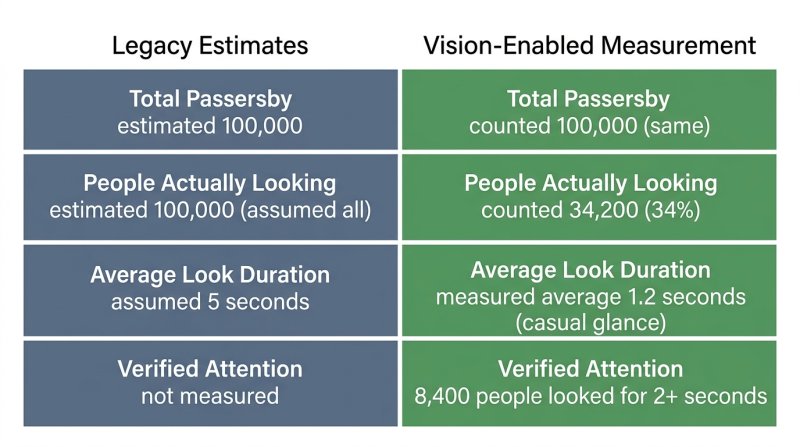
This creates a new metric currency for DOOH. Forwarding agencies and media owners are beginning to report something like OOH viewability, modeled on the digital viewability standard that became table stakes in programmatic display around 2015. The comparison is not perfect, since a billboard cannot report exact pixel viewability in the same way a webpage can, but the concept is analogous. Real attention is separable from potential exposure, and the gap between the two is now measurable.
The Privacy Tension Nobody Wants to Talk About
Here is the uncomfortable part of this story. The same technology that makes audience measurement more accurate also makes surveillance more capable. A camera that can count pedestrians and estimate their age and gender is a camera that can track individuals across a retail environment if the data is retained and linked. The industry is navigating this tension, but the public conversation is lagging behind the commercial deployment.
Several US municipalities have already passed or are considering local ordinances that restrict the use of cameras for advertising audience measurement purposes. Chicago and New York have seen proposals. The concern is not hypothetical. Some retail media networks that operate in-store cameras are already using their data for purposes beyond what their privacy notices describe. The DOOH industry does not want to be grouped with that behavior, but the technical capability overlap is real.
The honest position for the industry is this: computer vision at the edge, processing frames locally without transmitting identifiable data to a central server, is a defensible approach for audience measurement. It provides aggregate counts and anonymized behavioral signals without building individual-level profiles. This is what most serious DOOH technology companies are actually doing. The surveillance risk comes from companies that store and link the data in ways that go beyond what measurement requires. Those are different business models wearing similar technology as a costume.
Buyers who care about brand safety and responsible media buying should be asking specific questions about data retention, processing location, and what the privacy policy actually permits, before they sign any contract for vision-enabled audience data.
What This Means for Media Planning and Buying
The practical consequence of better measurement is not just cleaner reporting after the fact. It changes how the media gets bought and priced.
Programmatic DOOH platforms are beginning to incorporate real-time audience data into their bidding systems. A screen in a business district that is showing a luxury brand ad at 8 AM on Tuesday might be worth more than the same screen showing the same ad at noon on Saturday, if the audience composition is different and the purchase intent signals are stronger. Real-time audience data makes that distinction tradable.
This is the same dynamic that programmatic digital display went through between 2012 and 2018, when impression-level audience data started flowing into real-time bidding auctions. The result was a compression of waste in media buying, a repricing of underperforming inventory, and eventually a set of new winners who could demonstrate actual audience delivery rather than estimated reach.
DOOH is several years behind that curve, partly because the infrastructure is more complex and partly because the regulatory environment is more varied across markets. But the direction is clear. The industry is moving toward attention-weighted pricing, where what you pay is connected to what actually happened, not what was estimated to have happened.
For agencies and brands, this creates a planning discipline that was previously impossible. You can now build DOOH campaigns around actual audience delivery targets rather than circulation proxies. You can hold campaigns accountable to demonstrated exposure rather than estimated reach. The creative can be optimized in real time based on which creative variants are generating sustained attention versus casual glances.
The Infrastructure Reality Check
All of this sounds transformative, and in some markets it is. But it is worth being clear about where the technology is actually deployed versus where it is announced.
Globally, the installed base of vision-enabled DOOH screens is still a fraction of the total digital out-of-home inventory. The US and UK lead in commercial deployment because the regulatory frameworks are relatively settled and the commercial incentives are clear. Markets in Asia, particularly Japan and South Korea, have significant programmatic DOOH infrastructure but are more conservative about biometric inference in public spaces. European deployment varies sharply by market, with the Nordics and Netherlands leading and southern European markets lagging.
The majority of DOOH inventory worldwide is still measured by legacy methods. The transition is happening fastest in premium urban networks where the cost per point of adding vision hardware is easy to justify against higher CPM rates. The long tail of smaller format networks, suburban roadside digital, and secondary market inventory will take years to transition, if they ever fully do.
This matters for media planners who operate globally. You cannot assume that the sophisticated measurement available in New York or London is available in secondary markets in the same country. The measurement tier differences within DOOH are wider than in digital display, where measurement standards are more uniform across markets.
The Data Gap That Still Exists
Even with computer vision improving rapidly, there is a persistent gap in DOOH attribution that the technology does not fully close. How do you connect a billboard impression to a downstream action?
Digital channels have solved this problem through pixels and IDs. You see an ad, you click or search, you convert, the channel gets credit. The attribution chain is unbroken because it runs through a digital system end to end.
OOH exists in the physical world. The bridge between physical exposure and digital conversion has always been approximate. Incrementality studies, geo experiments, and attribution modeling can estimate the contribution of OOH to a conversion funnel, but they cannot close the loop with certainty. A viewer sees your billboard on the highway, then four days later, searches for your brand name at home. Did the billboard cause that search? Possibly. How much credit does it get? That depends on the model you use.
The industry has made genuine progress here. Studies using location data from mobile devices, when combined with panel data and search lift experiments, produce reasonable incrementality estimates. But the margin of error is wider than digital channels, and the methodology disputes between vendors are ongoing. Brands that want clean multi-touch attribution across their entire media mix will find that OOH still requires more interpretation than digital channels.
This is not a reason to avoid DOOH. It is a reason to set reasonable expectations and invest in measurement infrastructure before the campaign runs, not after.
Looking Ahead: The Next 18 Months
The trajectory is straightforward. More screens will get vision capability. The inference models will improve in accuracy, particularly on demographic estimation and attention detection. The regulatory frameworks will settle, probably toward a middle ground that allows aggregate measurement but restricts individual tracking.
The programmatic pipes that move DOOH inventory will increasingly incorporate real-time audience signals as standard feeds rather than premium add-ons. The CPM differentials between measured and unmeasured inventory will widen as buyers develop stronger preferences for accountable inventory.
This is good news for brands that want out-of-home to perform, not just to be seen. It is also good news for media owners who can demonstrate actual delivery rather than estimated reach. The transition will be uneven across markets and formats, and there will be a period where buyers need to navigate tiered measurement quality. But the direction is not in doubt.
What changes most is not the technology. It is the accountability conversation. When you can measure what actually happened, the discussion shifts from how many people might have seen it to how many people definitely did, what they did next, and whether the results justify the spend. That is a better conversation for everyone involved.
It is also a more demanding one. Legacy DOOH was forgiving because the data was vague. You could claim the campaign worked because you had no way to prove it did not. Precise measurement removes that safety valve. Campaigns that do not generate genuine incremental return will be visible as underperformers. That is a feature for brands that want to invest media dollars where they actually produce results.
The billboards are getting smarter. The question is whether your media strategy is keeping pace.
The AdGrid team builds software for outdoor advertising agencies worldwide. We share insights from working with networks managing thousands of panels across diverse markets.
Ready to Modernize Your OOH Operations?
Join the leading OOH media owners who use AdGrid to automate their quoting, manage inventory, and grow their revenue.