
DOOH Advertising in 2026: Why the Industry Is Betting on Liquid Audiences
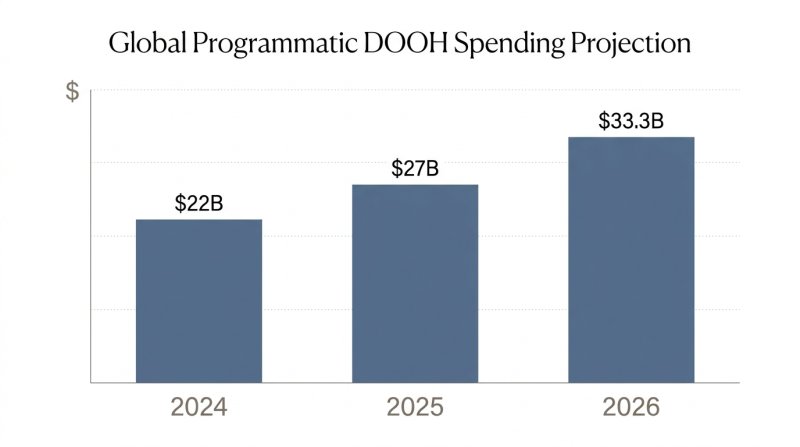
The outdoor advertising industry is undergoing its most significant shift in decades. Digital out-of-home (DOOH) advertising, once a passive medium defined by fixed locations and static placements, is now evolving into a data-driven system that reaches audiences in motion. By 2026, programmatic DOOH spending is projected to exceed $33.3 billion globally, according to Research & Markets. That figure tells part of the story. But the real change runs deeper: brands are no longer buying places. They are buying people.
This article breaks down the six trends defining DOOH advertising in 2026, what they mean for media buyers and brand strategists, and how to position your campaigns for maximum impact in a medium that has finally grown up.
From Static Billboards to Audience-First Activations
The old model was simple. An advertiser chose a location, signed a contract, and waited for impressions. It was a channel built on trust and gut instinct. That model is crumbling.
In advanced markets, over 70% of DOOH campaigns now begin with audience segments rather than static locations. This is a structural reversal. Media planners start with commuting patterns, lifestyle tribes, tourism surges, and income clusters. Only after identifying the audience do they select where screens should deliver the message.
This is what the industry calls liquid audiences: groups of people defined by behavior and intent, not by postal addresses or landmark buildings. A brand targeting high-income commuters in New York does not simply buy Times Square. Instead, it buys morning commuters who pass through transit hubs with premium purchase intent, regardless of which specific screen they pass.
The implication is significant. When audiences become fluid, inventory becomes programmable. Advertisers stop bidding on fixed assets and start bidding on moments. That reframe is driving the entire programmatic DOOH ecosystem forward.
Programmatic DOOH Crosses the Chasm
Programmatic digital out-of-home has been "emerging" for years. In 2026, it finally arrived.
One of the biggest accelerations came from automated in-advance buying, which combines the certainty of direct deals with the efficiency of programmatic infrastructure. Historically, high-demand inventory like sports venue screens or transit hubs required long-lead negotiations. Now, automated systems allow buyers to secure premium placements weeks ahead of time without sacrificing the workflow advantages of digital buying.
The result is a more flexible market. Planners manage guaranteed deals, PMPs (Private Marketplace Deals), and real-time bidding from a single platform, choosing the right model for each campaign objective. This flexibility has brought OOH into the same workflow that agencies already use for CTV, mobile, and online video. Shared KPIs, consistent reporting, and cross-channel attribution are now standard expectations, not aspirational goals.
Retail media networks are adding another layer of complexity and opportunity. In-store screens at entrances, pharmacy sections, and checkout zones now link with out-of-store pathways, creating closed-loop attribution that connects ad exposure to actual purchase behavior. The DOOH category is expected to gain over 40% in revenue by 2027, with much of that growth coming from retail-integrated experiences, according to Caretta Research.
Dynamic Creative Optimization Moves from Experiment to Standard
For years, dynamic creative optimization (DCO) in DOOH felt like a proof of concept. Campaigns would adapt messaging based on weather conditions or time of day, but execution was inconsistent, workflows were clunky, and scale was limited.
That friction is disappearing. As DSPs, SSPs, and publishers have aligned on standardized workflows, activating dynamic creative across thousands of screens has become practical for mid-sized campaigns, not just global giants.
The use cases are multiplying. A coffee brand adjusts messaging by temperature: warm drinks on cold mornings, cold brew on hot afternoons. A retailer changes hero products based on store inventory data. A sports brand rotates messaging based on game-day context. Each adaptation is automated, triggered by real-world signals rather than manual creative swaps.
AI is accelerating this shift. Rather than relying on static rule sets, machine learning models now select creative variations at scale, learning which combinations of context, audience, and message drive the strongest engagement. The technology is not replacing human creativity. It is removing the operational bottleneck that prevented creative ambition from reaching screens at scale.
The Retail Media Inflection Point
Retail environments are becoming the most strategically valuable real estate in the OOH ecosystem. Digital screens at the entrance, in the aisle, and near checkout allow brands to reach shoppers at high-intent moments, when purchase decisions are actually being made.
The overlap between physical retail and digital advertising ecosystems is redefining shopper marketing. Screens that once displayed static promotional posters now deliver data-driven messages tuned to store context, time of day, and product availability. When ad exposure can be connected to real sales outcomes through loyalty program data or closed-loop attribution, OOH gains a performance advantage it never had in the era of estimated impressions.
Many media buyers still underestimate the value of retailer first-party data in powering smarter DOOH targeting. Retailers hold rich behavioral insights tied directly to actual purchase decisions. When that data layers onto audience planning, the targeting precision improves dramatically. A brand that knows which customer segment buys organic products on Saturday mornings can now reach exactly those people on the screens they pass on Saturday morning routes.
AI Agents Are Changing How Audiences Move
Here is a trend that almost no one in the OOH industry is preparing for adequately: AI agents are beginning to influence physical audience movement.
As consumer decisions are increasingly shaped by digital assistants and voice-enabled suggestions, the pathways people take through the physical world are starting to reflect algorithmic recommendations. A person asking their AI assistant for a "good coffee shop nearby" receives a short list. The one at the top of that list benefits from foot traffic that used to come from habit or chance.
This has direct implications for DOOH planning. If AI agents are increasingly directing consumer behavior, then the screens that appear in AI-recommended routes gain value. Brands that understand how AI-driven recommendations shape movement patterns will find new opportunities in the OOH ecosystem before their competitors even recognize the shift.
This is still an emerging dynamic, but it is directionally clear. The advertisers who win in the latter half of 2026 and beyond will be those who start modeling intention-driven movement alongside traditional audience segmentation. The two approaches are not separate. They are converging.
Measurement Finally Catches Up
The historical weakness of OOH was always attribution. Brand campaigns would claim reach and frequency, but linking those impressions to actual business outcomes was largely theoretical. That limitation drove many performance-focused advertisers to discount OOH as a branding tool at best.
The measurement landscape has shifted substantially. Advanced computer vision, mobility data, and AI-powered analytics now allow advertisers to measure impressions with greater accuracy, analyze demographic trends, understand dwell time, and optimize campaigns mid-flight. The combination of first-party data from the advertiser side and location intelligence from the publisher side creates a closed loop that was impossible five years ago.
First-party data is central to this shift. Brands are bringing insights from their own customers, loyalty programs, and digital touchpoints into DOOH planning. When paired with contextual signals like time of day, location type, and environmental triggers, DOOH creative can feel timely and relevant without being intrusive. The channel is no longer asking advertisers to trust the medium on faith. It is showing receipts.
Carbon Performance Enters the Buying Criteria
Sustainability has graduated from a nice-to-have to a negotiating point.
Across Europe and Asia, media owners are scoring screens for energy use and reporting real-time emissions data to buyers. Smart cities are enforcing DOOH energy caps and prioritizing solar-powered builds. In the UK, OOH accounts for just 3.3% of advertising's total power consumption and under 3.5% of its carbon footprint, according to Outsmart and KPMG research from 2023.
That already favorable profile is improving as the industry shifts toward more efficient digital infrastructure. Recent research from billups and Cedara found that traditional OOH formats are up to 336% more carbon-efficient than programmatic video. For brands under pressure to reduce their media carbon intensity, this is not a marginal consideration. It is becoming a channel selection factor.
Buyers in 2026 are asking which screens run on renewable energy, which operators provide carbon dashboards, and how inventory compares on energy-per-impression metrics. Media owners that cannot answer those questions are losing ground to those that can.
Frequently Asked Questions
How does programmatic DOOH work?
Programmatic DOOH uses automated bidding platforms to buy OOH inventory in real time, similar to how digital display advertising works. Advertisers define audience criteria, and the system delivers messages to screens that match those criteria at the right moment. This replaces manual negotiation with API-driven transactions, making OOH buying faster and more data-driven.
What is liquid audience targeting in DOOH?
Liquid audience targeting means defining campaign audiences by behavior and intent rather than fixed locations. Instead of buying a specific billboard, a brand buys access to people who exhibit certain patterns, such as morning commuters with high purchase intent. This approach makes OOH buying more precise and easier to integrate with other digital channels.
Why is DOOH measurement improving in 2026?
Measurement is improving because of advances in computer vision, mobility data, and AI analytics. These technologies allow advertisers to connect DOOH impressions to actual business outcomes, such as store visits or purchase data, rather than relying on estimated reach numbers. First-party data from advertisers combined with location intelligence from publishers creates a closed-loop attribution model that was not possible a few years ago.
Is DOOH advertising suitable for performance-focused campaigns?
Yes. DOOH has historically been viewed as a branding channel, but the combination of programmatic buying, dynamic creative, and closed-loop measurement now makes it viable for performance objectives. Retail media networks are particularly effective, because they connect in-store screens to actual sales data, giving advertisers clear evidence of ROI.
How is carbon performance affecting DOOH buying decisions?
Carbon performance is becoming a selection criterion for sustainability-conscious brands. Media owners that provide energy scoring, renewable-powered screens, and carbon dashboards are winning preferential placement with buyers who need to reduce their media carbon footprint. OOH's carbon efficiency compared to programmatic video is a genuine differentiator in this conversation.
Key Takeaways
- Over 70% of DOOH campaigns in advanced markets begin with audience segments, not locations. Planners must think in terms of liquid audiences in motion.
- Automated in-advance buying, PMP deals, and real-time bidding now coexist in a single platform workflow. OOH is fully integrated into cross-channel media planning.
- Rule-based and AI-driven DCO is now operational at scale. Brands still running static creative in digital environments are leaving performance on the table.
- In-store DOOH, connected to retailer first-party data, delivers attribution that traditional OOH never could.
- AI agents will reshape physical audience movement patterns, creating new opportunities for brands that understand algorithmic recommendation behavior.
- First-party data, mobility intelligence, and AI analytics now make DOOH a performance channel, not just a reach channel.
- Energy scoring, renewable-powered screens, and carbon dashboards are influencing media selection among sustainability-conscious buyers.
Conclusion
DOOH advertising in 2026 is unrecognizable from the medium it replaced. The shift is not cosmetic. It is structural: from fixed assets to liquid audiences, from manual negotiations to programmatic automation, from estimated impressions to measured outcomes, from carbon-oblivious to carbon-conscious.
The brands that understand this transformation are restructuring their OOH strategies around audience intelligence, dynamic creative, and closed-loop measurement. The ones still treating digital billboards as upgraded static posters are working with a channel that no longer exists.
What started as a technology upgrade is now a strategic reinvention. OOH has become a global operating system for real-world audience activation. Whether that system works for your brand depends entirely on how intelligently you use it.
Ready to Modernize Your OOH Operations?
Join the leading OOH media owners who use AdGrid to automate their quoting, manage inventory, and grow their revenue.