
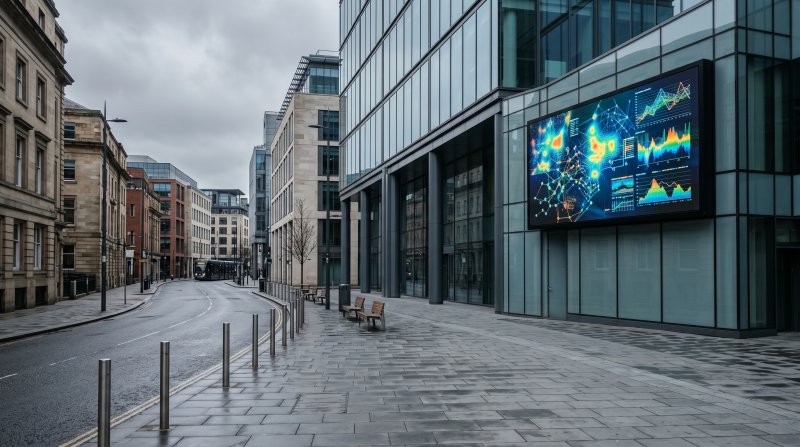
The billboard on the highway has not changed much in fifty years. A printed vinyl stretched across steel, catching wind and sun, showing the same image to every driver who passes. That model is eroding fast. In 2026, digital out-of-home (DOOH) is undergoing a fundamental shift, and the billboards that survive will be the ones that know how to talk back.
Dynamic creative optimization (DCO) sits at the center of this transformation. It is the technology layer that lets a DOOH screen show one message at 8 a.m. and something entirely different at 6 p.m., based on real-world signals like weather, foot traffic, inventory levels, or the local sports score. This is not a theoretical future state. Major media owners and technology platforms have spent the last two years removing the operational friction that once made DCO in DOOH a proof-of-concept exercise rather than a campaign staple. That work is largely done.
This post examines what is driving the DCO revolution in DOOH right now, what it means for advertisers who buy the medium, and where the practical opportunities lie for teams ready to move beyond static.
The numbers behind the shift
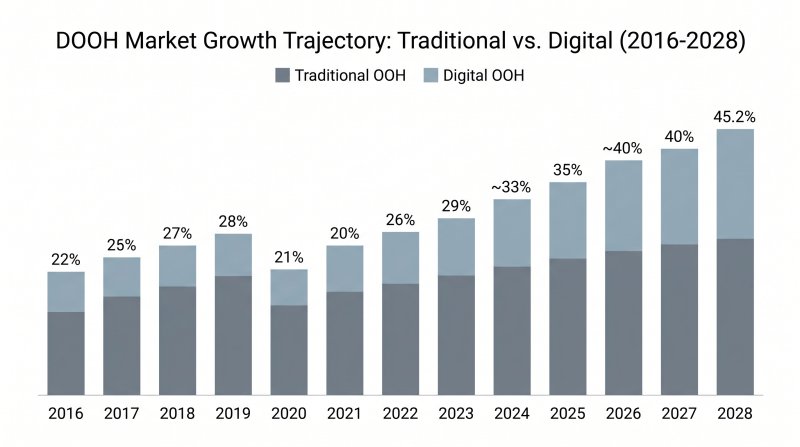
DOOH now accounts for roughly 30 to 35 percent of all OOH advertising spend in the United States, and it is growing at an annual rate of 10 to 12 percent, according to industry data. Traditional static OOH still makes up the majority of inventory, but the trajectory is clear. Analysts project that DOOH will represent 45.2 percent of total OOH ad spend by 2028. That is less than three years away.
Programmatic DOOH is a significant part of this growth. The automated buying of digital screen inventory, once limited to a narrow set of technology-forward buyers, is now a mainstream workflow for agencies and brands managing OOH budgets. In-advance programmatic guaranteed deals, which let buyers lock up premium digital inventory before a campaign launch while preserving the efficiency of automated systems, are replacing the older model of last-minute manual insertion orders. The OAAA (Outdoor Advertising Association of America) reported that total OOH revenue surpassed $9 billion annually, with digital formats accounting for the majority of new investment.
What dynamic creative optimization actually does
DCO in DOOH means using data to serve different creative executions to the same screen or screen network at different moments. The data inputs fall into several categories. Contextual signals include weather conditions, time of day, and day of week. Audience signals come from mobile location data, pedestrian counts, and in some cases retail loyalty data linked to store networks. Operational signals include product availability at nearby retail locations and event triggers like a sports score or a flight delay.
A beverage brand, for example, can configure a DOOH campaign to show iced drink creative when the temperature forecast for that zip code exceeds 75 degrees Fahrenheit, and warm beverage creative when it drops below 50 degrees. A retail chain can trigger different offers at screens near stores based on whether the store is in-stock on a featured SKU or has inventory pressure. A QSR brand can adjust messaging based on whether it is breakfast, lunch, or dinner hours in that market.
The practical implication is that DOOH stops being a broadcast medium and starts behaving more like a programmatic digital channel. The creative still appears on a physical screen in the real world, but the decisioning engine underneath it works the same way a DSP would for a display campaign.
The infrastructure finally caught up
For years, DCO in DOOH was technically possible but operationally painful. Executing a weather-triggered campaign required coordinating the brand creative team, the media owner, the DSP or SSP involved in the transaction, and the data provider, all on the same timeline and with compatible technical standards. The failure points were numerous and the turnaround times were slow.
That changed as DSPs, SSPs, and media owners built more mature integration pathways. Platforms like Broadsign, VIOOH, and Place Exchange spent 2024 and 2025 building standardized connectors that let data flow into creative decisioning without custom engineering for every campaign. The result is that a media buyer can now activate a DCO DOOH campaign through the same interface they use for CTV or digital display, using the same audience segments and the same reporting dashboards.
This convergence of workflows matters because it lowers the skill barrier. Teams that already know how to run programmatic display campaigns can apply that knowledge to DOOH without learning an entirely new system. That is a meaningful expansion of who can actually buy DCO.
Programmatic guaranteed and the in-advance shift
One of the quieter but more consequential shifts in DOOH buying is the move toward in-advance programmatic guaranteed deals. Standard real-time bidding (RTB) works well for capturing leftover inventory at the last minute, but premium digital screens in high-traffic locations often get claimed well before a campaign launch. In-advance programmatic guarantees solve this by letting buyers reserve that premium inventory through automated channels, well in advance, while preserving the pricing certainty and direct relationship benefits of guaranteed deals.
This is not a marginal trend. The OOH industry has been building toward this model as inventory digitization has accelerated and the tools for managing guaranteed and non-guaranteed OOH from a single platform have matured. In 2026, more planners are expected to manage their guaranteed and RTB OOH from unified consoles, choosing the right model for each campaign objective rather than treating them as separate workflows.
For advertisers, this means it is now realistic to plan DOOH alongside CTV and mobile in the same campaign architecture, using shared KPIs, consistent audience definitions, and unified reporting. The medium is no longer a standalone insert in a media plan. It is part of an omnichannel ecosystem.
Retail media is pulling DOOH closer to the shelf
Retail media networks have grown aggressively over the past three years, and the connection between retail media and DOOH is getting tighter. Retailers are converting store environments from passive shopping spaces into active media channels. Digital screens at store entrances, along aisles, near pharmacy sections, and at checkout zones now represent significant inventory for brands trying to reach shoppers at the moment of purchase decision.
The opportunity for advertisers is using retailer first-party data to power smarter OOH targeting. A retailer knows which customers buy peanut butter every week. That same retailer can help a peanut butter brand target DOOH messaging to households in a defined radius around stores where that product is in stock, and then measure whether that exposure correlates with a lift in purchase frequency. When ad exposure can be connected to actual sales outcomes, OOH gains a measurability advantage it has not historically had.
The tighter integration between in-store digital screens and off-site DOOH is pushing the medium toward accountability that traditional OOH never had to deliver. Brands are no longer satisfied with impressions. They want visitation data, loyalty program response, and sales lift. Retail media ecosystems are providing the closed-loop measurement that makes those claims credible.
Audience-first planning replaces location-first planning
The older model for buying OOH was straightforward. A media planner identified high-traffic locations, negotiated a rate for a two-week run, and handed the creative to the media owner. The planning was location-centric because the medium was location-centric. You bought a place and hoped the right people passed it.
Audience-first planning inverts this. Instead of starting with a screen location and then estimating who walks by, buyers start with the audience they want to reach and then find the screen environments where that audience is actually present. This shift is enabled by the same mobile location data and audience segmentation tools that power programmatic digital advertising. The screens become delivery mechanisms for an audience strategy rather than the strategy itself.
This changes how success is measured. Reach and impressions remain relevant, but they are joined by dwell time, foot traffic visitation to nearby stores, and cross-channel attribution. The metrics are getting more sophisticated because the buying is more sophisticated.
The role of AI in creative at scale
AI is beginning to play a more active role in the DCO creative workflow. The manual production of creative variations for different audience segments, weather conditions, and dayparts was a bottleneck that limited how granular DCO campaigns could get. If every creative variant required a designer to produce a unique execution, the economics broke down at a certain level of variation.
Generative AI tools are changing this calculation. Creative teams can now produce a base set of DCO executions and use AI to generate the permutations needed for different triggers without manual production for each one. A campaign that once required 10 distinct creative executions can now support 50 or 100, covering finer-grained audience segments and trigger conditions.
The practical effect is that DCO campaigns are moving from a handful of variants to dozens or hundreds, which shifts the performance gap from who can execute DCO to who can configure the decisioning logic well. The creative production bottleneck is being replaced by a strategic configuration bottleneck. Knowing what to trigger, when, and for whom becomes the differentiating capability.
What this means for your campaign planning
If you are managing DOOH campaigns today or in the near future, several practical implications follow from these trends.
First, DCO is now a viable default rather than a premium add-on. The platforms that support dynamic execution have matured enough that the marginal cost and complexity versus static DOOH is low. For campaigns with any meaningful data infrastructure behind them, defaulting to dynamic creative should be the starting assumption rather than the upgrade tier.
Second, plan your data triggers before you brief your creative team. The limiting factor on DCO performance is usually not the technology but the quality of the trigger logic. A weather-triggered campaign will only be as good as the weather segments you define and the creative permutations mapped to those segments. Spend time on the decisioning matrix before the creative production begins.
Third, treat DOOH as part of your programmatic ecosystem, not alongside it. The unified platform trend means DOOH can now sit in the same campaign architecture as CTV, mobile, and online video. That integration creates real opportunities for cross-channel attribution and frequency management that were not available when OOH was bought as a standalone medium.
Fourth, push your media owner or DSP for retail media integration if your brand has a retail footprint. The data linkage between in-store screens, off-site DOOH, and actual purchase behavior is the combination that makes OOH accountable in a new way. Not every media owner can deliver this today, but the ones that can will command a premium because the measurement story is stronger.
The physical world is catching up to digital expectations
The most significant thing happening in DOOH right now is not any single technology. It is the closing of the gap between what digital advertising buyers expect from a programmatic channel and what DOOH can deliver. Real-time targeting, dynamic creative, granular measurement, unified reporting, in-advance guarantee options. These capabilities have existed in display and video advertising for years. DOOH is catching up, and the pace of that catch-up is accelerating.
For advertisers, the implication is straightforward. The physical world advertising that was once limited to static brand awareness is becoming a data-driven, measurable, dynamically personalized channel that integrates with the rest of a modern media plan. The screens on the highway and in the mall and at the grocery store are becoming as addressable as the phone in your pocket. That is the story of DOOH in 2026, and it is only the beginning.
Key Takeaways
- DOOH now represents 30 to 35 percent of total OOH spend and is growing at 10 to 12 percent annually. It is projected to reach 45.2 percent of OOH spend by 2028.
- Dynamic creative optimization lets advertisers serve different DOOH messages based on real-world triggers like weather, time of day, inventory levels, and audience data.
- Programmatic in-advance guaranteed deals are replacing last-minute insertion orders for premium digital inventory, making DOOH easier to plan alongside CTV and mobile.
- Retail media integration is pushing DOOH toward closed-loop measurement, connecting screen exposure to actual purchase behavior.
- AI is reducing the creative production bottleneck for DCO, enabling hundreds of permutations where once only a handful were feasible.
- DCO is no longer a premium add-on. It is becoming the default execution mode for data-forward DOOH campaigns.
Frequently Asked Questions
What is dynamic creative optimization in DOOH? Dynamic creative optimization in DOOH is the practice of using real-time data signals to serve different creative messages to the same digital screen at different moments. Instead of a single static ad running for the duration of a campaign, a DCO-enabled DOOH screen can display weather-specific, time-of-day-specific, or audience-specific creative based on triggers configured before the campaign launches.
How does DCO in DOOH differ from traditional static OOH advertising? Static OOH shows the same creative to everyone who passes a billboard for the full duration of the campaign. DCO-enabled DOOH can change the creative in real time based on contextual signals. A screen near a coffee shop might show iced drinks on warm mornings and hot drinks on cold mornings. The targeting is dynamic rather than static, and the measurement can connect exposure to real-world outcomes.
What data powers DCO campaigns in DOOH? Common data signals include weather forecasts for the screen location, time of day and day of week, mobile location and audience footfall data, product availability at nearby retail locations, sports scores and event triggers, and retailer loyalty program data when the campaign is integrated with a retail media network.
Is programmatic DOOH only for large brands with big budgets? No. The maturation of DSP and SSP platforms has lowered the barrier to entry for programmatic DOOH significantly. Small and mid-market advertisers can now access DOOH inventory through the same programmatic interfaces used for digital display advertising, with minimum spend thresholds that are increasingly competitive with other digital channels.
How is AI changing DOOH creative production? AI tools are reducing the cost and time required to produce the large number of creative permutations that DCO campaigns need. Instead of manually producing every variant, creative teams produce a base set of executions and use AI to generate the permutations needed for different triggers. This shifts the bottleneck from creative production to strategic configuration of the decisioning logic.
What is the relationship between retail media and DOOH? Retail media networks are investing heavily in in-store digital screens, and DOOH is becoming an extension of those networks. When brands advertise on DOOH screens near retail locations, retailer first-party data can connect that exposure to purchase behavior, creating closed-loop measurement that traditional OOH could not provide. This integration is a major driver of increased DOOH investment from consumer packaged goods brands.
Ready to Modernize Your OOH Operations?
Join the leading OOH media owners who use AdGrid to automate their quoting, manage inventory, and grow their revenue.