

Your Billboard Setup Is Stuck in 2015
Last updated: April 28, 2026
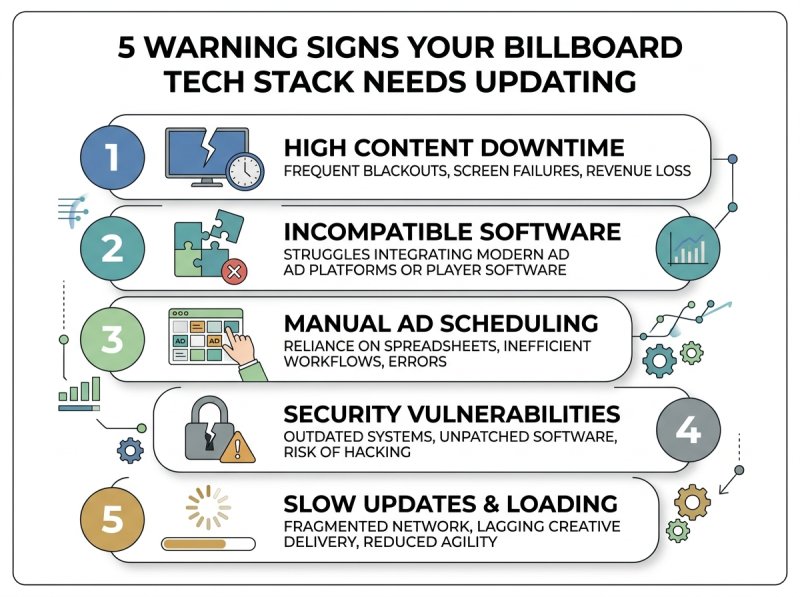
Let me tell you about Marcus. Marcus runs a mid-sized outdoor operation in Ohio — forty-three panels, two sales reps, one guy named Dave who handles "everything IT." Dave's been there since 2009. He knows the network better than anyone. He also has never heard of an API.
Last month I watched Marcus try to respond to a programmatic DOOH opportunity. The buyer wanted a response in four seconds. Marcus's team was manually checking a spreadsheet to see if the panel was available. They missed it. Of course they missed it.
This is not a story about Marcus being bad. This is a story about an industry that built its infrastructure on quicksand and called it bedrock.
The Three Reasons Operators Don't Move
1. The Spreadsheet Trap
Most billboard operators — companies running anywhere from twenty faces to a few hundred — still track their inventory in spreadsheets. Not spreadsheets with any sophistication. I mean cells that say "SOLD" or "AVAILABLE" with a date in the corner that someone has to manually update.
A buddy of mine, Theresa, runs a family-owned outfit in Tennessee. Her inventory system is a Google Sheet that five people have edit access to. Last Tuesday, two of them updated it at the same time. The version conflict ate a booking. The client found out when their ad didn't run. Theresa spent three hours on the phone apologizing.
The spreadsheet trap isn't about being cheap. It's about perceived risk. The spreadsheet works well enough, until it doesn't. And operators have been burned by "modernization" projects that cost $80,000 and produced a system nobody could actually use. So they stay. They patch. They tolerate.
If this sounds familiar, you should read our breakdown of why billboard operators still run inventory in spreadsheets. Same problem, different angle.
2. "If It Ain't Broke"
The second reason is identity. Operators have built relationships, reputation, revenue on their current setup. Switching feels like admitting you were wrong. Or worse — it feels like risking client relationships that took decades to build.
I've talked to operators who literally say: "My buyers know how to work with me. They call, I check the board, I confirm. It works."
And you know what? It does work. For now. For a certain definition of "work."
But here's what they don't see: the buyer who didn't call because they found a programmatic platform that could place the campaign in forty-three markets while they were asleep. The media planner who moved budget to digital because the reporting was easier. The agency that started treating OOH as a "legacy channel" because the tech integration was too painful.
That pain is real. It's happening right now. And it's accelerating.
3. The Migration Horror Stories
Every operator I know has heard the story. The big regional shop in Georgia that spent eighteen months and $400,000 on a new platform. They migrated. The system crashed during a high-profile campaign launch. The sales team went back to paper orders. They eventually got it working, but the damage to client trust took two years to rebuild.
Or the operator in California who discovered his new "cloud-based" inventory system required a fiber connection he didn't have at two of his most profitable locations. He'd signed the contract. The implementation started. He was trapped.
These stories spread. They become mythology. And every time an operator considers moving, the mythology whispers: you could be next.
Which brings me to what an actual migration actually looks like. Because the mythology is wrong. Or at least, it's only half the story.
What an Actual Migration Looks Like
First, let's be honest about the difficulty. Migrations are hard. Not "difficulty escalating" hard, but genuinely painful in ways that don't show up in vendor demos.
I watched a 60-panel operator in Michigan migrate last year. Here's what actually happened:
Month 1: Vendor promises "seamless transition." Sales team ignores the new system because their old one still works. Nothing bad happens, so everyone assumes the problem is solved.
Month 2: First real test. A large regional grocery chain wants to book forty panels across three markets for a six-week campaign. The old system shows availability. The new system shows availability. They book. Implementation goes to the new system. Two panels weren't actually available — the old system had them marked reserved in a notebook nobody had updated.
The client finds out. Not great. Not catastrophic. But it shook confidence.
Month 3-6: Painful reconciliation. Sales reps start using both systems simultaneously as a trust-building exercise. This is, as the kids say, not scalable. But it works. Slowly, they migrate.
Month 9: The new system is fully live. The sales team hates it less than they thought they would. Two junior reps who grew up with modern UI actually prefer it.
Month 12: The operator tells me the migration was "worth it, barely, but definitely worth it."
That's the honest story. Nine months of discomfort followed by a system that actually works. Compare that to the alternative — staying on infrastructure that wasn't designed for 2026, let alone 2030.
The real lesson? Migrations fail when operators try to do it all at once. The successful ones I've seen go in phases. Inventory first. Then booking. Then reporting. Then API integration for programmatic buyers.
Think of it like renovating a house while you live in it. Yes, it's inconvenient. But the house doesn't have to be empty for the work to get done.
For more on what a proper proposal looks like — and how to evaluate these vendors — see what your billboard proposal is missing. This applies to tech vendor selection too, almost exactly.
What the Audience Measurement Guys Actually See
I spend time with the Geopath team when I can. Not as part of any formal arrangement. Just because the people who sit on the other side of the OOH measurement problem are worth listening to. They see thousands of inventory faces across the country, and they see patterns that operators in the trenches don't always notice from ground level.
Here's what I mean. Geopath calculates IMPs — impressions — for OOH inventory using a combination of traffic counts, audience pass-through rates, and geographic calibration. The methodology is auditable, the data is peer-reviewed, and it is the closest thing this industry has to a standardized currency. Geopath's inventory database is what makes it possible for buyers and sellers to agree on what a panel is actually worth in gross rating points.
The problem is this: operators with outdated inventory systems often report circulation figures that don't match what Geopath has on file. Not because anyone is lying. Because the handwritten sign counts from 2019 are still sitting in a binder on someone's desk, and nobody has touched them since the highway rerouting happened. The data underneath the deal has gone stale without anyone noticing.
I've spoken with media buyers who now require Geopath IMP data as part of any proposal above $25,000. Not as a nice-to-have. As a hard requirement. They want the panel-level GRPs, the weekly gross rating points, the audience composition breakdown by daytime versus evening commute windows. If you can't produce that data within 48 hours of a request, you are not in the conversation anymore. You are on the outside looking at an RFP you will never receive.
One buyer I know — she handles out-of-home for a regional bank chain — told me she now filters for digital bulletin inventory at minimum 14-light illumination, standard trivision rotation speed, and IMP scores above 20,000 weekly. She sends the spec sheet to operators and waits. The ones who come back with properly formatted Geopath data within 24 hours get the buy. The ones who send PDFs from 2017 with handwritten annotations get a polite no. She's not being difficult. She's being professional. And there are a lot more buyers like her showing up every quarter.
That is the tier where the market is moving. And if your system can't talk to the measurement infrastructure that buyers are increasingly demanding, you will keep losing deals you didn't even know you were bidding on.
The Cost of Waiting
Let's talk numbers, because numbers are what make people listen.
Last year, I worked with an operator in Texas — call him David — who had 127 panels across three markets. He was resistant to any tech change. His system was "fine." He told me that word for word: "It's fine."
Here's what happened to David over eighteen months:
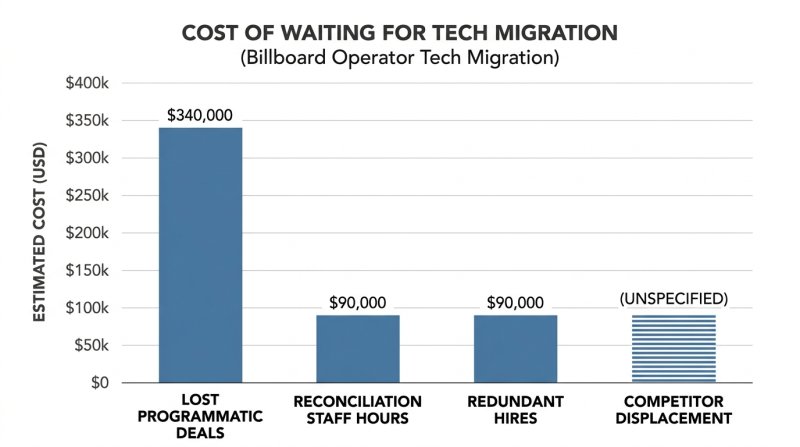
- Lost two programmatic deals worth $340,000 combined because he couldn't respond fast enough through manual processes
- Spent roughly 600 man-hours per year reconciling booking conflicts between his paper system and actual inventory
- Watched a competitor 90 miles away capture a major QSR chain's regional buy because their system integrated directly with the agency's DSP
- Hired two additional sales support staff at approximately $45,000/year each — staff he wouldn't have needed if his inventory system worked properly
David's "fine" system was costing him somewhere between $180,000 and $250,000 per year. He just couldn't see it because the costs were diffuse. They showed up as "staff time" or "lost opportunity" rather than "your tech stack is broken."
The Bureau of Labor Statistics tracks employment and wages across industries. The data on tech investment in the advertising sector is not flattering for operators who've delayed. While digital ad channels invest aggressively in automation, OOH has stayed paradoxically manual in many operations. BLS data on advertising sector wages and employment patterns shows where the talent is flowing, and it's not toward legacy systems.
The cost of waiting isn't static. It compounds.
Every year you delay, another slice of your potential buyer pool moves upmarket to partners who can handle programmatic volume. Every year, another generation of media buyers enters the workforce who've never called a sales rep for a billboard. They don't know the ritual. The old dance. They don't want to learn it. They want an API and a dashboard.
The OAAA has been tracking industry trends in out-of-home advertising — the data consistently shows programmatic DOOH growing at double-digit rates while traditional booking methods plateau or decline. That's not a prediction. That's already happening.
You can sit on the sidelines and watch it happen, or you can get in the game. But understand: the longer you wait, the more customers you lose that you'll never get back.
Frequently Asked Questions
How long does a typical migration actually take?
Most operators underestimate this. A realistic timeline for a 50-100 panel operation is six to twelve months for full migration with minimal disruption. Smaller operations (under 30 panels) might do it in three to four months. Bigger than 150 panels? Start thinking in eighteen months, minimum. The people side — training, change management, the sheer organizational inertia — takes longer than the technical side. Plan for that.
What's the actual cost? Not the vendor quote — the real cost.
Vendor costs vary wildly. I've seen quotes from $15,000 to $500,000. The real cost is usually 1.5 to 2x the vendor price when you factor in internal staff time, opportunity cost during transition, and the inevitable consulting hours when something goes sideways (and something always goes sideways). Budget accordingly. The operators who get surprised are the ones who only looked at the software contract.
Can we do this incrementally or do we have to rip off the bandaid?
Please, for the love of everything, do it incrementally. Phase 1 should always be inventory management only. Get that right. Get everyone using it. Then layer in booking. Then reporting. Then API. Trying to migrate everything at once is how you end up with a $400,000 disaster story that everyone tells at industry conferences.
What if our sales team revolts?
They will. To some degree. Here's the thing: your best sales reps are probably the ones who hate the current system most — they just cope better than anyone else. Bring them in early. Make them part of the selection process. Let them kick the tires. People support what they help build. Also, offer training in chunks — don't do a full-day session nobody will remember. Three hours a week for six weeks beats eight hours on a Saturday.
How do we handle the data? We have years of historical bookings in old formats.
This is a real problem. Most legacy systems have data that's messy, inconsistent, or stored in file formats nobody remembers how to open. My advice: don't try to migrate everything. Migrate the last 24 months of active data. Archive the rest. Yes, you'll lose some historical context. No, it won't kill you. Trying to clean five years of booking data will delay your migration by six months and cost you $30,000 in consultant fees.
What about our buyers who call in? Do they have to change?
Not immediately. Phase 1 should keep the phone order workflow intact. The goal is to make your team faster, not to force your buyers into a new system before they're ready. You can absolutely run a hybrid model — phone orders handled manually, digital bookings automated — while you transition. The hybrid phase sucks, but it's better than the alternative (broken workflows during migration).
Is it worth it? Honestly?
I've seen maybe fifteen to twenty full migrations over my career. The ones that succeeded: zero regrets, even the painful ones. The ones that failed were almost always failures of expectation management, not technology. Go in knowing it'll be hard. Go in knowing it'll take longer than promised. Go in knowing your team will complain. And then do it anyway. The alternative is being Marcus, watching programmatic deals slip away, wondering why the buyer never called back.
The Part Where I Give You Advice
I've been doing this for a long time. Long enough to remember when "programmatic OOH" was a PowerPoint concept people joked about at conferences. Now it's real, it's growing, and it's leaving operators behind.
If you're running a billboard operation with more than 30 panels and you're still managing inventory in spreadsheets or legacy software that hasn't been updated since 2014, you're not just behind — you're bleeding money you can't see.
The good news: you don't have to fix everything at once. You just have to start. Pick one vendor. Run a pilot on twenty panels. Learn what works. Then expand.
Or don't. Keep running your setup the way you've been running it. Hope that the industry stays exactly like it is today. Hope that programmatic never figures out how to work with your inventory. Hope that your clients never find a better option.
Hope is not a strategy. It's barely even a plan.
The path forward isn't that complicated. It's just uncomfortable. And the cost of staying uncomfortable is higher than you think. I promise you that.
For more on how OOH pricing actually works, see our post on billboard rate negotiation. The two problems are connected more than most operators realize.
If you want to see what modern OOH inventory management can actually look like — no vendor pitch, just a demo — you know where to find us. No pressure. But the door's open.
About the Author
James Okafor has been working in programmatic OOH since before the acronym "DSP" was a thing people used in sentences. He's watched the industry evolve from paper tickets to pixels and back again (in some markets). He writes about the gap between how billboard technology works and how it should work. He is an Ad Tech Analyst at AdGrid. The opinions above are his own, which he's had for many years and isn't particularly interested in changing.
James Okafor has been working in programmatic OOH since before the acronym "DSP" was a thing people used in sentences. He has watched the industry evolve from paper tickets to pixels and back again, in some markets. He writes about the gap between how billboard technology works and how it should work.
Ready to Modernize Your OOH Operations?
Join the leading OOH media owners who use AdGrid to automate their quoting, manage inventory, and grow their revenue.