
A rep I know in Chicago let a six-figure deal go dark last summer. Regional retailer, twelve-week flight, two markets. He had the call on a Tuesday, sent the proposal that Friday. Then he waited. Waited for the buyer to come back. Waited because that is what operators do.
His competitor found out about the buyer three weeks later. By then the deal was already running on someone else's boards.
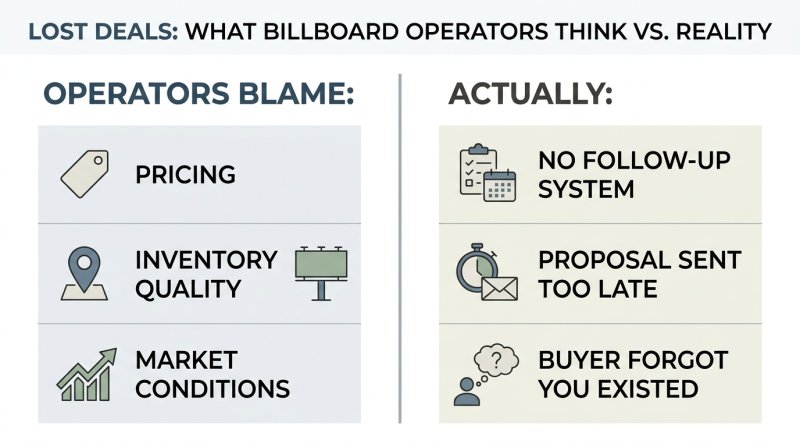
I have heard some version of this story from operators in a dozen markets. The details change. The outline does not. The call goes well. The proposal goes out. The deal goes quiet. Nobody follows up with purpose. The buyer moves on, not because they did not like the inventory, but because they got busy and nobody brought the deal back to the top of their stack.
Pricing gets blamed most of the time. Inventory gets blamed some of the time. The actual killer, the thing I see wrecking closeable deals across every market tier I have worked, is the follow-up gap. What happens after you hang up.
Why OOH Sales Has a Follow-Up Problem
Here is the thing about OOH sales training. It is all about the first call. How to qualify the buyer. How to present the inventory. How to handle the rate question. Every workshop, every certification, every piece of sales collateral is built around that first conversation.
Nobody teaches you what to do on Day 4. Day 5. Day 8.
In my experience, the operators who are good at their jobs are good at the first call. They know their markets. They know their boards. They can answer circulation questions without pulling out a rate card. They give buyers confidence.
Then they hang up, and the deal goes quiet, and they decide that means the buyer is thinking about it. Making a decision. Running it up the chain.
What it usually means is the buyer got pulled into something else and forgot you exist. That is not a knock on buyers. That is just how purchasing works when OOH is one of a dozen media channels competing for a budget that has not been decided yet. Your proposal is sitting in an inbox with 340 other emails. The buyer is dealing with their CFO, their media planner, and their product launch that is three weeks out.
The operators who keep deals alive are not better at the first call. I will say that again because it is the most counterintuitive thing in this business: they are not better at the first call. They are better at what comes after. They have built a follow-up structure that keeps the deal in front of the buyer without being annoying about it. They treat the follow-up as part of the sales process, not an interruption to it.
Most operators have not built that structure. So they lose deals they should have closed.
There is a secondary problem underneath this that is worth naming. A lot of operators are managing their follow-up process the same way they manage their inventory: in their head, or in a notebook, or in a spreadsheet only they can read. When the rep who handled the first call is also the one supposed to follow up, and they are also managing twelve other things that day, the follow-up does not happen on time. It does not happen consistently. Eventually it does not happen at all.
For more on how operational disorganization shows up in operator workflows, the AdGrid team wrote about why inventory management in spreadsheets is the root cause of half the problems operators attribute to pricing.
The 72-Hour Gap That Costs You the Deal
The single most expensive thing in OOH sales is silence.
If a buyer calls you on Tuesday and you send the proposal on Friday, you have given them four days to fill with other thoughts. By Friday afternoon their CFO has asked about the media plan. By Thursday a competitor has followed up with a lower number. By Friday your proposal arrives and it feels like it is arriving late, even if the timing is reasonable on paper.
The operators who close at the highest rates have internalized something that sounds simple but is not: the follow-up is not a courtesy. It is the close.
Specifically, here is what I see working:
The first follow-up goes out within 24 hours of the initial call. Not 48. Not end of the week. 24 hours. That follow-up is not a proposal. It is a confirmation that you heard them. A one-paragraph note: "Great talking through this today. Based on what you described, I am putting together a package for the River North and Evanston markets. You will have it by Thursday."
That note does three things. It confirms you are working on it. It gives a specific delivery timeline. It puts a date on the map.
The second follow-up is the proposal, sent on the promised date, with a brief cover note pointing to the most relevant item for their situation. Not a forwarding of an attachment with no context. A note that takes 90 seconds to write: "Here is the package we discussed. The River North digital face at I-90 and Grace is the anchor. I have also included the Evanston static option as a lower-cost alternative. Let me know if you want to talk through either one before the internal review."
That note does two more things. It makes the package feel tailored, not templated. It gives the buyer a reason to respond, because you have asked them a question.
The third follow-up goes out four days later, if you have not heard back. Not a reminder that you sent something. A new piece of information. A relevant article about their category. A data point about the market they are buying in. Something that shows you are paying attention to their business, not just waiting for a signature.
I want to pause here and say something honest. This is not a natural instinct for most operators. The feeling when you have sent a proposal and you have not heard back is to feel like you are bothering someone. To wait. To give them space. That instinct is exactly wrong. The buyers who are worth the most to you are the ones with the most going on, which means they need the most follow-up to keep your deal from falling off their radar. The ones who respond immediately to your first proposal are not necessarily your best clients. They might just be the ones who had fewer things on their plate.
Four Follow-Up Calls That Should Never Happen
The most expensive calls in OOH sales are the ones that happen when it is already too late. Here is what I mean.
The just-checking-in call. This happens three weeks after the proposal went silent. The rep calls, says they are just checking in, and the buyer has to pretend they have been thinking about it. What they have actually been doing is working with your competitor who followed up two weeks ago and sent a proposal that feels more recent. There is no way to recover the energy in this call. I have tried. It does not work.
The has-the-buyer-seen-it call. This happens when a manager asks the rep if the buyer has opened the email. The rep does not know because they have no tracking on their proposals. So they call and ask. This call signals to the buyer that you do not have a system. That is not the impression you want to leave. One of the operators I worked with in Chicago told me he knew he needed to move off spreadsheets when a buyer asked him during a call whether his proposal system could send read receipts. He had to admit it could not. He was embarrassed. He did not need to be, but he was.
The let-me-explain-our-rates call. This happens when the buyer comes back with a pricing objection and the rep, who did not follow up proactively, now has to defend a number that has been sitting in their inbox for ten days without context. By this point the buyer has formed an opinion about the rate and the rep is on defense. This is not a position you want to be in. It is also avoidable.
The I-did-not-know-you-had-already-signed call. This is the worst one. It happens when a rep finds out from the market that a buyer they were in conversation with has been running a campaign with a different operator for three weeks. They did not know because they did not follow up, and they did not follow up because they assumed the buyer would tell them. Buyers do not always tell you. I wish they would. They do not.
For the full anatomy of what a proposal needs to contain before it goes out, our piece on what your billboard proposal is missing covers the things that should be in every package. The follow-up is downstream of the proposal. If the proposal is missing the things that matter to the buyer, no amount of follow-up saves the deal.
Building a Follow-Up System That Closes Without Chasing
Here is what I want operators to understand about follow-up systems. The goal is not to call more often. The goal is to call with purpose, on a timeline that keeps your deal alive without making the buyer feel pestered.
The difference is in the question you ask yourself before every outreach.
If you are asking "how do I get them to respond," you will send generic check-ins and feel vaguely annoying doing it. If you are asking "what would make this easier for them right now," you will send relevant information and specific next steps. The second question leads somewhere. The first one does not.
One of the operators I worked with in Chicago put it this way: "I stopped thinking of follow-up as chasing and started thinking of it as curating." That stuck with me.
What that looks like in practice: your follow-up calendar is not a reminder to call someone. It is a schedule for delivering specific value to specific buyers on a specific timeline. The buyer who asked about River North inventory on Tuesday is getting a market update on Friday that is relevant to their Q3 planning. The buyer who went quiet on a proposal is getting a note that says "rates on comparable boards in this DMA moved in June, here is what that means for your package." These are not check-ins. They are data points.
This is also where technology helps, and I do not say that lightly. A shared pipeline view does not make you a better salesperson. But it does make sure that when a rep is out sick on Thursday, the follow-up for the six-figure deal does not fall through the floor. The manager can see that the proposal was sent, that it was viewed, and that the second follow-up is scheduled. That visibility is worth more than any CRM feature.
For operators running multiple sales people across markets, a shared system for tracking who said what, when they said it, and what the next step is, is the difference between a follow-up process and a follow-up gap. I have seen operators lose deals because the person who had the first call left the company and nobody knew the buyer had asked about daypart pricing on digital inventory. That information was in one person's email history. When that person left, it left with them.
The other thing that matters is the handoff. When a deal moves from initial inquiry to proposal stage, the person who had the first call needs to brief the person who is writing the proposal, and that person needs to be included in the follow-up loop. Buyers are not talking to a company. They are talking to a person. If your proposal comes from an email address they have never heard from before, with no context about the prior conversation, you have just reset the relationship. This sounds obvious. It happens constantly.
What a Real OOH Follow-Up Timeline Looks Like
I want to be specific here, because "follow up more" is not useful advice. Here is what a real timeline looks like for a mid-market deal, from call to close.
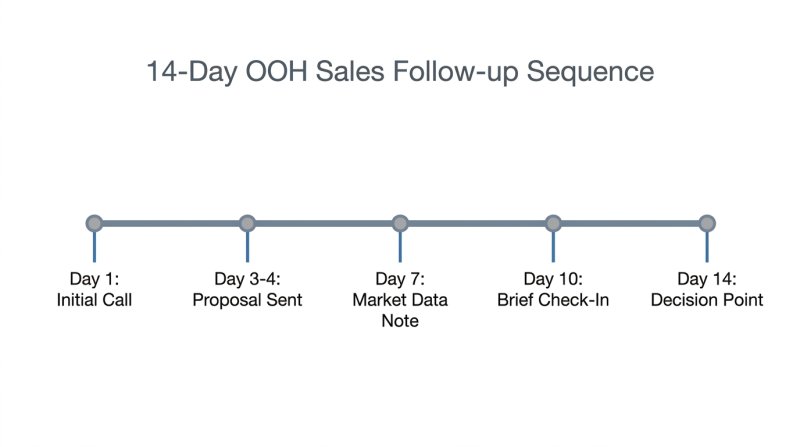
Day 1. Initial call. You capture what they need, what their campaign timeline looks like, who else is involved in the decision, and what their biggest concern is about OOH. You send a same-day confirmation email: "Based on our conversation, I am putting together X and Y. You will have it by Thursday."
Day 3 or 4. Proposal sent. Not Day 5. Not Day 7. Day 3 or 4. With a cover note that references the specific conversation from Day 1.
Day 7. If you have not heard back, send a brief note with a market data point or a relevant observation. Not a reminder. A new piece of information. "June data from Geopath on the O'Hare corridor shows a 12 percent uptick in weekly impressions versus Q1. Happy to walk through what that means for your CPM if it is useful."
Day 10. If still no response, a second note. Brief. Low pressure. "Just wanted to make sure the package made it through. Happy to hop on a 15-minute call if it is easier to talk through the options."
Day 14. If you have not heard back by Day 14, the deal is not dead but it is on life support. At this point the call you need is not a check-in. It is a "I have another buyer who is looking at the same River North inventory and I want to give you a chance to lock it before it goes to someone else." That is not pressure. That is information. If you are actually in that situation. Which you should be, if your inventory is moving.
The operators who consistently close at the top of their market are not the ones who have better inventory. They are the ones who run this timeline without having to think about it. It becomes a process, not a feeling.
One thing I want to add here, because I have been told I am being too optimistic about operator bandwidth: if you are a one-person shop running 20 faces, this timeline is harder. You do not have the same infrastructure. You are also probably getting inbound inquiries that are lower quality, which means your close rate on outbound should be higher to compensate. The math changes at every scale, but the principle does not. Consistent follow-up with specific value beats sporadic check-ins every time.
FAQ
How many follow-ups should you do before giving up on a billboard deal?
Give it at least four structured touches over three to four weeks before assuming the buyer is gone. Most buyers in OOH are not saying no. They are saying I have not gotten to this yet. The ones who have decided against you will usually tell you, if you give them a reason to respond. The ones who have gone quiet are often just waiting for the next touch to bring your deal back to the top of their stack. What I have seen work: send something genuinely useful on touch three or four, not just a "checking in." If you cannot think of anything genuinely useful to send, that is information. It means you do not know enough about their business yet to be useful. Go learn something before you follow up again.
What should you say in a follow-up email that is not a proposal re-send?
Give them something new. A relevant data point, a market observation, a note about a campaign that ran successfully in their category. The worst thing you can do is send the same email again with a different subject line. Buyers recognize that. It makes you look disorganized and desperate. A good follow-up note is specific to them, not templated for everyone in your pipeline. I have gotten templated follow-up emails from vendors. I have never once responded to one. I have responded to follow-up notes that clearly came from someone paying attention to what I said I was working on.
How do you follow up with a buyer who has gone silent after receiving a proposal?
First, do not call and ask if they saw it. That signals you have no tracking. Send a follow-up note that adds new information rather than reiterating what was already in the proposal. Reference a specific element of their situation that has become more relevant since you sent it. Offer a call to walk through their questions. If you do not hear back after that, give it four more days, then call. At that point the call should be brief and direct: "I wanted to make sure we did not lose this one to timing. Is there anything I can help clarify?" The key word there is "timing." You are not asking them to buy. You are reminding them that you exist and that their window may be closing. Buyers respond to that more than they should admit.
Is there a point where following up becomes too pushy?
Yes, and the line is when your outreach is about your anxiety rather than about their situation. "Just checking in to see if you have had a chance to review the proposal" is about your anxiety. "I wanted to share some Q2 circulation data that came out last week that is directly relevant to what you are planning in the North Side market" is about their situation. If you cannot articulate what value you are delivering in the follow-up, wait a day and think about it again before sending. Also: if you have sent four notes and gotten no response, stop. Something is wrong that follow-up will not fix. Either they have moved on or there is a blocker you do not know about. A fifth note does not recover either one.
How does the follow-up process change for digital versus static inventory?
Digital inventory moves faster and the follow-up timeline needs to reflect that. If a buyer is evaluating digital faces for a campaign in the next 60 to 90 days, the gap between your first call and your proposal needs to be shorter, not longer. Static inventory gives you more breathing room but the same dynamic applies. Silence is not a sign the deal is dead. Consistent follow-up with new information is what keeps it alive. The one difference with digital is the daypart conversation. Buyers who are buying digital want to know about daypart availability and daypart pricing, which means your follow-up can include daypart-level inventory updates that are genuinely useful to them. Use that.
Last updated: April 27, 2026
About Priya Nair
Priya Nair leads sales strategy at AdGrid. Before joining the team, she spent five years in OOH sales in Chicago, where she built the sales operations function for a regional billboard network managing faces across the Chicago metro and surrounding suburban markets. She has negotiated deals ranging from single-face placements to multi-market annual packages and has a reputation for knowing exactly when to follow up and what to say when she does. She is the person operators call when they want to understand why their close rate is lower than it should be and what to do about it.
Priya Nair leads sales strategy at AdGrid. Before joining the team, she spent five years in OOH sales in Chicago, where she built the sales operations function for a regional billboard network managing faces across the Chicago metro and surrounding suburban markets.
Ready to Modernize Your OOH Operations?
Join the leading OOH media owners who use AdGrid to automate their quoting, manage inventory, and grow their revenue.