
Billboard Rates Are Negotiable. Here Is What Actually Determines What You Pay.
Every week, at least one buyer comes to us with the same opening line: "We got a quote from Lamar for $4,200 a month." My response is always the same. "That's the card rate. What did they actually say when you pushed back?"
Usually, the answer is nothing. They took the first number. That's fine if you have the budget and the timing is right. But for most mid-market brands testing out-of-home for the first time, accepting the listed rate means leaving real money on the table.
Billboard pricing is not like buying a plane ticket. There is no algorithm adjusting the price by the second. There is a rate card, and then there is what operators actually accept. The gap between those two numbers varies from 10 percent to 40 percent, depending on market, timing, and frankly, how you carry yourself in the conversation.
After eight years of negotiating OOH deals on behalf of brands and agencies, here is what I have learned about how these rates actually get set.
Why the Listed Rate Is a Starting Point, Not a Ceiling
The out-of-home industry publishes rate cards as a reference, not a rule. An operator publishes what they want to receive for a given face. Then the negotiation begins. Or it doesn't, depending on market conditions and the buyer's approach.
The rate card exists for two reasons. First, it gives sales teams a number to start from. Second, it establishes a ceiling in the operator's mind. When you negotiate well, you are trying to move the final accepted rate closer to the floor, not the ceiling.
On a standard 14-by-48 poster in a secondary market, the card rate at Lamar might sit around $1,800 per month. In our experience, brands who negotiate based on annual commitment, inventory timing, and package structure have closed that same face at $1,250 to $1,400. That is not a trivial difference over a 12-week flight.
The Five Variables That Move the Rate
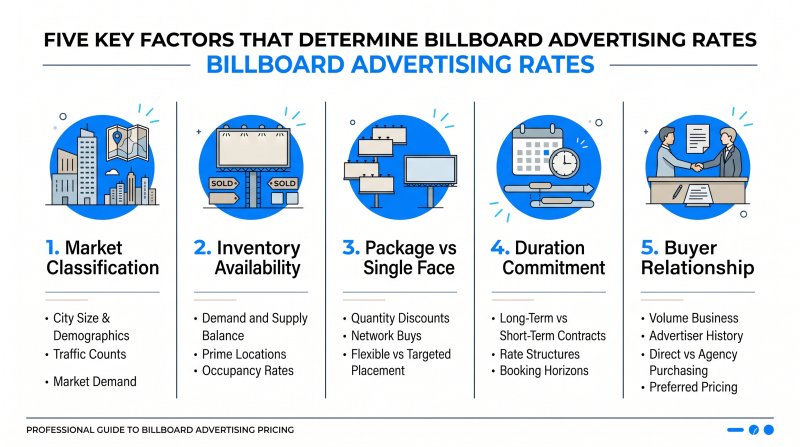
1. The Market Classification
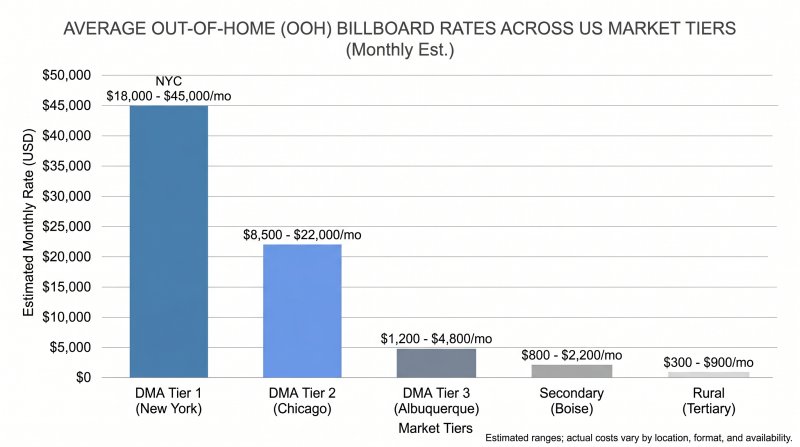
The single biggest factor in OOH pricing is market tier. The industry loosely sorts locations into DMA (Designated Market Area) tiers, secondary markets, and rural or tertiary zones.
DMA Tier 1 markets like New York, Los Angeles, and Chicago operate at 85 to 95 percent occupancy for premium inventory almost year-round. Operators in these markets have limited motivation to negotiate because someone else will book the face at card rate if you walk away. You are not as necessary to their revenue as you think you are.
Secondary markets tell a different story. Places like Albuquerque, Louisville, or Boise might run 65 to 75 percent occupancy in slower quarters. An operator with a 30 percent vacancy rate has a different conversation than one running at capacity. When we have run campaigns in markets like these, we found rates were negotiable in direct proportion to how empty the board inventory was at the time of the call.
This does not mean avoid Tier 1 markets. It means adjust your negotiation expectations accordingly. In Manhattan, you might get 5 to 10 percent off card rate through packaging. In Boise, you might get 25 to 30 percent off if you are willing to commit to a full quarter.
2. How Empty the Inventory Is Right Now
Operators fill their boards on a rolling basis, but their revenue teams feel pressure differently depending on the quarter. Q4 is typically slow. Budget cycles reset in January, and many brands have already committed their OOH spend. An operator answering the phone in November faces a different commercial reality than one in March when everything is ramping.
We saw this play out concretely in Q4 2024. A national quick-service restaurant brand pulled back on OOH spend heading into the holidays. We were negotiating for a regional client at the same time. In two separate markets, operators who had been firm on rate in September became substantially more flexible in November. One Clear Channel sales rep we worked with in a Midwest market dropped the rate on a bulk package by 18 percent rather than carry empty inventory through December.
The lesson: your negotiating use is highest in the off-peak windows. Q1 (January through mid-March) and Q4 (October through November) are typically softer for OOH negotiations. If your campaign dates are flexible, this is worth building into your media planning.
3. Whether You Are Buying a Package or a Single Face
Single-face deals get single-face rates. When you ask an operator for one face in one market, you are asking them to give you a rate that covers their fixed costs for that unit. They have less flexibility because they are not recovering any overhead across multiple placements.
When you buy a package, you change the math. A 10-face buy across a region gives the operator revenue certainty that a single poster does not. They are more willing to price accordingly because they are locking in a meaningful chunk of their monthly revenue.
How much does this actually matter? In our experience, moving from a 3-face deal to a 10-face deal in a secondary market can shift the effective rate by 15 to 22 percent on equivalent units. That is not a small number when you are running 10-week flights.
There is a caveat. Package rates only work if you actually have the inventory available. If you need 10 faces in markets where the operator only has 4 available, the package conversation does not happen. This is where knowing your markets and having a good broker or rep who can tell you fast becomes important.
4. The Duration of Your Commitment
Four-week flights and 52-week commitments are not priced the same way. Operators prefer durable revenue. A brand that commits to a full year gives the sales team a story to tell internally about occupancy stability. That has value beyond just the raw revenue figure.
We work primarily with brands running 8 to 12 week campaigns. That is not a full-year commitment. But we have found that framing a multi-quarter intent even when you are buying quarterly creates negotiating room. "We are planning to be in market for three quarters, starting in Q2. We want to understand what a multi-quarter relationship looks like." The operator hears revenue certainty. That shifts the conversation.
Do not commit to more than you actually intend. That damages relationships and your reputation in the industry faster than anything else. But within the bounds of what you actually need, duration framing is a real negotiating tool.
5. How You Show Up to the Conversation
This one is harder to quantify, but it shows up in every deal we run. Operators respond differently to buyers who come in with homework versus buyers who come in cold.
If you can reference specific inventory IDs, mention competing operators you have spoken with in the same market, or show that you understand the local OOH landscape, the tone of the conversation shifts. You are no longer a faceless buyer asking about "available billboards." You are a known quantity who understands the market and has alternatives.
We maintain relationships with reps at three major operators and two regional companies specifically because it gives us negotiating context. When Lamar knows we have a relationship at Outfront, and we reference that in a call, the conversation moves differently. This is not about dishonesty or bad faith. It is about demonstrating that you are a serious participant in the market, not a charity case.
When You Should Not Bother Negotiating
There is a version of this article where I tell you to negotiate every single deal and always push back on rate. That would be dishonest.
In certain markets, at certain times of year, for certain inventory types, the card rate is close to the floor. If you need premium digital inventory in Times Square for a Q2 activation, you are not getting a deal. Occupancy in high-demand urban cores runs 92 to 97 percent for digital formats in major DMAs. Operators have no reason to move on price because the face will book at card rate within days of becoming available.
Similarly, if you are working with a very small independent operator in a tertiary market, their rate card may already reflect their actual cost structure. Pushing too hard in these situations can damage the relationship without getting you anywhere meaningful.
Our rule of thumb: negotiate when you have use (softer market, larger package, multi-quarter intent, or genuine alternatives in the same market). Accept card rate when the inventory is genuinely scarce and the timing does not give you negotiating room.
What a Real Negotiation Looks Like
Let me give you a specific example. In early 2025, we were working with a regional healthcare brand trying to activate a 12-week OOH campaign across three secondary markets. The initial quote came in at card rate for all three markets, totaling $38,400 for the flight.
Here is what we did. First, we asked for a package rate on all three markets together, rather than treating them as separate single-market buys. The rep came back with a 12 percent reduction. Second, we indicated we were evaluating Q3 continuation and wanted to understand what a multi-quarter structure would look like. That added another 7 percent. Third, we moved the start date from early April to mid-April, which gave the operator additional inventory fill time they were originally missing. Another 4 percent.
The final rate was 23 percent below the initial card rate quote. Total savings on the flight was roughly $8,800. We did not lie about our Q3 intentions; we genuinely were evaluating continuation. But we structured the conversation to make multi-quarter value visible to the operator.
That is what a real OOH negotiation looks like. Structured, informed, and built around what the operator actually needs.
How to Start the Conversation
Most first-time OOH buyers make one critical mistake. They ask "what is your rate for a billboard" and accept whatever number comes back. The buyers who get better rates ask differently.
Start by knowing what you actually need. Number of faces, markets, duration, and format. The more specific your request, the more the operator can see you as a serious buyer and not a price explorer.
Second, ask about "available inventory and rate positioning" rather than "what does this cost." The first phrasing invites a conversation. The second invites a quote.
Third, give the operator something. A multi-quarter signal, a package across markets, or flexibility on start dates. Operators negotiate on value, and you need to give them something meaningful to unlock the rate positioning.
Fourth, run at least two competitive conversations simultaneously. You do not need to use one operator against another manipulatively. But knowing that you have alternatives in the same market changes how you negotiate, and operators sense that confidence.
The Honest Caveat
What I am describing here is what I have observed working across roughly 600 faces over eight years. Your specific results will depend on market conditions at the time you are buying, the specific operator you are working with, and the quality of your rep relationships. I am not suggesting there is a guaranteed playbook that works every time. The OOH market is local, fragmented, and relationship-driven in ways that do not always follow the patterns I have described.
But the underlying principle holds: the listed rate is a starting point. Whether you get to the finish line depends on how well you prepare and what use you actually have.
If you are planning an OOH campaign and want a second opinion on the market positioning before you start calling reps, talk to us at AdGrid. We have the operator relationships and the market data to help you understand where you actually stand before you pick up the phone.
The Regional and Independent Operator Variable
National brands working with major operators like Clear Channel, Lamar, or Outfront are working within a relatively transparent pricing framework. Rate cards exist, reps have authority to negotiate within ranges, and corporate guidelines constrain how far any individual deal can move. The dynamics are predictable, even if the negotiation still requires skill.
Regional and independent operators introduce a different variable. Companies like Adams Outdoor, which operates across the Southeast, or independent bulletin owners in markets like Omaha, Raleigh, or Spokane operate with different cost structures and different incentive systems than the national players.
Regional operators often own their structures outright. They do not have the same lease overhead that drives some national operator pricing. Their rate cards may be less systematized, and their willingness to negotiate varies more by individual owner personality than by corporate policy. We have worked with Adams Outdoor accounts where the local ownership made decisions in a single phone call that would have required three internal approvals at a national company.
Independent operators in tertiary markets like Roanoke or Tri-Cities, Tennessee, often have bulletin inventory that has been idle for months. An independent who owns six faces in a market with limited national brand activity faces a very different economic reality than a national operator with 200 faces in the same territory. For buyers willing to work with smaller operators, this is where some of the most favorable negotiating dynamics exist. The inventory is available, the owner is accessible, and the pricing flexibility can be substantially greater than what the national framework would allow.
The tradeoff is consistency. National operators offer standardized reporting, network-level buying options, and predictable fulfillment. Regional and independent operators offer pricing flexibility and relationship access, but less infrastructure. For brands testing OOH for the first time or working with limited budgets, the regional operator relationship is often where the best value lives.
OOH Rate Terminology Every Buyer Should Know
Before you start calling operators, understand the vocabulary. These terms show up in every OOH rate conversation, and knowing them changes how the rep responds to you.
Card Rate: The published rate for a specific face. Not the price you will pay. The rep knows this is negotiable. So should you.
Display Fee: The component of the rate that covers showing the creative on the board. Separated from production and installation in some operator quotes, bundled in others.
Flight: The period your creative runs on the face. A 12-week flight means 12 weeks of display. Operators price flights differently than single months because longer commitments reduce their sales cycle cost.
Bulk Rate: A discounted rate applied when buying multiple faces across one or more markets. The discount percentage varies by operator and occupancy level at time of purchase.
Run of Schedule (ROS): A buying option where the operator places your creative on whatever inventory is available within certain parameters, rather than on specific pre-selected faces. Typically cheaper because you are giving up face-level control.
Impression: The estimated number of people who will see your creative during the flight. Derived from traffic counts and visibility adjustments. Operators calculate impressions differently, so ask for the methodology before comparing across providers.
Gross Rating Point (GRP): A measure of reach multiplied by frequency. Used to compare OOH performance against other media channels. GRP = (reach percentage) x (frequency). A campaign reaching 40 percent of the market with an average frequency of 3 generates 120 GRP.
Daily Effective Circulation (DEC): The estimated daily number of people passing the face. Used primarily in transit and street-level formats. Some markets still use DEC; others have moved to impression-based models.
Digital Billing: Charging based on actual days of display rather than a flat flight rate. Some operators bill digitally by the day in softer markets, which creates different negotiation dynamics than flat-rate billing.
Premiere Panel: A specific face within a market that the operator designates as premium inventory. Usually a high-traffic location with demographic alignment. Premiere panels cost more and are less negotiable than standard inventory.
Flush: A creative placement where the advertisement appears on the full board face, as opposed to a partial installation. Full flush is standard for most billboard sizes but costs more than partial placements on larger formats.
Reps use all of these terms, and they expect buyers to know them. When you demonstrate familiarity with the language, you signal that you are a serious buyer who understands the market. That shifts the conversation from "educating a first-time buyer" to "working with a qualified professional." The dynamic difference is real.
Marcus Webb is the Operations Lead at AdGrid, with eight years of experience in the out-of-home industry. He has managed more than 600 billboard faces across print and digital formats and has negotiated OOH deals for brands ranging from regional healthcare systems to national quick-service restaurants. Last updated: April 2026.
Marcus Webb is the Operations Lead at AdGrid with eight years of experience in the out-of-home industry. He has managed more than 600 billboard faces across print and digital formats and has negotiated OOH deals for brands ranging from regional healthcare systems to national quick-service restaurants.
Ready to Modernize Your OOH Operations?
Join the leading OOH media owners who use AdGrid to automate their quoting, manage inventory, and grow their revenue.