
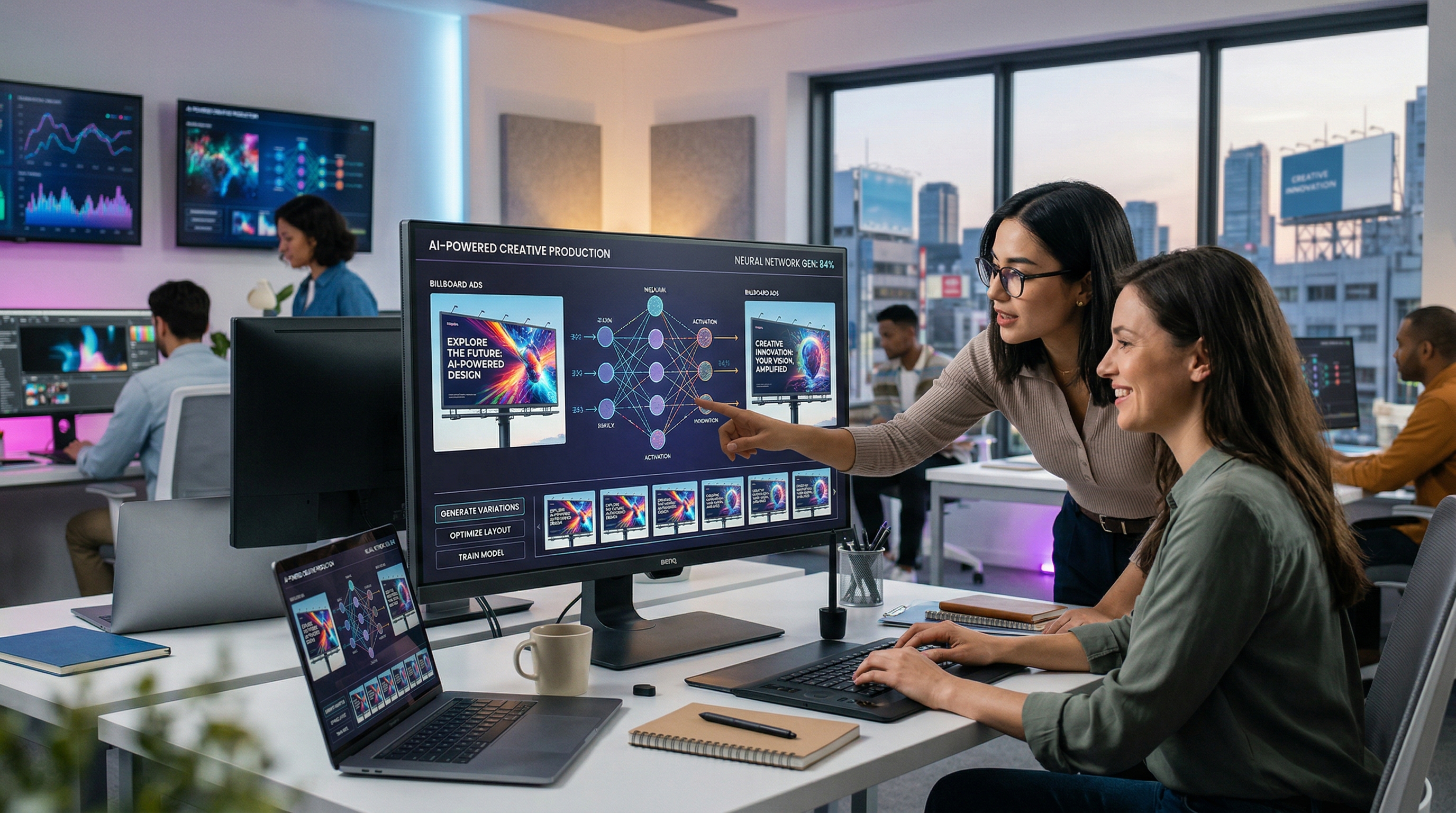
How AI-Powered Creative Production is Transforming DOOH in 2026
The billboard creative process used to mean weeks of back-and-forth with design agencies, expensive revisions, and creative that was already stale by the time it went live. That's no longer acceptable in a world where digital screens can update in real time, and advertisers expect dynamic, data-informed content that speaks to exactly who's standing in front of the board.
In 2026, artificial intelligence is closing that gap. Creative production for digital out-of-home (DOOH) is moving from static timelines to instantaneous, AI-assisted workflows — and the agencies that adopt these tools earliest are pulling ahead of the competition in both speed and contract value.
What AI Creative Production Actually Means for DOOH
When we talk about AI in DOOH creative, we're covering a surprisingly wide territory:
- Generative image and video production — feed a brief into an AI model and get production-ready creative in minutes, not days
- Dynamic content customization — AI adjusts creative elements (copy, colors, imagery, offers) based on real-time signals like weather, time of day, or audience demographics
- Automated localization — instantly adapt a national campaign for regional markets without a full agency re-sprint
- Creative performance prediction — models trained on billions of impressions help predict which creative variants will perform best before they run
- Compliance and brand safety automation — AI checks creative against advertiser guidelines and industry standards automatically, reducing manual review cycles
The common thread: AI removes the bottlenecks that have historically made DOOH creative expensive, slow, and hard to personalize at scale.
Why 2026 Is the Inflection Point
The conditions for AI-driven DOOH creative have been building for years. Three developments in particular are pushing 2026 to the tipping point.
1. DOOH Screen Density Has Reached Critical Mass
Digital out-of-home screens are now pervasive enough that AI tools have enough data to be genuinely useful. In the U.S. alone, the DOOH market is projected to sustain double-digit growth rates, with digital display billboard CAGR continuing its upward trajectory. More screens means more real estate to populate — and more need for creative at scale that doesn't require a full production team for every execution.
2. Programmatic Buying Demands Faster Creative Cycles
Programmatic DOOH (pDOOH) has moved beyond the experimental stage, consolidating as a mature, data-driven channel in 2026. But programmatic only works well when creative can keep pace with automated media buying. If an algorithm serves an ad to a specific audience segment at a specific location, but the creative is a generic national campaign from three months ago, the opportunity is wasted.
AI closes that loop. Creative can now be generated, customized, and deployed to match the speed of programmatic media buying — unlocking the real potential of dynamic, data-driven OOH campaigns.
3. Advertisers Expect Personalization — Even in Physical Space
The same personalization expectations that drove digital advertising's growth are now hitting OOH. Brand managers want creative that speaks to the person standing in front of the board — not a generic audience. AI-powered creative tools make that feasible at scale, even for advertisers running campaigns across hundreds of screen locations.
The Creative Production Workflow Is Being Rebuilt
Here's what a modern AI-assisted DOOH creative workflow looks like in practice:
Traditional Flow (Weeks)
- Brief from advertiser → 2. Agency interprets and concepting → 3. Creative development (multiple rounds) → 4. Client revisions → 5. Production → 6. Deployment
Timeline: 3–8 weeks. Cost: $5,000–$50,000+ per campaign.
AI-Assisted Flow (Hours to Days)
- Brief from advertiser → 2. AI generates creative variants + localization options → 3. Human review and light refinement → 4. Automated brand safety check → 5. Direct deployment to screen network
Timeline: Hours to 2 days. Cost: Fraction of traditional production.
The delta is not just speed — it's the ability to run iterative creative testing, something that was financially prohibitive in traditional OOH production.
How AdGrid Agencies Are Using AI Creative Today
AdGrid's rich media template library is designed to slot directly into this new workflow. Rather than building creative from scratch every time, agencies can:
- Use AI-generated base creative as a starting point, then customize through AdGrid's template tools
- Deploy dynamic creative where the AI adjusts template elements based on contextual signals (weather triggers, time-of-day copy swaps, location-specific offers)
- Produce regional variants at scale — what used to require a full agency re-sprint now takes hours via AI-assisted localization
- Feed performance data back in to continuously improve creative relevance across their network
Early adopters are already seeing the impact. Agencies using AI-assisted creative with AdGrid are reporting:
- 40% reduction in creative production time for standard campaign refreshes
- 2–3x more creative variants tested per campaign compared to traditional production cycles
- Higher win rates on pitches — the ability to show a client multiple creative directions in a single sales meeting is a meaningful differentiator
The Skills Your Team Needs Now
Adopting AI creative tools doesn't mean replacing your team — it means evolving what your team spends time on. The agencies winning in 2026 are building skills in:
- Prompt engineering for creative production — writing effective briefs that get useful AI outputs
- Creative direction with AI — knowing how to evaluate, refine, and composite AI-generated work
- Data-informed creative strategy — understanding which audience signals should drive creative customization
- Platform fluency — mastering tools like AdGrid's rich media suite that put AI-assisted production within reach without a full agency budget
These aren't technical skills. They're strategic ones — and they're the differentiator for agencies that are ready to move at the speed the market now demands.
The Bottom Line
AI-powered creative production is not a future possibility for DOOH — it's the present reality in 2026. Agencies that treat it as a competitive advantage rather than a novelty are already seeing faster production cycles, more compelling creative, and clients who come back because the work actually performs.
The good news: you don't need a massive technology budget or a dedicated AI team to get started. Platforms like AdGrid are bringing these capabilities into the standard platform subscription — the same subscription your team is already using.
The question isn't whether AI will transform DOOH creative. It's whether you'll be among the agencies leading that transformation — or catching up to the agencies that did.
Ready to explore AI-assisted creative production for your network? Contact AdGrid to see what's available in your platform.
Ready to Modernize Your OOH Operations?
Join the leading OOH media owners who use AdGrid to automate their quoting, manage inventory, and grow their revenue.